
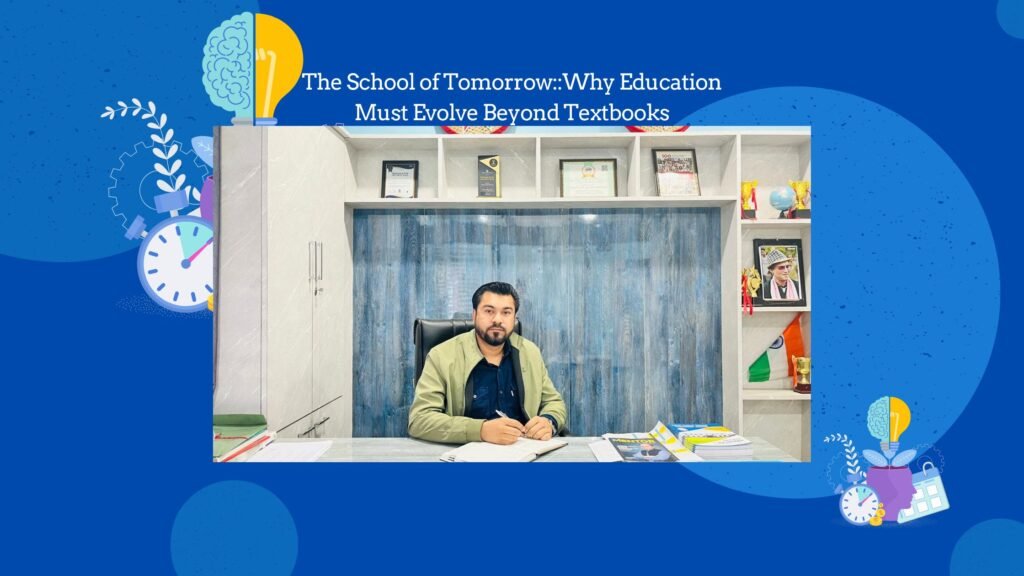
Future of Education in Schools: Why Education Must Evolve Beyond Textbooks
On a quiet morning in a school courtyard, as students gather for assembly and their voices rise together in song, one cannot help but reflect on the deeper purpose of education. Schools are more than buildings filled with classrooms; they are the foundations upon which the future of society is built.
Today, however, educators across the world are confronting a critical question about the future of education in schools:
Are our schools truly preparing students for the world they will inherit?
For generations, education was built around textbooks, examinations, and structured curricula. Teachers delivered knowledge, students absorbed it, and success was measured largely through test scores.
But the world outside the classroom has changed dramatically.
Information now moves faster than ever before. Technology reshapes industries within years. Careers that will dominate the next decade have not yet been invented.
In this rapidly evolving world, the future of education in schools cannot rely solely on traditional teaching methods. Education must evolve beyond memorization and textbook learning to cultivate curiosity, creativity, and critical thinking.
Future of Education in Schools: From Memorization to Meaning
One of the biggest transformations shaping the future of education in schools is the shift from memorization to meaningful learning.
Traditional education systems often rewarded students for their ability to remember information. Success in examinations depended largely on recalling definitions, formulas, and historical facts.
While knowledge remains important, modern education recognizes that memorization alone cannot prepare students for real-world challenges.
Tomorrow’s students must develop skills such as:
-
critical thinking
-
creativity
-
problem-solving
-
collaboration
-
emotional intelligence
These abilities enable students to adapt to complex situations and navigate a rapidly changing world.
Schools that encourage curiosity and exploration produce innovators and thinkers rather than passive learners.
A classroom where students are encouraged to ask questions becomes a laboratory of ideas.
A school that values curiosity creates future leaders.
Future of Education in Schools: The Rise of Holistic Learning
Another defining feature of the future of education in schools is the growing emphasis on holistic education.
Education today is no longer limited to academic achievement. A child’s development involves intellectual growth, emotional well-being, creativity, and character building.
Holistic education recognizes that learning happens in many different forms.
Sports teach discipline, teamwork, and resilience.
Art nurtures imagination and creative expression.
Community service instills empathy and social responsibility.
When schools integrate these experiences into the learning environment, they create students who are not only knowledgeable but also compassionate and confident.
Modern education therefore seeks to develop the whole child, not merely the academic performer.
Future of Education in Schools: Technology as a Learning Partner
Technology is another powerful force shaping the future of education in schools.
Over the past decade, classrooms around the world have been transformed by digital tools and online resources. Smart boards, virtual laboratories, digital libraries, and online learning platforms now provide students with unprecedented access to information.
Technology can enhance learning in many ways:
-
interactive educational content
-
global access to knowledge
-
virtual simulations for science and technology
-
personalized learning experiences
However, technology must remain a tool, not a replacement for human teaching.
A student may learn mathematical formulas from a digital platform, but it is the teacher who encourages confidence and curiosity.
A science video may demonstrate an experiment, but it is classroom discussion that sparks genuine understanding.
The most effective schools therefore combine technology with strong human mentorship, creating a balanced learning environment.
Future of Education in Schools: The Role of Leadership
Behind every successful school stands visionary leadership.
In shaping the future of education in schools, the role of school leadership—especially the principal—is crucial.
A principal does far more than manage administrative tasks.
A principal defines the culture of the school.
A principal empowers teachers to innovate.
A principal inspires students to pursue excellence.
When school leaders embrace progressive educational philosophies, they encourage teachers to adopt modern teaching methods and create classrooms that promote curiosity and collaboration.
Visionary leadership transforms schools into communities of learning rather than mere institutions of instruction.
Future of Education in Schools: Preparing Students for an Uncertain World
One of the most important goals of modern education is preparing students for a future that is constantly evolving.
The future of education in schools must therefore focus on adaptability.
Students must be equipped with skills that allow them to learn continuously throughout their lives.
These skills include:
-
independent learning
-
adaptability
-
innovation
-
communication skills
-
ethical decision-making
By developing these qualities, schools prepare students not just for specific careers but for lifelong growth.
Education becomes a journey of exploration rather than a race toward examinations.
Future of Education in Schools: Education as Nation Building
The influence of education extends far beyond individual success.
The future of education in schools is closely connected to the future of society itself.
Classrooms today will produce tomorrow’s:
-
scientists
-
engineers
-
entrepreneurs
-
policymakers
-
artists
-
educators
Schools therefore play a central role in shaping the intellectual and moral character of a nation.
An education system that encourages creativity and responsibility produces citizens who contribute positively to society.
As educational philosopher John Dewey famously argued, education is not merely preparation for life—it is life itself.
Future of Education in Schools: Creating a Culture of Lifelong Learning
Perhaps the most important transformation in the future of education in schools is the recognition that learning should never end with graduation.
Modern schools must inspire students to become lifelong learners.
This means cultivating:
-
curiosity
-
intellectual independence
-
love for knowledge
-
openness to new ideas
When students learn how to learn, they gain the ability to grow continuously throughout their lives.
The classroom becomes the starting point of an endless journey of discovery.
External Reference
For global perspectives on modern education systems, readers may explore research publications from UNESCO, which studies the future of global education and learning innovation.
Conclusion
The future of education in schools lies in transformation.
Education must move beyond textbooks and examinations to embrace creativity, critical thinking, and human development.
Schools must nurture curiosity, encourage innovation, and cultivate empathy.
Teachers must guide students not only in acquiring knowledge but also in understanding the world around them.
Ultimately, the purpose of education is not simply to prepare students for examinations.
It is to prepare them for life.

Founder of Englishfry.com, a captivating and knowledge-driven blog & Founder of Android app/website Studyfunnel.com, an online Mock Test Series Portal. With a wealth of experience spanning over 16+ years, he has excelled as an Ex-Asst.Professor, Teacher, Amazon published author, Website Developer, Graphic Designer,Blogger,Poet, and Creative academic content writer publisher of 4 academic books available Online on Amazon & Flipkart. His tryst in Literature helped him realize his love for writing and telling stories. A tech-savvy language nerd by day and, a passionate writer by night, he now translates his experiences into tales of wisdom served with a side of humor.His widely recognized profound insights ,captivating writing style of weaving words make him contribute to prestigious publications and a sought-after authority in the field that transport readers to extraordinary worlds.