Table of Contents
ToggleMiddle English Literature: The Age of Chaucer and the Rise of Storytelling
After the heroic age of Old English literature, the English language and its literature began to transform dramatically. New rulers, new cultural influences, and new social changes reshaped the language of England.
This period is known as Middle English Literature, which roughly lasted from 1100 to 1500. It was during this era that English slowly evolved into a language much closer to the one we speak today.
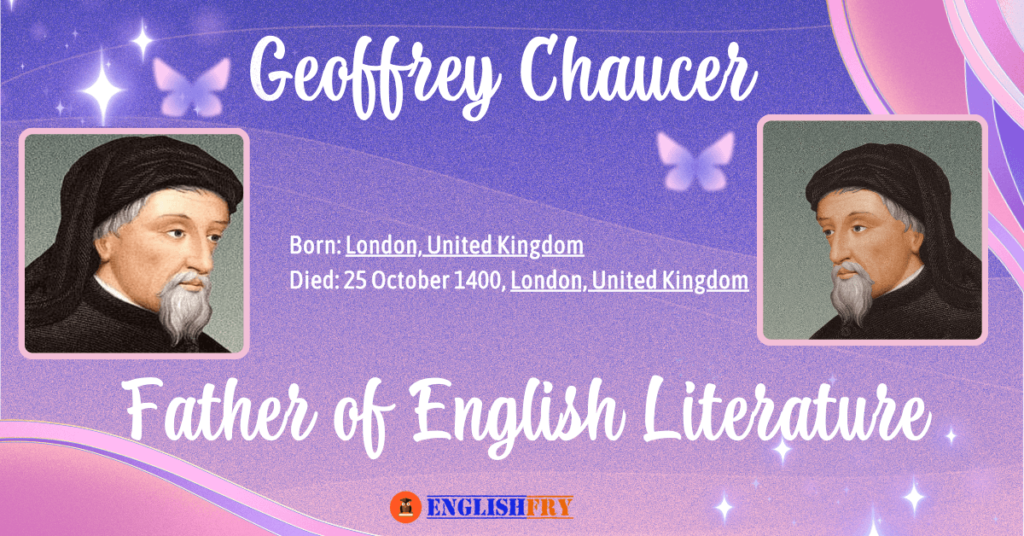
Most importantly, this period introduced some of the greatest storytellers in literary history, including the remarkable poet Geoffrey Chaucer, often called “the Father of English Poetry.”
Let us explore how literature flourished during this fascinating time.
A New England, A New Language
The transformation of English literature during the Middle English period was largely influenced by one major historical event: the Norman Conquest.
When William the Conqueror invaded England in 1066, French culture and language became dominant among the ruling class. For several centuries, the aristocracy spoke French, the church used Latin, and the common people continued speaking English.
Gradually, these languages blended together, giving birth to Middle English.
As the language evolved, writers began creating literature that reflected everyday life, social diversity, and human emotions in ways that earlier heroic poetry had not done.
Geoffrey Chaucer: The Father of English Poetry
The most important literary figure of the Middle English period is undoubtedly Geoffrey Chaucer.
Born around 1340 in London, Chaucer worked as a diplomat, court official, and public servant throughout his life. His experiences allowed him to travel widely and observe people from different social classes.
These experiences later became the foundation for his greatest literary work.
Chaucer’s writings marked a turning point in English literature because he chose to write in English rather than French or Latin, making literature accessible to a wider audience.
Today, Chaucer is celebrated as one of the pioneers who helped establish English as a respected literary language.
The Masterpiece: The Canterbury Tales
Chaucer’s most famous work is the extraordinary collection of stories known as The Canterbury Tales.
This masterpiece is not simply a single story—it is a series of interconnected tales told by a group of travelers.
The Story Framework
The story begins with a group of pilgrims traveling together to visit the shrine of Thomas Becket at Canterbury Cathedral.
During the long journey, the pilgrims decide to entertain themselves by telling stories. Each traveler shares a tale, reflecting their personality, profession, and worldview.
This storytelling competition becomes the central structure of the book.
A Mirror of Medieval Society
What makes The Canterbury Tales so remarkable is the diversity of characters.
Chaucer introduces readers to people from nearly every level of medieval society, including:
knights
monks
merchants
doctors
lawyers
millers
cooks
students
priests
Each character tells a story that reflects their social position, values, and personality.
Through humor, satire, and vivid storytelling, Chaucer creates a powerful portrait of fourteenth-century English society.
Chaucer’s Other Important Works
Although The Canterbury Tales is Chaucer’s most celebrated work, he also wrote several other influential poems.
Some of his notable writings include:
The Book of the Duchess – an elegy mourning the death of Blanche of Lancaster.
Parlement of Foules – a dream vision about love and the mating of birds.
Troilus and Criseyde – one of the greatest tragic love stories in medieval literature.
The Legend of Good Women – a collection of stories about virtuous women.
These works demonstrate Chaucer’s ability to combine poetry, philosophy, humor, and human psychology in a way that was revolutionary for his time.
William Langland and the Vision of Piers Plowman
Another important writer of the Middle English period was William Langland.
Langland is believed to be the author of the powerful allegorical poem Piers Plowman.
Unlike Chaucer’s lively storytelling style, Piers Plowman presents a serious and moral vision of society.
The poem describes a series of dreams experienced by the narrator, who searches for truth and righteousness in a corrupt world.
Through symbolic characters and religious imagery, Langland criticizes social injustice and the moral failures of religious institutions.
Despite its complex themes, the poem uses simple and direct language, making its message accessible to ordinary readers.
The Rise of Miracle Plays
Literature during the Middle English period was not limited to poetry and written texts. Drama also began to develop in fascinating ways.
One of the earliest forms of medieval drama was the Miracle Play.
These plays were originally performed inside churches and told stories from the Bible or the lives of saints. Over time, they became extremely popular and were performed in public spaces such as marketplaces and town squares.
Entire towns participated in producing these performances.
Famous Cycles of Miracle Plays
Several English cities became famous for organizing large collections of religious plays known as play cycles.
The most famous cycles include:
the York Plays
the Chester Plays
the Wakefield Plays
the Coventry Plays
These plays dramatized stories from the Creation of the world all the way to the Final Judgment.
Craft guilds—such as bakers, carpenters, and merchants—would sponsor and perform different sections of the story.
These performances were lively, colorful, and sometimes even humorous, helping ordinary people understand religious teachings in an engaging way.
Why Middle English Literature Matters
The Middle English period played a crucial role in shaping the future of English literature.
This era introduced several important developments:
English became a serious literary language
storytelling expanded beyond heroic legends
writers began portraying real people and real social life
drama started developing into a powerful art form
Most importantly, writers like Chaucer demonstrated that English could be used to create literature that was both entertaining and intellectually meaningful.
The Legacy of the Middle English Period
By the end of the Middle English period, English literature had evolved significantly.
The heroic epics of the Anglo-Saxon age had given way to rich storytelling, social satire, and dramatic performances.
These developments laid the foundation for the next great era in English literary history—the Elizabethan Age, which would produce legendary writers such as William Shakespeare and Christopher Marlowe.
But that is a story for my next blog post.

Founder of Englishfry.com, a captivating and knowledge-driven blog & Founder of Android app/website Studyfunnel.com, an online Mock Test Series Portal. With a wealth of experience spanning over 16+ years, he has excelled as an Ex-Asst.Professor, Teacher, Amazon published author, Website Developer, Graphic Designer,Blogger,Poet, and Creative academic content writer publisher of 4 academic books available Online on Amazon & Flipkart. His tryst in Literature helped him realize his love for writing and telling stories. A tech-savvy language nerd by day and, a passionate writer by night, he now translates his experiences into tales of wisdom served with a side of humor.His widely recognized profound insights ,captivating writing style of weaving words make him contribute to prestigious publications and a sought-after authority in the field that transport readers to extraordinary worlds.