Table of Contents
ToggleIntroduction: The Poet and the Vision
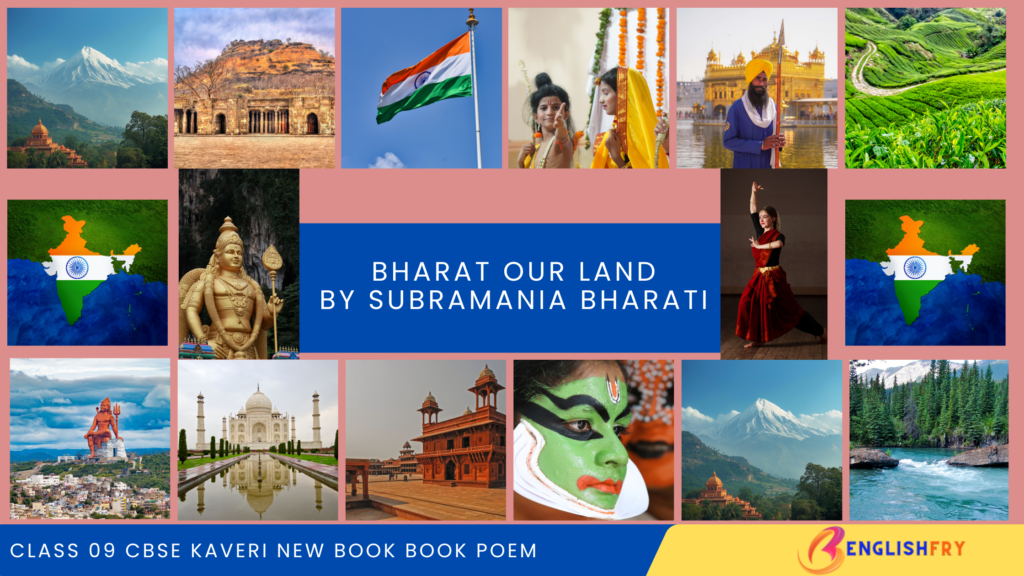
Subramania Bharati, popularly known as Mahakavi Bharati, was a pioneer of modern Tamil poetry and a fierce Indian independence activist. In “Bharat Our Land,” he transcends regional boundaries to paint a portrait of a unified, majestic, and spiritually enlightened India. This poem is a masterclass in patriotic fervor, using the “peerless” nature of India’s geography and history to ignite a sense of national pride.
The Poem
The mighty Himavant is ours— there’s no equal anywhere on earth. The generous Ganga is ours— which other river can match her grace? The sacred Upanishads are ours— what scriptures else to name with them? This sunny golden land is ours— she’s peerless, let’s praise her!
Gallant warriors have lived here, many a sage has sanctified this land. The divinest music has been heard here, and here all auspicious things are found. Here Brahma-knowledge has taken root, and the Buddha preached his dhamma here. Of hoary antiquity is Bharat, she’s peerless, let’s praise her!
Section 1: Line-by-Line “Deep Dive”
To score full marks in annotation or explanation questions, students must understand the connotation of Bharati’s words:
“Mighty Himavant & Generous Ganga”: The poet begins with the physical boundaries. By personifying the Ganga as “generous,” he highlights India as a land of abundance and nurturing.
“Sacred Upanishads & Sunny Golden Land”: He moves from the physical to the intellectual. The “sunlight” and “gold” symbolize the clarity of thought and the richness of Indian philosophy.
“Gallant Warriors & Sanctified Sages”: This illustrates the balance of Kshatriya (valor) and Brahmana (wisdom). A nation is only great if it can both protect itself and remain spiritually grounded.
“Brahma-knowledge & Buddha’s Dhamma”: These lines emphasize India as the “Vishwaguru” (World Teacher), showcasing a history of profound spiritual inquiry and the path of non-violence.
“Hoary Antiquity”: This emphasizes that India’s civilization is not a new creation but a timeless entity that has evolved over millennia.
Section 2: Literary Devices & Keywords
Exams often award extra points for identifying the “tools” the poet uses.
Refrain: The line “she’s peerless, let’s praise her!” acts as a chorus, reinforcing the central theme of uniqueness.
Rhetorical Questions: “Which other river can match her grace?” This is used to challenge the reader and assert India’s superiority without needing an answer.
Epithets: Phrases like “Mighty Himavant” and “Gallant Warriors” characterize the subjects with immediate majesty.
Topper’s Vocabulary: Use these words in your essays: Exceptionalism, Metaphysical, Sanctity, Sovereign, Incomparable, Inherent.
Section 3: Competency-Based Assessment (CBQs)
A. Inference-Based (Reading between the lines)
Q1. Why does the poet refer to the Ganga as “generous” rather than just “long” or “deep”?
Ans: The word “generous” personifies the river as a benevolent mother. It emphasizes her role as a provider that sustains life and spirituality, aligning with the Indian ethos of viewing nature as divine.
Q2. What is the significance of the “sunny golden land”?
Ans: It represents a land of enlightenment (sunny) and prosperity (golden). It suggests that Bharat is illuminated by the light of knowledge and the wealth of its resources.
B. Analytical (Structure & Logic)
Q1. How does the poet bridge geography and spirituality?
Ans: By listing the Himalayas alongside the Upanishads, the poet suggests that India’s physical landscape is the foundation for its spiritual height. The land is not just soil; it is a “sanctified” space where wisdom grows.
Q2. Analyze the effect of the word “Ours.”
Ans: The repetition of “ours” creates a sense of collective ownership and unity. It transforms ancient history into a personal inheritance for every reader.
C. Values-Based (Ethics & Application)
Q1. What does the mention of “Gallant warriors” and “Sages” teach us about a balanced society?
Ans: It teaches that a great nation requires both the strength to defend its values (Warriors) and the wisdom to define those values (Sages).
Q2. How does the poem promote the value of “Auspiciousness”?
Ans: By stating that “all auspicious things are found here,” the poet encourages a mindset of gratitude and positivity toward one’s heritage, fostering a sense of belonging.
Section 4: Model “Topper” Answer
Question: Summarize the central theme of ‘Bharat Our Land’ and explain why the poet calls it ‘peerless’.
Model Answer:
In the poem Bharat Our Land, Subramania Bharati presents a grand vision of India as a land of incomparable beauty and wisdom. He calls the land “peerless” because it possesses a unique combination of natural grandeur (the Himalayas and Ganga), intellectual depth (the Upanishads), and ethical leadership (the Buddha’s Dhamma).
The poet argues that Bharat’s superiority lies in its “hoary antiquity,” meaning its greatness is timeless and proven. By weaving together the physical, the spiritual, and the historical, Bharati concludes that India stands alone as a beacon of “Brahma-knowledge” and “auspiciousness,” making it a land worthy of eternal praise and collective pride.
Questions and Answers (Easy to Memorise Version)
1. Why does the poet call India a unique land?
The poet calls India a unique land because it is beautiful, ancient, and full of greatness. It has the Himalayas, the Ganga, and rich cultural traditions. Many brave warriors and wise sages were born here. India is also known for spiritual knowledge and wisdom. Therefore, the poet says India is special and unmatched.
2. What feelings does the poem create in the reader?
The poem creates feelings of pride, love, and respect for India. It reminds readers of the country’s beauty and glorious past. The poem also inspires patriotism in the hearts of people. Readers feel happy and honoured to belong to such a great nation. Thus, the poem creates national pride.
3. How do the Himalayas add glory to India?
The Himalayas add glory to India because they are high, beautiful, and majestic mountains. They symbolize strength and greatness. They are famous all over the world for their beauty. Their presence makes India proud and special. Therefore, the poet praises the Himalayas.
4. Why is the Ganga considered sacred?
The Ganga is considered sacred because it is connected with faith and purity. It is respected by millions of people in India. The river has great religious and cultural importance. In the poem, it is shown as a symbol of holiness and beauty. Therefore, the Ganga is called sacred.
5. What role do sages play in the poem?
The sages represent wisdom, truth, and spiritual knowledge. They guided people with their teachings and values. They helped society through peace and morality. Their presence shows India’s rich heritage of learning. Thus, sages play an important role in the poem.
6. How does the poem connect nature with patriotism?
The poem connects nature with patriotism by praising India’s mountains and rivers. The Himalayas and Ganga are symbols of national pride. The poet shows that loving the country means loving its natural beauty. These natural features make India glorious. Thus, nature and patriotism are linked in the poem.
7. Why is the mention of the Upanishads important?
The mention of the Upanishads is important because they represent India’s ancient wisdom. They contain deep spiritual and philosophical ideas. They show India’s contribution to world knowledge. The poet includes them to create pride in Indian heritage. Therefore, the Upanishads are important in the poem.
8. What values can students learn from this poem?
Students can learn patriotism, respect, and pride in their country. They learn to value culture, history, and traditions. The poem also teaches peace, wisdom, and responsibility. It encourages students to become good citizens. Thus, the poem gives many life lessons.
9. How does the poet balance strength and peace in the poem?
The poet balances strength and peace by mentioning warriors and sages. Warriors represent courage and power. Sages and Buddha represent peace and wisdom. This shows that a great nation needs both strength and kindness. Therefore, the poem presents a balanced idea of greatness.
10. Why is this poem relevant for today’s students?
This poem is relevant for today’s students because it teaches love for the country. It helps them understand India’s culture and history. It also gives lessons of peace, wisdom, and responsibility. These values are important in modern life. Therefore, the poem is useful even today.

Founder of Englishfry.com, a captivating and knowledge-driven blog & Founder of Android app/website Studyfunnel.com, an online Mock Test Series Portal. With a wealth of experience spanning over 16+ years, he has excelled as an Ex-Asst.Professor, Teacher, Amazon published author, Website Developer, Graphic Designer,Blogger,Poet, and Creative academic content writer publisher of 4 academic books available Online on Amazon & Flipkart. His tryst in Literature helped him realize his love for writing and telling stories. A tech-savvy language nerd by day and, a passionate writer by night, he now translates his experiences into tales of wisdom served with a side of humor.His widely recognized profound insights ,captivating writing style of weaving words make him contribute to prestigious publications and a sought-after authority in the field that transport readers to extraordinary worlds.