
Introduction
Stepping into Class 10 is an exciting yet critical milestone for every student under the Central Board of Secondary Education (CBSE). While subjects like Mathematics and Science often take up the majority of study schedules, your language papers hold the ultimate key to skyrocketing your overall board exam aggregate. To conquer your final assessment, the very first step is to completely master the CBSE Class 10 English Syllabus.
CBSE designs the English curriculum to test not just your memorization capacities, but your reading, analytical writing, grammatical accuracy, and literary interpretation skills. Whether you are enrolled in Language & Literature (Code 184) or Communicative English (Code 101), entering the examination hall with a crystal-clear understanding of the course layout gives you an immediate competitive edge.
In this exhaustive, one-stop guide on EnglishFry.com, we break down every section, list every single chapter and poem, analyze the official board marking scheme, and give you proven, teacher-tested preparation strategies to effortlessly secure a 95+ score in your 2026 board examinations.
Table of Contents
ToggleSection-Wise Weightage & Marks Distribution
The CBSE Class 10 English paper is evaluated out of a total of 100 marks. This evaluation is divided into two distinct components: the Theory Paper (80 Marks) written during the final board exams, and the Internal Assessment (20 Marks) conducted continuously by your school.
Let us look closely at how those crucial 80 theory marks are distributed across your question paper:
                  ┌────────────────────────────────────────┐
                  │   CBSE CLASS 10 ENGLISH THEORY PAPER   │
                  │               (80 MARKS)               │
                  └───────────────────┬────────────────────┘
                                      │
         ┌────────────────────────────┼────────────────────────────┐
         │                            │                            │
         ▼                            ▼                            ▼
┌──────────────────┐         ┌──────────────────┐         ┌──────────────────┐
│    SECTION A     │         │    SECTION B     │         │    SECTION C     │
│  Reading Skills  │         │  Writing & Gram  │         │    Literature    │
│    (20 Marks)    │         │    (20 Marks)    │         │    (40 Marks)    │
└──────────────────┘         └──────────────────┘         └──────────────────┘
1. Section A: Reading Skills (20 Marks)
This section assesses your comprehension, inference, and vocabulary extraction skills through unseen passages. It contains:
-
Discursive Passage (10 Marks): A text of around 400–450 words testing your analytical and reasoning capacity.
-
Case-Based Factual Passage (10 Marks): A text of around 200–250 words backed by visual data, charts, statistical inputs, or reports to evaluate your data-reading skills.
2. Section B: Writing Skills and Grammar (20 Marks)
This section measures your creative expression and structural command over formal functional grammar.
-
Grammar (10 Marks): Fill-in-the-blanks, editing/omission, or sentence transformation tasks focusing on Tenses, Modals, Subject-Verb Concord, Determiners, and Reported Speech.
-
Creative Writing (10 Marks): Divided into a Formal Letter based on a given situation (5 Marks) and an Analytical Paragraph analyzing a graph, map, chart, or cue line (5 Marks).
3. Section C: Literature Textbooks & Supplementary Reading (40 Marks)
Accounting for half of your total theory paper, this section evaluates your understanding, interpretation, and synthesis of the prose and poetry pieces in your prescribed textbooks. It contains extract-based reference questions, short-answer responses, and analytical long-answer questions.
Core Syllabus Breakdown: Section-by-Section Details
Detailed Literature Book Layout (Chapters & Poems)
To build perfect topical authority, every student must know their reading inventory down to the last chapter. Below is the full directory of chapters and poems you must prepare from your official NCERT textbooks.
                      ┌──────────────────────────────┐
                      │    NCERT CLASS 10 TEXTBOOKS  │
                      └──────────────┬───────────────┘
                                     │
               ┌─────────────────────┴─────────────────────┐
               │                                           │
               ▼                                           ▼
   ┌───────────────────────┐                   ┌───────────────────────┐
   │     FIRST FLIGHT      │                   │   FOOTPRINTS WITHOUT  │
   │    (Main Textbook)    │                   │          FEET         │
   └───────────────────────┘                   │(Supplementary Reader) │
                                               └───────────────────────
Importance of CBSE Class 10 English Syllabus
English is a globally spoken language and is one of the essential subjects in the curriculum of schools and colleges. In CBSE Class 10, English is a compulsory subject, and it is essential to score well in this subject as it lays the foundation for higher studies. In this blog post, we will discuss the importance of English, the study plan for CBSE Class 10 English, and the list of chapters that are included in the syllabus.
English, a globally spoken language, is fundamental in school and college curricula, especially CBSE Class 10. Mastering this subject is vital for higher studies. In this post, we explore the importance of English, CBSE Class 10 study plans, and syllabus chapters.
In our daily lives, English is pivotal, not just for communication but also for career growth. CBSE Class 10 divides English into two parts : English Language sharpens communication skills, while Literature enhances reading and writing.
In today’s world, where information is predominantly in English, proficiency is crucial. English skills extend beyond academics, influencing job opportunities and international careers. Hence, excelling in English is not just advised but essential.
Now, let’s delve into crucial details—the CBSE Class 10 English syllabus for 2022-23 and 2023-24. Download the CBSE Class 10 English syllabus 2022-23 in PDF from cbse.nic.in. We’ll touch on the deleted syllabus for CBSE Class 10 English 2023-24, adapting to evolving educational needs.
For specifics, explore the CBSE Class 9 and 10 English syllabus 2023-24, available on cbse.academic.nic.in. The website offers a holistic view of Class 10 CBSE syllabus for all subjects in PDF format, ensuring a comprehensive educational journey.
Venturing into specifics, unravel the nuances of the Class 10 CBSE English Grammar syllabus. Recognize the evolution of the syllabus, including modifications in CBSE Class 10 English syllabus chapters for the years ahead.
Acknowledging concerns about the deleted syllabus for Class 10 CBSE English 2023-24, we explore its implications. A clear understanding of the Class 10 English syllabus is crucial as we gear up for CBSE board exams in 2023.
Diving into the broader landscape, touch upon the CBSE Class 10 English communicative syllabus 2023-24. The official website, cbse.nic.in, is a gateway to vital information, including the Class 10 CBSE English course A syllabus and the Class 10 CBSE board English grammar syllabus.
In conclusion, success in English transcends academics; it’s a passport to opportunities. Nurturing a deep understanding of the CBSE Class 10 English syllabus is a leap towards a future brimming with possibilities.
Study Plan for CBSE Class 10 English
Here is a study plan that can help you prepare for CBSE Class 10 English:
-
- Know the syllabus: The first step is to understand the syllabus and the marking scheme. The syllabus is available on the CBSE website, and it is important to understand what topics are covered, their weightage, and the question pattern.
-
- Make a study schedule : Once you know the syllabus, make a study schedule. Divide the topics into smaller sections and allocate a specific time to each section. Set aside time for revision as well.
-
- Practice grammar: English Language section requires a good understanding of grammar. Practice grammar exercises regularly to improve your grammar skills.
-
- Read regularly: Reading helps in improving vocabulary, comprehension skills, and writing skills. Read books, newspapers, and articles regularly to enhance your reading skills.
-
- Writing practice: Writing is an essential part of the English Language and Literature section. Practice writing short essays, letters, and reports regularly to improve your writing skills.
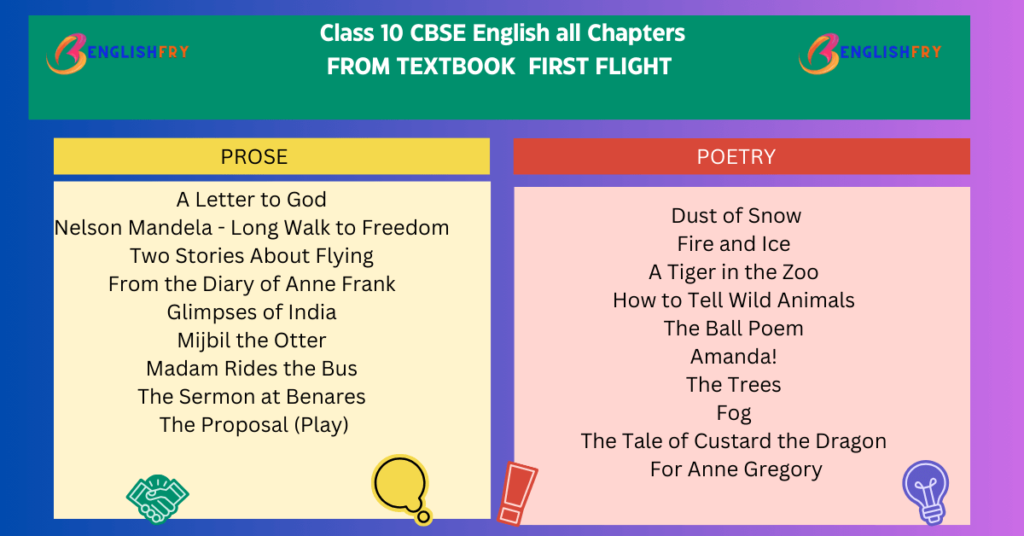
Class 10 cbse english all chapters
| FIRST FLIGHT | |
|---|---|
| A Letter to God | CLICK |
| Nelson Mandela - Long Walk to Freedom | CLICK |
| Two Stories About Flying | CLICK |
| From the Diary of Anne Frank | CLICK |
| Glimpses of India | CLICK |
| Mijbil the Otter | CLICK |
| Madam Rides the Bus | CLICK |
| The Sermon at Benares | CLICK |
| The Proposal (Play) | CLICK |
| Poems | |
| Dust of Snow | CLICK |
| Fire and Ice | CLICK |
| A Tiger in the Zoo | CLICK |
| How to Tell Wild Animals | CLICK |
| The Ball Poem | CLICK |
| Amanda! | CLICK |
| The Trees | CLICK |
| Fog | CLICK |
| The Tale of Custard the Dragon | CLICK |
| For Anne Gregory | CLICK |
Importance of studying in CBSE schools
As a parent, ensuring that your child gets the best possible education is a top priority. One of the ways to ensure that your child receives a quality education is by enrolling them in a CBSE school. The Central Board of Secondary Education (CBSE) is a national-level education board that is responsible for conducting exams for secondary and higher secondary classes in India.
CBSE is highly regarded for its commitment to excellence in education. The curriculum is designed to provide students with a broad-based education that prepares them for a wide range of careers. CBSE also ensures that its teachers are highly trained and qualified. The board places a high emphasis on professional development for its educators, so they are up-to-date with the latest teaching techniques and pedagogies.
One of the key benefits of studying in a CBSE school is that there is no bias towards any particular group or community. CBSE schools are known for their inclusivity and the fair treatment of all students. This is because CBSE is governed by a set of regulations that ensures equal treatment for all students, regardless of their background or socio-economic status.
CBSE is also known for its commitment to implementing all constitutional schemes instantly. This means that CBSE schools are at the forefront of implementing government initiatives aimed at improving the quality of education. CBSE schools are often the first to adopt new teaching methodologies and technologies, ensuring that their students receive a world-class education.
At CBSE schools, students are taught by highly qualified and experienced teachers who are passionate about their profession. These teachers are not only experts in their respective subjects but are also trained in using the latest teaching techniques to deliver a high-quality education to their students. This ensures that students receive the best possible education, which is critical in today’s competitive world.
| FIRST FLIGHT | |
|---|---|
| A Letter to God | CLICK |
| Nelson Mandela - Long Walk to Freedom | CLICK |
| Two Stories About Flying | CLICK |
| From the Diary of Anne Frank | CLICK |
| Glimpses of India | CLICK |
| Mijbil the Otter | CLICK |
| Madam Rides the Bus | CLICK |
| The Sermon at Benares | CLICK |
| The Proposal (Play) | CLICK |
| Poems | |
| Dust of Snow | CLICK |
| Fire and Ice | CLICK |
| A Tiger in the Zoo | CLICK |
| How to Tell Wild Animals | CLICK |
| The Ball Poem | CLICK |
| Amanda! | CLICK |
| The Trees | CLICK |
| Fog | CLICK |
| The Tale of Custard the Dragon | CLICK |
| For Anne Gregory | CLICK |

Founder of Englishfry.com, a captivating and knowledge-driven blog & Founder of Android app/website Studyfunnel.com, an online Mock Test Series Portal. With a wealth of experience spanning over 20+ years, he has excelled as an Ex-Asst.Professor, Teacher, Amazon published author, Website Developer, Graphic Designer,Blogger,Poet, and Creative academic content writer publisher of 4 academic books available Online on Amazon & Flipkart.Internationally Certified as the World’s Top 100 admired Educator 2021 by theexcelligent.com,National Award recipient-Golden Quill award for Best English educator 2024,Receipent of Indian Literature Award 2026.His tryst in Literature helped him realize his love for writing and telling stories. A tech-savvy language nerd by day and, a passionate writer by night, he now translates his experiences into tales of wisdom served with a side of humor.His widely recognized profound insights ,captivating writing style of weaving words make him contribute to prestigious publications and a sought-after authority in the field that transport readers to extraordinary worlds.