Table of Contents
ToggleIntroduction
If you are preparing for exams, this guide on The Shehnai of Bismillah Khan summary and questions answers will help you understand the chapter easily.
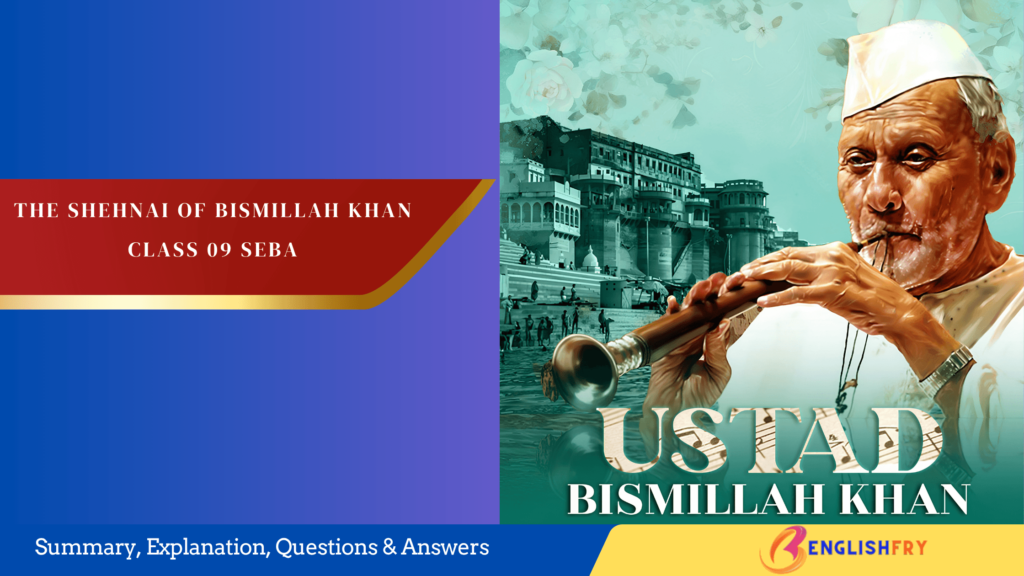
This chapter tells the inspiring life story of Ustad Bismillah Khan, the legendary musician who brought the shehnai to the world stage.
Summary of The Shehnai of Bismillah Khan
The chapter begins with the history of the shehnai. During the time of Emperor Aurangzeb, a musical instrument called the pungi was banned because of its harsh sound. Later, a barber from a family of musicians modified it by creating a new instrument with a longer pipe and holes, producing a soft and melodious sound. This instrument came to be known as the shehnai.
Traditionally, the shehnai was played in temples and weddings and was considered auspicious. However, it was Ustad Bismillah Khan who brought it onto the classical music stage.
Bismillah Khan was born in 1916 in a family of musicians in Bihar. From a young age, he showed great interest in music. He learned shehnai from his uncle Ali Bux in Varanasi and practiced for hours near the Ganga, which inspired his music.
He got his big break when he performed at the All India Radio in Lucknow in 1938. Later, on 15 August 1947, he played the shehnai at the Red Fort during India’s Independence, making the moment historic.
He gained worldwide recognition and performed in many countries. Despite fame and offers from abroad, he remained deeply attached to India, especially Benaras and the Ganga.
In 2001, he was awarded the Bharat Ratna. His life reflects India’s rich cultural heritage and unity.
Word Meanings
| Word | Meaning |
|---|---|
| Shrill | Sharp and unpleasant sound |
| Generic | General name |
| Melodious | Sweet sounding |
| Auspicious | Lucky or शुभ |
| Ensemble | Group of instruments |
| Recital | Musical performance |
| Maestro | Great musician |
| Souvenir | Memory item |
| Artificiality | Lack of naturalness |
| Prestigious | Highly respected |
| Coveted | Highly desired |
| Devout | Deeply religious |

Textual Questions and Answers (30–40 Words)
- Why did Aurangzeb ban the playing of the pungi?
Aurangzeb banned the pungi because it produced a shrill and unpleasant sound. It was considered unsuitable for the royal court, and therefore its use was stopped in the palace.
- How is a shehnai different from a pungi?
The shehnai is different from the pungi as it has a longer and broader pipe with holes that produce soft and melodious music, unlike the harsh and unpleasant sound of the pungi.
- Where was the shehnai played traditionally? How did Bismillah Khan change this?
Traditionally, the shehnai was played in temples and weddings. Bismillah Khan elevated its status by introducing it to classical music concerts and bringing it to international platforms.
- When and how did Bismillah Khan get his big break?
Bismillah Khan got his big break in 1938 with the opening of All India Radio in Lucknow, where he became a regular shehnai performer and gained recognition.
- Where did Bismillah Khan play on 15 August 1947? Why was it historic?
He played the shehnai at the Red Fort in Delhi on India’s Independence Day. It was historic because it marked India’s freedom, and he was the first to greet the nation musically.
- Why did Bismillah Khan refuse to start a shehnai school in the U.S.A.?
He refused because of his deep attachment to India, especially Benaras and the Ganga. He felt that the spiritual and cultural environment of India could not be recreated abroad.
- Give two examples showing Bismillah Khan’s love for India.
He refused to settle abroad despite offers and always expressed his longing for Benaras and the Ganga when away. These show his deep emotional connection to India.
Competency-Based Questions (CBSE Pattern)
1. Why do you think Bismillah Khan is considered a cultural icon of India?
Answer:
Ustad Bismillah Khan is considered a cultural icon of India because he played a major role in popularising the shehnai on both national and international platforms. He transformed a traditional folk instrument into a respected part of classical music. Despite achieving global fame, he remained deeply connected to Indian culture, traditions, and spirituality. His life represents dedication, simplicity, and pride in India’s rich musical heritage, making him a true symbol of cultural excellence.
2. What lesson do students learn from Bismillah Khan’s life?
Answer:
Students learn several important lessons from the life of Ustad Bismillah Khan. His journey teaches the value of hard work, continuous practice, and dedication towards one’s goal. He achieved great success through discipline and passion for music. At the same time, he remained humble and connected to his roots. His life shows that true success lies not only in fame but also in preserving one’s culture, values, and identity.
3. How does this chapter promote unity in diversity?
Answer:
This chapter strongly promotes the idea of unity in diversity through the life of Ustad Bismillah Khan. Although he was a devout Muslim, he played the shehnai regularly in Hindu temples like the Kashi Vishwanath temple. His music went beyond religious boundaries and connected people emotionally. This reflects the true spirit of India, where different cultures and religions coexist peacefully, showing harmony, respect, and mutual understanding.
4. Why is practice important according to Bismillah Khan’s life?
Answer:
The life of Ustad Bismillah Khan clearly shows that practice is essential for success. From a young age, he spent long hours practising the shehnai near the banks of the Ganga. His dedication helped him master the instrument and create new musical styles. His journey proves that talent alone is not enough; consistent effort, discipline, and regular practice are necessary to achieve excellence in any field.
5. What would have happened if Bismillah Khan had accepted foreign offers?
Answer:
If Ustad Bismillah Khan had accepted foreign offers, he might have gained even more international fame and financial success. However, he would have lost the deep cultural and spiritual connection he had with India, especially with Benaras and the Ganga. His music was closely linked to Indian traditions, and living abroad might have reduced that emotional depth, which was the soul of his art.
6.“If you work hard and know where you’re going, you’ll get there,” says Evelyn Glennie. You have now read about two musicians, Evelyn Glennie and Ustad Bismillah Khan. Do you think that they both worked hard? Where did they want to ‘go’ ? Answer these questions in two paragraphs, one on each of the two musicians.
Answer:Evelyn Glennie is a great example of hard work and determination. Despite losing her hearing at a young age, she did not give up her passion for music. Instead, she trained herself to feel vibrations through her body and continued learning percussion instruments with great dedication. Her goal was to become a successful musician, and through constant practice, strong willpower, and confidence, she achieved international fame. Her journey shows that with clear direction and hard work, even physical challenges can be overcome.
Ustad Bismillah Khan also worked extremely hard to achieve success. From childhood, he practised the shehnai for long hours, especially near the banks of the Ganga, which inspired his music. His aim was to master the shehnai and bring it to the level of classical music. Through dedication and passion, he not only achieved this goal but also gained worldwide recognition. His life proves that hard work, devotion, and clarity of purpose lead to great success.

Founder of Englishfry.com, a captivating and knowledge-driven blog & Founder of Android app/website Studyfunnel.com, an online Mock Test Series Portal. With a wealth of experience spanning over 20+ years, he has excelled as an Ex-Asst.Professor, Teacher, Amazon published author, Website Developer, Graphic Designer,Blogger,Poet, and Creative academic content writer publisher of 4 academic books available Online on Amazon & Flipkart.Internationally Certified as the World’s Top 100 admired Educator 2021 by theexcelligent.com,National Award recipient-Golden Quill award for Best English educator 2024,Receipent of Indian Literature Award 2026.His tryst in Literature helped him realize his love for writing and telling stories. A tech-savvy language nerd by day and, a passionate writer by night, he now translates his experiences into tales of wisdom served with a side of humor.His widely recognized profound insights ,captivating writing style of weaving words make him contribute to prestigious publications and a sought-after authority in the field that transport readers to extraordinary worlds.