Table of Contents
ToggleAbout James Kirkup: The Poet
James Kirkup was born in South Shields in the northeast of England in 1918 and died in 2009. He wrote poetry, plays, travel books, memoirs and translations, and he spent much of his later life in Japan, where he taught and lived for several decades. This long experience of living among people of another culture gave him a lasting interest in what separates and what joins different nations.
No Men Are Foreign belongs to the years after the Second World War, a time when Europe was counting the cost of a conflict that had divided continents and left millions dead. Kirkup was a conscientious objector during the war, which means he refused to fight on grounds of conscience, and his attitude to violence and national hatred shaped the poem’s central appeal. The poem speaks as someone who has already thought hard about why people kill each other and has found the reasons empty.
No Men Are Foreign Summary
The No Men Are Foreign summary follows an argument in five movements.
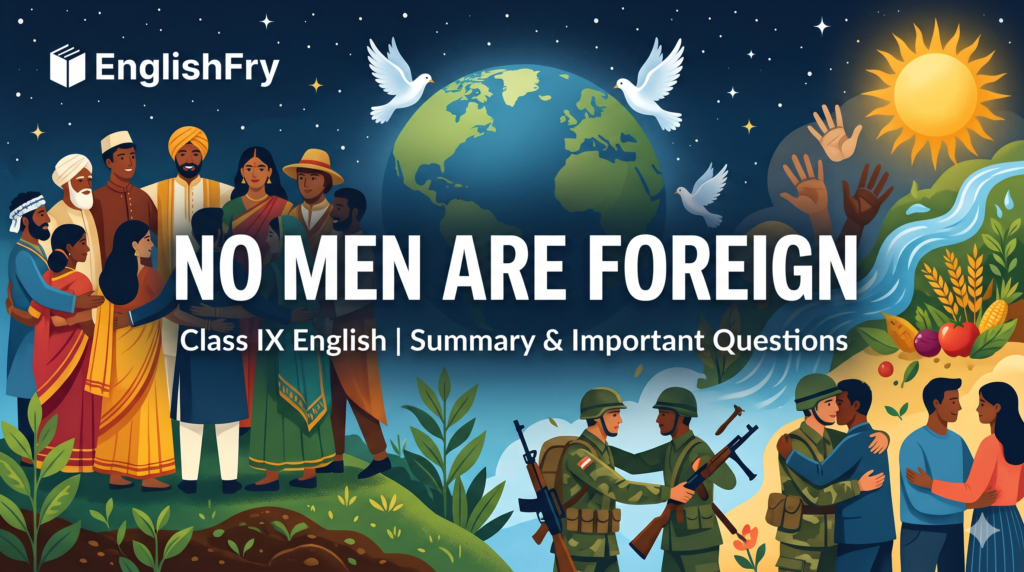
The poem opens by asking the reader to remember that no man is a stranger and no country is foreign. Beneath the different uniforms that soldiers wear, one human body breathes, just like ours. The soil that our so-called enemies walk upon is the same earth in which all of us will finally be buried.
The speaker then points to shared experience. People everywhere are aware of the sun, the air and the water. They are fed by peaceful harvests and starved by the long winter that war brings. Their hands, and the lines on those hands, show a life of work not so different from our own.
Next the speaker says that these other people have eyes like ours, that they wake and sleep like us and that their strength can be won over by love. In every land there is a common life that everyone can recognise and understand.
The tone then becomes more serious. Whenever we are told to hate our brothers, it is ourselves that we dispossess, betray and condemn. Those who take up arms against one another defile the human earth, and the hells of fire and dust created by war insult the innocence of the air, which belongs to all of us.
The poem closes by repeating its opening reminder: no men are foreign, and no countries are strange.
No Men Are Foreign: Detailed Analysis
The Voice and Tone
The speaker uses the pronouns “we” and “us” almost throughout, and the effect is to place himself alongside the reader rather than above. He is not a preacher scolding a guilty audience. He is a fellow human being sharing something he believes everyone already knows. The tone is calm, earnest and gentle, with a rising seriousness in the warning about hatred. This restraint makes the poem persuasive, because it appeals to reason and feeling together rather than shouting.
The Refrain
The poem begins and ends with nearly the same words, and the word “Remember” returns several times in between. This repetition works like the insistent voice of conscience. It also suggests that what the poem asks us to remember is not new knowledge but something we have forgotten or been taught to forget. The circular structure gives the poem unity and leaves the reader with its central idea.
From the Body to the Earth to the Air
The poem moves outward in widening circles. It begins with the human body, moves to the shared land and food, turns to hands and eyes and finally reaches the very air that surrounds the planet. This movement mirrors the argument, which starts with the smallest unit of humanity and builds to the largest. By the end, the reader is invited to see all people as part of one living world.
The Language of Uniforms
Uniforms are the poem’s key symbol of division. They show which side a person belongs to, but they are also only clothing, and the speaker says that beneath them one body breathes. The idea is that national identity is a layer that can be removed, whereas humanity is what remains.
The Contrast Between Peace and War
The poem sets peaceful harvests against war’s long winter and the innocence of the air against the hells of fire and dust. These contrasts show war as a harsh, unnatural force that destroys what peaceful life creates. Nature in the poem is shared and innocent, and war is a violation of it.
The Use of “we”
In the middle of the poem the speaker says that those who take up arms are “we”. He does not point at some distant aggressor. He includes himself and every reader among those who could defile the earth. This inclusion gives the poem moral honesty, because it accepts that responsibility for peace lies with everyone.
Poetic Devices Used in No Men Are Foreign
- Repetition and refrain: The word “Remember” appears at the opening of several sections, and the closing line echoes the opening line. This refrain gives the poem the quality of a chant or a solemn appeal and keeps the central message in the reader’s mind.
- Anaphora: The repeated use of “Remember” at the start of sentences is a form of anaphora, a device in which the same word begins successive phrases. It builds emphasis and gives the poem a steady, urgent rhythm.
- Metaphor: Calling war a “long winter” compares it to a cold, barren season that starves people. The “hells of fire and dust” are a metaphor for the destruction of modern warfare. Both images turn abstract suffering into something physical.
- Imagery: The poem offers images of breathing bodies, working hands, harvests, eyes that wake and sleep, the sun, the air and the water. These simple, everyday images show what all people share, and they make the poem’s argument concrete.
- Personification: The air is described as having innocence, which war outrages. By treating the air as something that can be offended, the poet gives nature a moral dignity and makes the damage of war feel like a wrong done to a living thing.
- Symbolism: Uniforms symbolise the divisions created by nations and armies. The earth and the air symbolise the common home of all humanity.
- Antithesis: The poem sets peace against war, love against hatred and the shared human body against the divided world of uniforms. These pairings sharpen the argument.
- Climax and the triple verb: The words dispossess, betray and condemn are arranged in rising order of seriousness. This tricolon, a series of three, adds force to the warning about hatred.
- Inclusive pronouns: The consistent use of “we”, “us” and “our” draws the reader into the poem and makes the message one of shared responsibility.
- Free verse and enjambment: The poem has no rhyme scheme and no regular metre. Its lines run into one another without strict pauses, and the effect is of natural, thoughtful speech. This form suits a poem that wants to reason with the reader rather than perform for them.
- Tone: The tone is gentle, earnest and persuasive, with a rising note of warning in the final section.

Major Themes and Key Ideas in No Men Are Foreign
The poem’s main theme is the unity of humankind. The speaker insists that the divisions between nations are surface divisions and that human life is fundamentally the same everywhere. People share bodies, needs, labour and the same earth, and this common ground is far greater than any difference.
A second theme is the foolishness and cruelty of war. War starves, destroys and defiles, and it does not respect the innocence of nature. It also makes fellow human beings into enemies, which the poem treats as a kind of lie.
A third theme is the power of love and understanding. The speaker’s belief that the strength of others can be won by love is a quiet but radical claim, because it offers an alternative to force. The poem sees peace as the result of recognising our shared humanity.
A fourth theme is responsibility. Because the poem uses “we”, it places the duty for peace on every individual. Hatred is taught and accepted, and the poem asks readers to refuse to take part in it.
Finally, there is a theme of harmony with nature. The earth, the air and the harvests are described as common gifts, and war’s destruction of them is a betrayal of a shared home.

Short Answer Questions (2–3 marks each)
Q1. What does the poet ask us to remember?
He asks us to remember that no man is a stranger and no country is foreign.
Q2. What is common to all soldiers under their uniforms?
They all have a human body that breathes like ours.
Q3. Which earth will all of us lie in?
The same earth on which our brothers in other lands walk. All humans are buried in the earth.
Q4. What do all people feel and enjoy, according to the poet?
They are all aware of the sun, the air and the water.
Q5. What are people fed by in peaceful times?
They are fed by peaceful harvests.
Q6. What does “war’s long winter” mean?
It means the hunger and suffering that war brings, which is like a cold, long winter.
Q7. How can we win the strength of other people?
We can win it only by love and not by force or hate.
Q8. What will happen to us if we hate our brothers?
We will harm ourselves. We shall dispossess, betray and condemn ourselves.
Q9. What do we spoil when we take up arms against each other?
We spoil the human earth.
Q10. What is meant by “our hells of fire and dust”?
It means the terrible fire and dust created by war, which turn the world into hell.
Q11. Why does the poet repeat the word “Remember”?
He repeats it to make us pay attention and to stress his message about human unity.
Q12. Which line in the poem is repeated in a similar way at the end?
“No men are foreign, and no countries strange” is the central idea in the first and last lines.
Long Answer Questions (5–6 marks each)
Q1. What is the central idea of the poem “No Men Are Foreign”?
The central idea is that all human beings are one family. People may live in different countries and speak different languages, but they are the same inside. They breathe, work, hunger, sleep and love in the same way. The poet says that war and hatred only bring pain to everyone. So we should treat all people as our brothers and live in peace.
Q2. How does the poet show that all people are alike?
The poet gives many examples. Under their uniforms, all soldiers breathe like us. All of us are aware of the sun, air and water. Everyone is fed by harvests and suffers in war. Other people’s hands and eyes are like ours, and their work is like ours too. All of us will lie in the same earth at last. These common things show that we are all alike.
Q3. Why does the poet say that it is ourselves we harm when we hate others?
The poet says that all humans are brothers and are part of one family. If we hate or fight others, we are really hurting our own family. We lose our peace and our goodness. We dispossess, betray and condemn ourselves. Also, war spoils the earth and the air, which belong to everyone, including us. So hating others is the same as harming ourselves.
Q4. What does the poem say about war?
The poem says that war is cruel and unnatural. It brings hunger, like a long winter. It makes people soldiers and forces them to fight their own brothers. It spoils the earth and insults the pure air with fire and dust. The poet calls these “hells of fire and dust”. He wants us to avoid war and choose love.
Q5. Explain the line “Beneath all uniforms, a single body breathes like ours.”
A uniform shows a person’s country or army. But the poet says that under the uniform there is only a human being. The soldier of another country is a person with a body, a heart and feelings, just like us. This line teaches that we should look at people as human beings, not as enemies because of their dress or country.
Q6. What lesson do you learn from the poem?
I learn that all human beings are equal and that hatred is wrong. We should not hate people only because they belong to another country or speak another language. We should love, respect and help each other. We should also protect our earth and live in peace. If everyone follows this, there will be no wars.
Q7. Write a short note on the use of repetition in the poem.
The poet repeats the word “Remember” again and again, like a gentle reminder. The first and last lines also give the same message: no men are foreign and no countries are strange. This repetition makes the message strong and helps us remember it. It also gives the poem a musical, serious tone.
Q8. Why is the poem titled “No Men Are Foreign”?
The title gives the main message of the poem. “Foreign” means belonging to another country. The poet says that no man should be seen as foreign, because all people are brothers. The title tells us to remove the feeling of difference between nations.
Q9. How can the message of this poem help the world today?
Today there are many wars, fights and conflicts between people and nations. The poem teaches us to see others as fellow humans. If people understood this, they would stop hating and fighting. They would share the earth with love and care, and the world would be a peaceful place.
Q10. Describe the tone and style of the poem.
The tone is calm, kind and serious. The poet speaks directly to the reader and advises us gently, but also warns us about the danger of hatred. The language is simple and the poem is written in free verse, which means it has no fixed rhyme scheme. Words such as “Remember” and “Let us” make the poet’s voice sound like a friend giving advice.

Founder of Englishfry.com, a captivating and knowledge-driven blog & Founder of Android app/website Studyfunnel.com, an online Mock Test Series Portal. With a wealth of experience spanning over 20+ years, he has excelled as an Ex-Asst.Professor, Teacher, Amazon published author, Website Developer, Graphic Designer,Blogger,Poet, and Creative academic content writer publisher of 4 academic books available Online on Amazon & Flipkart.Internationally Certified as the World’s Top 100 admired Educator 2021 by theexcelligent.com,National Award recipient-Golden Quill award for Best English educator 2024,Receipent of Indian Literature Award 2026.His tryst in Literature helped him realize his love for writing and telling stories. A tech-savvy language nerd by day and, a passionate writer by night, he now translates his experiences into tales of wisdom served with a side of humor.His widely recognized profound insights ,captivating writing style of weaving words make him contribute to prestigious publications and a sought-after authority in the field that transport readers to extraordinary worlds.
Related reading
- The Thief’s Story Summary Class 10 | English Explanation, Questions Answers & Character Sketch
- The School of Tomorrow::Why Education Must Evolve Beyond Textbooks
- 7 Powerful steps of Positive Thinking: How to Cultivate a Positive Mindset
- Modern Age in English Literature Notes 8 Powerful Insights into T.S. Eliot, James Joyce and Literary Modernism