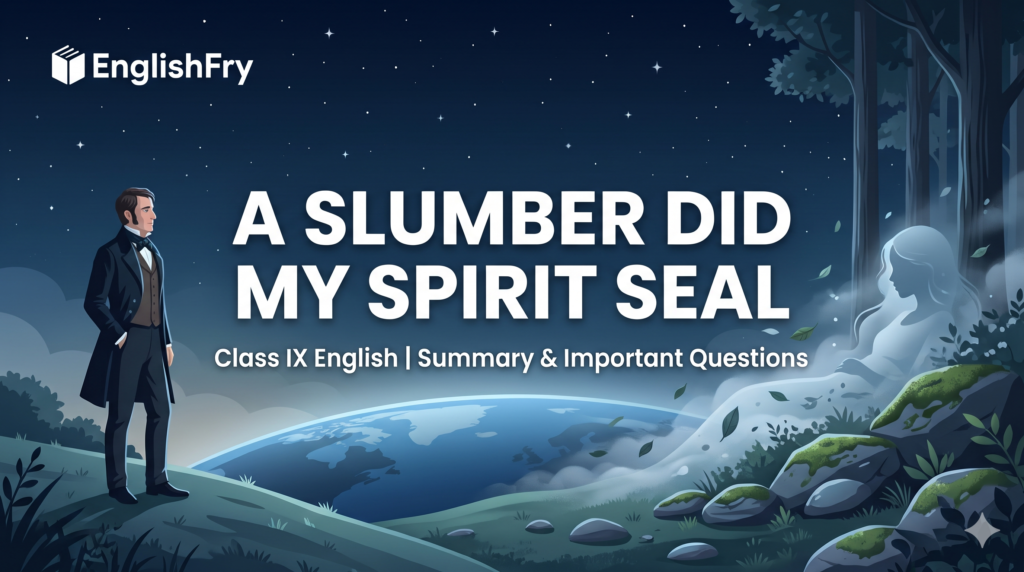
“A Slumber Did My Spirit Seal” (1798) is one of the more popular and accomplished poems by William Wordsworth. The poem is part of a wider collection of poems known as the “Lucy Poems.”
“Strange fits of passion have I known” (1800),
“She dwelt among the untrodden ways” (1800),
“I travelled among unknown men”(1807),
“Three years she grew in sun and shower” (1800),
“A slumber did my spirit seal” (1800).
A Slumber Did My Spirit Seal Class 9 Summary: Explanation, Translations & Question Bank
EnglishFry Study Notes | Class IX English Beehive | CBSE • SEBA • ASSEB (Assam) Board Exam 2026
Hello students! Welcome back to EnglishFry. Today, we are exploring one of the shortest yet deepest poems in your Class 9 English Beehive textbook: "A Slumber Did My Spirit Seal" by the great Romantic nature poet William Wordsworth.
Do not let its eight-line length fool you! In this A Slumber Did My Spirit Seal Class 9 Summary and complete study guide, we will unpack every single line like a classroom lesson so you can write high-scoring answers effortlessly.
Many students lose marks on this poem because they miss the sharp shift between the two stanzas. Let us break down the multi-lingual summaries, word meanings, literary devices, and exam-ready question bank step by step.
Table of Contents
Toggle★ About the Poet: William Wordsworth
William Wordsworth (1770–1850) was one of the founders of English Romanticism and served as Britain's Poet Laureate. He is celebrated as a "Worshipper of Nature" because he believed nature was a living spiritual teacher.
"A Slumber Did My Spirit Seal" belongs to his famous series called the "Lucy Poems", written between 1798 and 1801. Through simple, restrained language, Wordsworth reflects on the sudden death of a beloved girl named Lucy and how she peacefully merges back into the eternal cycle of nature.
1 Multi-Lingual Summary Vault
Think of this poem as two contrasting photographs of the poet's mind—one taken before his loved one's death, and the other taken after. In the first stanza, the poet confesses that a deep "slumber" (a dream-like illusion) had sealed his spirit. Because he loved Lucy so deeply, he took her life for granted and lived with "no human fears."
In that blind state of comfort, she seemed like an immortal being who could never feel "the touch of earthly years." He simply never imagined that time, aging, or death could take her away from him. His soul was completely closed off from harsh reality.
Then, between the two stanzas, tragedy strikes silently. In the second stanza, the poet wakes up from his slumber to face the cold truth: Lucy is dead. She has "no motion" and "no force," and she "neither hears nor sees" anything around her.
Yet, Wordsworth does not break down in loud, bitter grief. Instead, he finds quiet comfort in knowing that Lucy has become an inseparable part of nature. Buried in the earth, she is now "rolled round in earth's diurnal course" every single day, eternally united with "rocks, and stones, and trees."
'ए स्लंबर डिड माई स्पिरिट सील' (A Slumber Did My Spirit Seal) प्रसिद्ध प्रकृति कवि विलियम वर्ड्सवर्थ (William Wordsworth) द्वारा रचित एक अत्यंत भावुक और दार्शनिक कविता है। यह कविता केवल दो पद्यों (stanzas) की है, जो कवि के मन की दो अलग-अलग अवस्थाओं—भ्रम और कठोर वास्तविकता—को दर्शाती है।
पहले पद्य में कवि बताते हैं कि एक गहरी नींद या भ्रम (slumber) ने उनकी आत्मा को मानो बंद कर दिया था। इस भ्रम के कारण उनके मन में कोई मानवीय डर (no human fears) नहीं था। उन्हें लगता था कि उनकी प्रिय लुसी (Lucy) अमर है और उस पर समय या उम्र का कोई असर (touch of earthly years) नहीं हो सकता।
दूसरे पद्य में अचानक सच्चाई सामने आती है। लुसी अब इस दुनिया में नहीं रही। उसकी मृत्यु के बाद कवि का भ्रम टूट जाता है। अब न तो उसके शरीर में कोई गति (no motion) है और न ही कोई शक्ति (no force); वह न कुछ सुन सकती है और न ही देख सकती है।
हालांकि, कवि इस दुख को शांत और परिपक्व भाव से स्वीकार करते हैं। वे महसूस करते हैं कि धरती में दफन होकर लुसी अब प्रकृति का एक अभिन्न अंग बन गई है। वह चट्टानों, पत्थरों और पेड़ों (rocks, and stones, and trees) के साथ पृथ्वी के दैनिक चक्कर (earth's diurnal course) में हमेशा के लिए घूम रही है।
উইলিয়াম ৱৰ্ডছৱৰ্থৰ (William Wordsworth) দ্বাৰা ৰচিত 'এ স্লাম্বাৰ ডিড মাই স্পিৰিট চিল' (A Slumber Did My Spirit Seal) এক অতি গভীৰ আৰু দাৰ্শনিক কবিতা। মাত্ৰ আঠটা শাৰীৰ এই কবিতাটোৱে কবিৰ মনৰ দুটা বিপৰীত অৱস্থা—কল্পনাৰ ভ্ৰম আৰু মৃত্যুৰ কঠিন বাস্তৱ—অতি সুন্দৰকৈ দাঙি ধৰিছে।
প্ৰথম স্তৱকত কবিয়ে কৈছে যে এক গভীৰ নিদ্ৰা বা ভ্ৰমে (slumber) তেওঁৰ আত্মাক যেন বন্ধ কৰি ৰাখিছিল। সেই অৱস্থাত তেওঁৰ মনত কোনো মানৱীয় ভয় (no human fears) নাছিল। তেওঁ ভাবিছিল যে তেওঁৰ প্ৰিয় লুচী (Lucy) যেন অমৰ, যাক সময় বা বয়সৰ প্ৰভাৱে (touch of earthly years) কেতিয়াও স্পৰ্শ কৰিব নোৱাৰে।
কিন্তু দ্বিতীয় স্তৱকত হঠাৎ কঠিন বাস্তৱ সন্মুখলৈ আহে। লুচীৰ মৃত্যুৰ লগে লগে কবিৰ ভ্ৰম ভাঙি যায়। এতিয়া তাইৰ শৰীৰত কোনো গতি (no motion) বা শক্তি (no force) নাই; তাই একো শুনিবও নোৱাৰে আৰু দেখিবও নোৱাৰে।
তথাপি কবিয়ে হতাশ হৈ হাহাকাৰ কৰা নাই, বৰঞ্চ মৃত্যুৰ এই চিৰন্তন সত্যক শান্তভাৱে মানি লৈছে। তেওঁ অনুভৱ কৰিছে যে মাটিৰ বুকুত বিলীন হৈ লুচী এতিয়া প্ৰকৃতিৰ এক অবিচ্ছেদ্য অংগ হৈ পৰিছে। শিল, পাথৰ আৰু গছ-গছনিৰ (rocks, and stones, and trees) সৈতে তাই পৃথিৱীৰ দৈনিক আৱৰ্তনত (earth's diurnal course) চিৰকাল ঘূৰি আছে।
2 Stanza-Wise Explanation & Word Meanings
I had no human fears.
She seemed a thing that could not feel
The touch of earthly years.
Teacher's Explanation: Here, the poet looks back at the time when his beloved was alive. A deep trance-like sleep ("slumber") had shut off his mind from the reality of death. Because he felt no ordinary human fear of losing her, he treated her as if she were untouched by time, aging, or mortality.
She neither hears nor sees,
Rolled round in earth's diurnal course
With rocks and stones and trees.
Teacher's Explanation: The verb tense shifts abruptly from past ("did", "had", "seemed") to present ("has", "hears", "sees"). Death has arrived. She can no longer move, hear, or see. Yet, buried beneath the soil, she rotates daily with the planet, permanently united with rocks, stones, and trees.
| Word / Phrase | Simple Meaning |
|---|---|
| Slumber | Deep sleep; metaphorically, a state of ignorance or illusion |
| Spirit seal | Closed off the soul from harsh reality or fear |
| Earthly years | The passage of time, aging, and mortality on earth |
| Motion / Force | Physical movement and living energy |
| Diurnal course | Earth's daily rotation on its axis (causing day and night) |
3 Teacher’s Deep Dive: Gold Standard Keywords & Literary Devices
Gold Standard Textual Keywords: To score full marks in CBSE and SEBA exams, weave these exact textbook phrases into your answers: "slumber", "spirit seal", "no human fears", "touch of earthly years", "no motion", "no force", "neither hears nor sees", "earth's diurnal course", and "rocks, and stones, and trees".
- Rhyme Scheme: The poem follows a regular ABAB CDCD rhyme scheme (seal/feel, fears/years; force/course, sees/trees).
- Metaphor: "Slumber" is a metaphor for the poet's deep illusion and ignorance about death, which sealed his spirit from anxiety.
- Alliteration: Repetition of consonant sounds in "slumber did my spirit seal" ('s' sound) and "Rolled round" ('r' sound).
- Enjambment: A thought continues without punctuation to the next line, as in "She seemed a thing that could not feel / The touch of earthly years."
- Irony & Contrast: In Stanza 1, she "could not feel" time because she seemed immortal; in Stanza 2, she literally cannot feel anything because she is dead.
A Very Short Answer Questions (1 Mark)
Ans:The poem "A Slumber Did My Spirit Seal" is written by the celebrated English Romantic poet William Wordsworth, known for his deep love of nature.
Ans:The word "slumber" symbolizes a deep, dream-like state of illusion and ignorance that kept the poet's spirit sealed away from the harsh fear of death.
Ans:"She" refers to the poet's deeply beloved young girl, traditionally identified as Lucy from Wordsworth's "Lucy Poems," whose sudden death shattered his illusions.
Ans:"Earth's diurnal course" refers to the daily rotation of the earth on its axis, which causes the continuous cycle of day and night.
Ans:After her death and burial in the soil, the poet's loved one has become an inseparable part of the earth alongside rocks, stones, and trees.
B Extract-Based Questions (5 Marks)
I had no human fears.
She seemed a thing that could not feel
The touch of earthly years."
Ans:(i) "Spirit seal" means that the poet's soul and mind were closed off by a comforting illusion, keeping him blind to the reality of mortality. (ii) He had "no human fears" because he foolishly believed his beloved was immortal and completely safe from death. (iii) "The touch of earthly years" refers to the natural effects of aging, decay, and time on every mortal human being. (iv) The poetic devices in line 1 are Alliteration (slumber, spirit, seal) and Metaphor. (v) The word in the extract that means 'deep sleep' is "slumber."
She neither hears nor sees,
Rolled round in earth's diurnal course
With rocks and stones and trees."
Ans:(i) She has "no motion" and "no force" because she is dead and lies lifeless beneath the earth. (ii) She has lost all physical senses and "neither hears nor sees" anything in the living world. (iii) Even though she is motionless on her own, she is carried along continuously as she is "rolled round in earth's diurnal course" with rocks, stones, and trees. (iv) The tone of this stanza is calm, factual, and deeply stoic, reflecting quiet acceptance rather than loud grief. (v) The word in the extract that means 'daily' is "diurnal."
C Short Answer Questions (30-40 Words | 2-3 Marks)
Ans:The poet reacts to his loved one's death with quiet, stoic acceptance rather than bitter grief. Although deeply shocked out of his "slumber," he finds calm peace knowing she has merged eternally with nature's "rocks, and stones, and trees."
Ans:The lines "She seemed a thing that could not feel / The touch of earthly years" convey that the passing of time will no longer affect her. Once an illusion of youth, this becomes a literal truth after her death.
Ans:Wordsworth does not imagine her living in a traditional heaven. Instead, he sees her as an inseparable part of physical nature, lying motionless in the soil and "rolled round in earth's diurnal course" alongside rocks, stones, and trees.
Ans:The poet had "no human fears" because a deep "slumber" of illusion had sealed his spirit. Blinded by love, he took his beloved's life for granted and never imagined that aging or death could ever touch her.
Ans:In the first stanza, the poet lives in a dreamy past tense of false security, believing his loved one is immune to time. In the second stanza, reality strikes in the present tense, forcing him to accept her motionless, silent death.
Ans:The central theme is the contrast between human illusion and the inescapable truth of mortality. While humans often take loved ones for granted, death inevitably unites every mortal being with the eternal, unchanging cycle of nature.
D Long, Analytical & Competency-Based Questions (100-120 Words | 5 Marks)
Ans:William Wordsworth constructs "A Slumber Did My Spirit Seal" around a powerful contrast between dreamy human illusion and cold natural reality. The first stanza is written in the past tense and reflects a state of blissful ignorance. A deep "slumber" had sealed the poet's spirit, leaving him with "no human fears" because his beloved seemed immune to "the touch of earthly years." Between the two stanzas, however, death intervenes silently. The second stanza shifts abruptly to the present tense, stripping away every comforting illusion. Now, she has "no motion" and "no force," and she "neither hears nor sees." Instead of being a lively companion, she is "rolled round in earth's diurnal course" with "rocks, and stones, and trees," marking the poet's painful yet serene awakening to mortality.
Ans:As a devoted nature poet, William Wordsworth refuses to portray death through loud despair or horror. Although the sudden loss of his beloved wakes him from the "slumber" that had sealed his spirit, he does not indulge in bitter grief. He honestly acknowledges her physical stillness—she has "no motion," "no force," and "neither hears nor sees." Yet, he transforms this stark reality into a source of quiet consolation. Rather than vanishing into nothingness, she becomes an eternal companion to the universe itself. Buried in the soil, she participates in "earth's diurnal course," endlessly rotating alongside "rocks, and stones, and trees." Through this calm, stoic imagery, Wordsworth teaches us that death simply returns human life to the enduring, timeless embrace of nature.
Ans:The title "A Slumber Did My Spirit Seal" is deeply significant because it captures the exact psychological state that makes the poet's loss so poignant. Here, "slumber" does not mean ordinary physical sleep; it represents a trance-like illusion of permanence that closed off the poet's soul from "human fears." Because he loved Lucy deeply, he carelessly assumed she could never feel "the touch of earthly years." The title also carries sharp irony. In the first stanza, the poet's spirit was sealed in a metaphorical sleep of ignorance, while in the second stanza, his beloved is sealed forever in the literal sleep of death—having "no motion" and "no force." Thus, the title brilliantly bridges human blindness to mortality and the sudden, sobering arrival of truth.
Ans:Wordsworth's short elegy holds up a mirror to a deeply relatable human weakness: our habit of assuming that the people we love will remain with us forever. When his beloved was alive, a comforting "slumber" sealed the poet's spirit, freeing him from "human fears." He viewed her as someone beyond "the touch of earthly years," completely forgetting that every mortal life is fragile and temporary. Only when death strikes does he realize how sudden and irreversible loss can be. Suddenly, she has "no motion," "no force," and "neither hears nor sees," becoming one with "rocks, and stones, and trees." This quiet reflection urges readers to stay awake to the preciousness of life, cherishing our loved ones in the present instead of living in a blind slumber.
Ans:Unlike traditional elegies filled with dramatic weeping and elaborate mourning, "A Slumber Did My Spirit Seal" achieves immense emotional power through silence and restraint. Wordsworth never even uses the word "dead" or "grave" anywhere in the eight lines. Instead, he leaves a silent gap between the two stanzas where the tragedy occurs. By placing the dreamy illusions of "no human fears" directly beside the stark, factual statement that she has "no motion" and "no force," he lets the reader feel the full shock of emptiness. His closing image of her being "rolled round in earth's diurnal course" with "rocks, and stones, and trees" feels vast, timeless, and hushed—proving that quiet acceptance often expresses deeper sorrow than loud lamentation.
Ans:In "A Slumber Did My Spirit Seal," William Wordsworth blends deep grief with his lifelong reverence for nature's eternal rhythm. While human beings are vulnerable to "the touch of earthly years" and eventually lose all physical "motion" and "force," nature itself never stops moving. Even after Lucy "neither hears nor sees," she is not abandoned in isolation; she is gently folded into the planet's grand, unstoppable movement—its "diurnal course." By placing her among "rocks, and stones, and trees," Wordsworth elevates ordinary natural elements into sacred, permanent companions. Nature appears neither cruel nor sentimental here; it is an all-encompassing, timeless cycle that softly receives every mortal soul back into its fold, giving the poet a calm, enduring peace.
FAQ Frequently Asked Questions (Quick Exam Revision)
The poem teaches us that death is an unavoidable law of nature. Humans often live in a comforting illusion that their loved ones will live forever, yet after death, every mortal returns peacefully to the earth and becomes part of nature's eternal cycle.
He calls her "a thing" not out of disrespect, but to show that in his dreamy illusion he saw her as an ageless, almost timeless being who could never be touched by aging or mortality—ironically foreshadowing her later stillness among rocks and stones.
The poem consists of two four-line stanzas (quatrains) written in a steady ABAB CDCD rhyme scheme, which mirrors the calm, rhythmic movement of the earth's daily rotation.
★ Internal Linking Vault for Class 9 Students
Keep your CBSE & SEBA Class 9 English preparation sharp with these complete EnglishFry study guides:
• The Bond of Love Class 9 Summary & Q&A
• The Lake Isle of Innisfree Class 9 Explanation & Questions
• No Men Are Foreign Class 9 Summary & Notes
• English Grammar: Complete Guide to Transformation of Sentences
With this complete A Slumber Did My Spirit Seal Class 9 Summary, multi-lingual translations, and keyword-rich question bank, you have everything you need to score full marks in your 2026 exams. Revise the eight lines once before entering the exam hall, underline key phrases like "slumber," "earthly years," and "earth's diurnal course" in your answer sheet, and watch your literature score soar!