
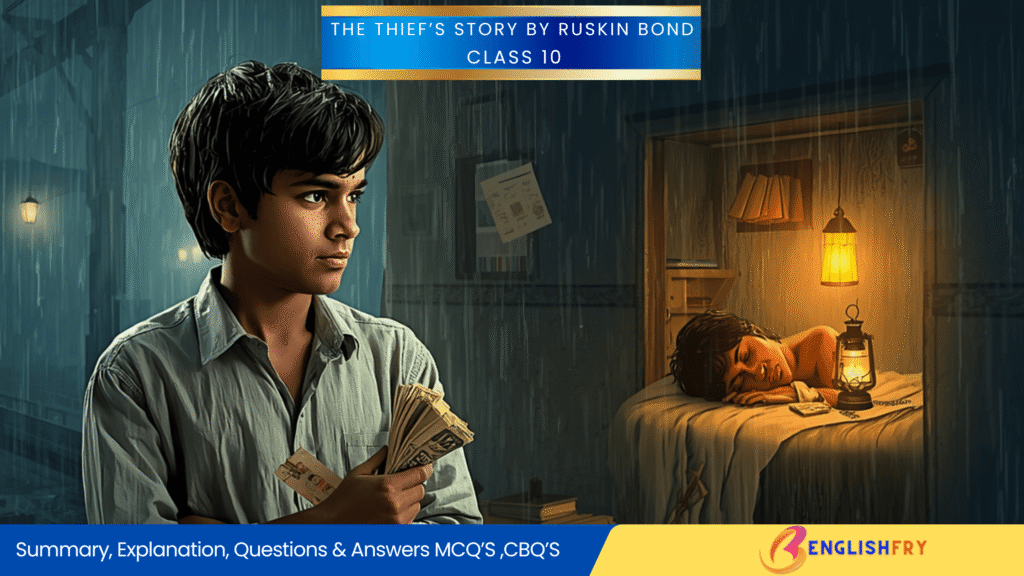
Now, look at me. Before we even read the first sentence or i explain you the story , I want you to understand one thing: this is not just a story about a robbery. If you write in your board exam that this is a story about a boy who stole money, you are going to lose out on the top marks.
This story is a deep, psychological masterclass on human nature, trust, and the power of education.
Let’s break down exactly how you need to visualize this chapter so you can write flawless, high-scoring answers.
Table of Contents
Toggle👥 Act I: The Predator and The Prey (The Characters)
In any board exam question comparing these two, you must use the word “contrast.” Bond sets up two completely opposite characters.
Hari Singh: He’s 15. Now, think about it—at 15, most kids are worrying about school or sports. Hari is worrying about his next target. He is a seasoned, cunning criminal. “Hari Singh” isn’t even his real name! He changes it every month to stay two steps ahead of the cops and his old employers. He is a master manipulator who uses a “winning, appealing smile” as a weapon.
Anil: He’s 25. He’s tall, lean, and looks incredibly simple and easygoing. He is a struggling freelance writer who earns money “by fits and starts”—meaning his income is totally irregular.
The Hook: Hari spots Anil at a wrestling match. Why a wrestling match? Because it’s a place where people are relaxed. Hari uses his classic flattery: “You look a bit of a wrestler yourself.” It works. When Anil says he can’t pay him, Hari shifts his strategy instantly: “Can you feed me?” Anil replies with a brilliant condition: “Can you cook?” Hari lies and says yes.
🍳 Act II: The One-Rupee Cheat & The Power of Literacy
Anil takes Hari to his room above the Jumna Sweet Shop.
The first night is a disaster. Hari’s cooking is so utterly terrible that Anil takes the food and throws it to the stray dogs on the street. He tells Hari to pack his bags. But instead of leaving, Hari just stands there, giving his most charming, helpless smile. Anil melts. He pats him on the head and says, “Never mind, I’ll teach you to cook.”
But Anil doesn’t stop at cooking. Write this down in your notes, it’s a major value point: Anil promises to teach him to write his name, write full sentences, and add numbers.
The Teacher’s Insight: For the first time in his life, someone is offering Hari something far more valuable than cash. They are offering him literacy. Hari even admits to the reader: “I knew that once I could write like an educated man, there would be no limit to what I could achieve.”
Still, a leopard doesn’t change its spots overnight. Every morning, Hari goes to buy the daily supplies and slyly pockets one rupee from the change. He knows Anil realizes this, but Anil chooses to look the other way. Why? Because Anil is trying to win him over with patience, not punishment.
💰 Act III: The 600-Rupee Temptation
One evening, Anil comes home with a bundle of crisp notes—600 rupees in fifty-rupee bills—which he made by selling a book to a publisher. Hari watches him tuck the bundle under his mattress.
Hari’s criminal mind starts racing. “I haven’t stolen anything in a month. If I don’t take it, he’ll just waste it on his friends. Plus, he doesn’t even pay me a salary!” Rationalizing your crime is classic criminal psychology, and Hari does it perfectly.
At midnight, while Anil is sleeping peacefully in the moonlight, Hari creeps up, slides his hand under the mattress, and pulls out the money. He bolts out the door and runs straight to the railway station.
🚂 Act IV: The Critical Turning Point (The Station Platform)
The Lucknow Express is just starting to move out of the station. It’s moving slowly. Hari could easily jump into one of the carriages. He has the money in his pocket—enough to live like an “oil-rich Arab” for two weeks.
But he hesitates.
Why does he freeze? This is the most crucial part of the story. Hari stops because his conscience kicks in. He starts thinking about what will happen when Anil wakes up.
He thinks about his past victims:
The greedy man shows fear when robbed.
The rich man shows anger.
The poor man shows acceptance.
But Anil? Anil won’t show fear or anger. Anil will show pure sadness, not because of the missing money, but because of the loss of trust.
Hari realizes that if he boards that train, he remains a thief forever, running from the law, living under fake names. But if he goes back, he can become an educated, respected, clever man. He chooses dignity over a bundle of paper.
He walks back in the pouring rain. The notes get soaked and damp, but he carefully slips them back under Anil’s mattress and goes to sleep.
🌅 Act V: The Silent Reformation
The next morning, Hari wakes up late. Anil has already made the tea.
Anil walks over and stretches out his hand. In his fingers is a fifty-rupee note.
Hari’s heart sinks. He thinks, “I’ve been caught.”
But then he touches the note. It is still damp and wet from the night’s rain.
This is the ultimate moment of the story. Anil knows everything. He knows Hari took the money, went to the station, changed his mind, and came back. The damp note is the absolute proof.
But look at Anil’s greatness. He doesn’t call the police. He doesn’t scream. He doesn’t even mention the rain. He simply smiles and says, “I made some money yesterday. Now you’ll be paid regularly. Today, we will start writing sentences.”
Hari smiles back, but this time, it’s not his fake, calculating thief’s smile. It’s a genuine smile from the bottom of his heart. He has been completely transformed—not by a prison sentence, but by silent forgiveness and unconditional trust.
🎯 Exam Strategy: Key Vocabulary to Use
When answering questions on this chapter, make sure you sprinkle in these high-impact words to impress the examiner:
Fits and Starts: Used to describe Anil’s irregular income.
Hypocrisy/Deception: Hari’s initial behavior and smiles.
Conscience/Compunction: The inner voice that stopped Hari at the station.
Transformation/Reformation: The ultimate change in Hari’s character.
Magnanimity: Anil’s great-heartedness and ability to forgive silently.
Does everyone understand the emotional core of this story now? Excellent. Let’s make sure we bring this deep level of analysis into our blog notes!

The Thief’s Story Summary Class 10 in Hindi
चोर की कहानी (The Thief’s Story) हिंदी सारांश
यह कहानी एक पंद्रह वर्षीय चोर हरि सिंह और एक दयालु लेखक अनिल के बीच के संबंध पर आधारित है। हरि सिंह लोगों का भरोसा जीतकर चोरी करता था। एक दिन उसकी मुलाकात अनिल से हुई, जो सरल और दयालु स्वभाव का था।
हरि ने अनिल से काम माँगा। अनिल ने उसे अपने साथ रहने दिया और खाना बनाना तथा लिखना-पढ़ना सिखाने लगा। धीरे-धीरे हरि को महसूस हुआ कि अनिल उस पर भरोसा करता है।
एक दिन अनिल के पास छह सौ रुपये आए। रात को हरि ने पैसे चुरा लिए और स्टेशन पहुँच गया। लेकिन ट्रेन पकड़ने से पहले उसे एहसास हुआ कि शिक्षा और विश्वास पैसे से अधिक महत्वपूर्ण हैं। उसे लगा कि पढ़-लिखकर वह सम्मानजनक जीवन जी सकता है।
वह वापस लौटा और चुपचाप पैसे वापस रख दिए। अगली सुबह अनिल ने उसे कुछ नहीं कहा, बल्कि उसे पचास रुपये देकर पढ़ाई जारी रखने को कहा। इससे हरि को समझ आया कि विश्वास और दया इंसान को बदल सकते हैं।
The Thief’s Story Summary Class 10 in Assamese
“The Thief’s Story” অসমীয়া সাৰাংশ
এই গল্পটো হৰি সিং নামৰ পনৰ বছৰীয়া এজন চোৰ আৰু অনিল নামৰ এজন দয়ালু লেখকৰ মাজৰ সম্পৰ্কৰ ওপৰত আধাৰিত। হৰি সিং মানুহৰ বিশ্বাস জয় কৰি চুৰি কৰিছিল। এদিন তেওঁ অনিলক লগ পায় আৰু তেওঁৰ লগত কাম কৰিবলৈ আৰম্ভ কৰে।
অনিল দৰিদ্ৰ লেখক আছিল, কিন্তু তেওঁ হৰিক ৰন্ধন, লিখা-পঢ়া আৰু গণিত শিকাবলৈ আৰম্ভ কৰে। ধীৰে ধীৰে হৰিয়ে অনুভৱ কৰে যে অনিল তেওঁৰ ওপৰত বিশ্বাস কৰে।
এদিন অনিলে ছয়শ টকা ঘৰত ৰাখে। ৰাতি হৰিয়ে টকাখিনি চুৰি কৰি ষ্টেচনত যায়। কিন্তু ট্ৰেইনত উঠাৰ আগতে তেওঁ অনুভৱ কৰে যে শিক্ষা আৰু বিশ্বাস টকাৰ পৰা অধিক মূল্যবান। তেওঁ বুজি পায় যে শিক্ষাই তেওঁক সন্মানীয় মানুহ বনাব পাৰে।
তেওঁ ঘূৰি আহি টকাখিনি উভতাই দিয়ে। পিছদিনা অনিলে তেওঁক কিছু নক’ই পঞ্চাশ টকাৰ নোট দিয়ে। ইয়াৰ জৰিয়তে হৰি সিংৰ জীৱনত পৰিবর্তন আহে।

Word Meanings
| Word | Meaning |
|---|---|
| Appealing | Attractive or pleasing |
| Lean | Thin and tall |
| Grunting | Making low rough sounds |
| Confidence | Trust or belief |
| Hesitated | Stopped due to confusion or fear |
| Drizzle | Light rain |
| Deserted | Empty |
| Scar | Mark left after injury |
| Greedy | Wanting more and more |
| Trust | Belief in honesty |
| Creeped | Moved quietly |
| Affection | Love and care |
Character Sketches
Hari Singh – Character Sketch
Hari Singh is a clever, smart, and experienced young thief. Although he is only fifteen years old, he knows how to cheat people and avoid the police by changing his name frequently. In the beginning, he is dishonest and steals money for survival. However, after meeting Anil, his character slowly changes. Anil’s kindness, trust, and education deeply influence him. Hari realises that becoming educated and respectable is more important than stealing money. He finally returns the stolen notes, showing honesty, guilt, and emotional growth. Hari Singh represents transformation, self-realisation, and the power of trust.
Anil – Character Sketch
Anil is a kind, generous, and understanding young writer. He lives a simple life and trusts people easily. Although he knows Hari sometimes cheats while buying groceries, he ignores it because he wants to help the boy improve. Anil teaches Hari cooking, writing, and mathematics patiently. Even after understanding that Hari stole his money, he silently forgives him instead of punishing him. His behaviour shows maturity, wisdom, and compassion. Anil believes that education and kindness can change a person’s life. He symbolizes humanity, trust, forgiveness, and positive guidance.
Textual Questions and Answers
1. Do you think people like Anil and Hari Singh are found only in fiction, or are there such people in real life?
Yes, such people exist in real life too. Many poor children become thieves because of difficult circumstances and lack of education. Similarly, kind-hearted people like Anil also exist who help others selflessly. The story reflects real human emotions, trust, kindness, and transformation found in society.
2. Do you think it is significant that Anil is a struggling writer? Does this explain his behaviour?
Yes, it is significant because Anil understands hardship and struggle. Being a writer, he is sensitive, intelligent, and compassionate. His simple lifestyle and broad thinking explain why he forgives Hari and believes in improving him through education instead of punishment.
3. Have you met anyone like Hari Singh? Can you imagine circumstances that can turn a fifteen-year-old boy into a thief?
Poverty, lack of education, loneliness, and bad company can force young children towards crime. Many children steal for survival. Hari Singh’s life shows how difficult situations and lack of guidance can negatively influence young minds.
4. Where is the story set? Which language or languages are spoken there?
The story is set in North India, probably around Delhi or Lucknow. Clues such as the Jumna Sweet Shop and Lucknow Express suggest this setting. Languages like Hindi, Urdu, and local dialects are commonly spoken there. The characters most likely spoke Hindi.
Extra Important Questions and Answers
Why did Hari Singh return the stolen money?
Hari Singh returned the money because he realised that Anil’s trust and education were more valuable than stolen money. He wanted to become educated and respected instead of remaining a thief forever.
Why did Anil forgive Hari Singh?
Anil understood that Hari was changing and feeling guilty. Instead of punishing him, he silently forgave him because he believed kindness and education could reform the boy permanently.
What lesson do we learn from The Thief’s Story?
The story teaches that trust, kindness, and education can transform a person completely. It also shows that honesty and self-realisation are more important than money.

Competency-Based Questions and Answers
1. How does education change Hari Singh’s thinking?
Education changes Hari Singh’s life completely. Earlier, he believed stealing was the easiest way to survive. However, after meeting Anil, he understands that education can give him respect, confidence, and a better future. He realises that learning is more valuable than stolen money.
2. Why is trust an important theme in the story?
Trust is the foundation of the story. Anil trusts Hari despite knowing his dishonest habits. This trust creates guilt and emotional conflict within Hari. Finally, it transforms him into a better person and encourages him to return the stolen money.
3. How does Ruskin Bond present human values in the story?
Ruskin Bond highlights values like kindness, forgiveness, honesty, and compassion through Anil’s character. The story shows that positive behaviour and understanding can reform people more effectively than punishment.
Important Themes
Trust and Forgiveness
The story shows that trust and forgiveness have the power to change human behaviour positively.
Importance of Education
Education gives Hari hope for a better future and helps him choose honesty over crime.
Transformation
Hari changes from a selfish thief into a responsible and emotional human being.
Human Kindness
Anil’s kindness proves that compassion can reform people more effectively than strict punishment.
Conclusion
The Thief’s Story Summary beautifully teaches students the importance of trust, education, kindness, and honesty. Through simple language and emotional storytelling, Ruskin Bond presents a powerful message that every person deserves a second chance in life.
For CBSE Class 10 students, this chapter is extremely important for board examinations because it contains valuable moral lessons, character analysis, and competency-based learning.

Founder of Englishfry.com, a captivating and knowledge-driven blog & Founder of Android app/website Studyfunnel.com, an online Mock Test Series Portal. With a wealth of experience spanning over 20+ years, he has excelled as an Ex-Asst.Professor, Teacher, Amazon published author, Website Developer, Graphic Designer,Blogger,Poet, and Creative academic content writer publisher of 4 academic books available Online on Amazon & Flipkart.Internationally Certified as the World’s Top 100 admired Educator 2021 by theexcelligent.com,National Award recipient-Golden Quill award for Best English educator 2024,Receipent of Indian Literature Award 2026.His tryst in Literature helped him realize his love for writing and telling stories. A tech-savvy language nerd by day and, a passionate writer by night, he now translates his experiences into tales of wisdom served with a side of humor.His widely recognized profound insights ,captivating writing style of weaving words make him contribute to prestigious publications and a sought-after authority in the field that transport readers to extraordinary worlds.