
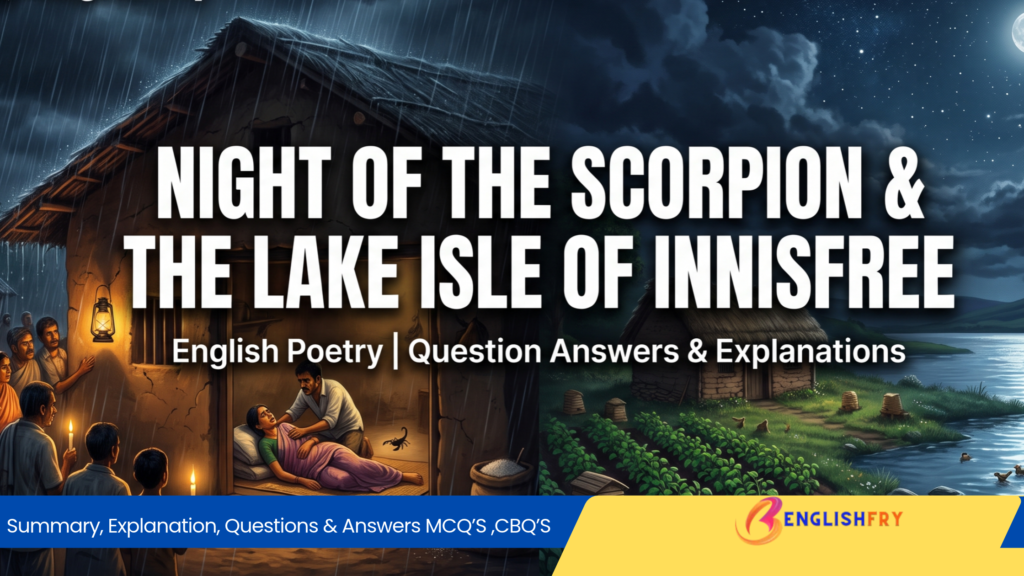
Introduction. Good morning, class. Today we study one of the most loved poems in Indian English literature. Nissim Ezekiel was born in Mumbai into a Bene Israel Jewish family and is regarded as one of the founding figures of modern Indian English poetry. The poem was published in 1965 in his collection The Exact Name, and it is narrated in the first person by a speaker who remembers a frightening night from childhood. Note that the chapter number differs between guides (some say 6, some say 11), so follow your own textbook. The poem is a narrative poem. It tells a story, but in a way that makes us think about faith, reason, community and a mother’s love.
The story of the poem. The poem opens on a dark, rainy night. A scorpion has been hiding under a sack of rice, driven there by the rain. It stings the speaker’s mother and then disappears. As the news spreads, the neighbours rush in. The poet compares them to swarms of flies, a simile that shows how many people arrive and how restless and noisy they are. They search for the scorpion with candles and lanterns, and the flickering light throws huge, frightening shadows on the walls. They cannot find the creature. Meanwhile the mother lies on the floor, twisting in pain and groaning.
The villagers’ beliefs. This is the heart of the poem. The villagers do not offer medicine. They offer explanations. They say that each movement of the scorpion sends its poison further through the mother’s blood. So they pray and chant the name of God, hoping to keep the scorpion still. They comfort her with the idea that the pain will burn away her sins from a past life and reduce her suffering in the next. They also say that this suffering is a good thing, because it will purify her. A holy man arrives and performs his rites, even using fire on the bitten toe. In this way the poem gives us a small picture of Indian village society, with its warmth, its crowd, its ritual and its superstition.
The father and the clash of attitudes. The father stands apart from the crowd. He is described as a rational, sceptical man who does not share the villagers’ faith. Yet, when his wife is in danger, he does everything he can. He tries powders, mixtures and herbs. The poem shows a father who is willing to put aside his own beliefs for the sake of his wife, so that rationality and tradition seem to work side by side. This contrast between faith and reason is one of the poem’s central tensions, and the poet does not tell us which is right. He simply shows both with sympathy. As one study note puts it, the central theme is the understanding of human faith and superstition in the face of adversity.
The ending. After about twenty hours, the poison loses its power and the mother recovers. Then she says something simple and moving: she thanks God that the scorpion picked on her and spared her children. This is the emotional turning point. After a long night of rituals, prayers, arguments and explanations, the poem ends not with a victory of faith or reason but with a mother’s selfless love. She has suffered terribly, yet her first thought is for her children. The final lines shift the focus from fear and ritual to parental love, which gives the poem its lasting emotional weight. This is why the poem stays in the memory.
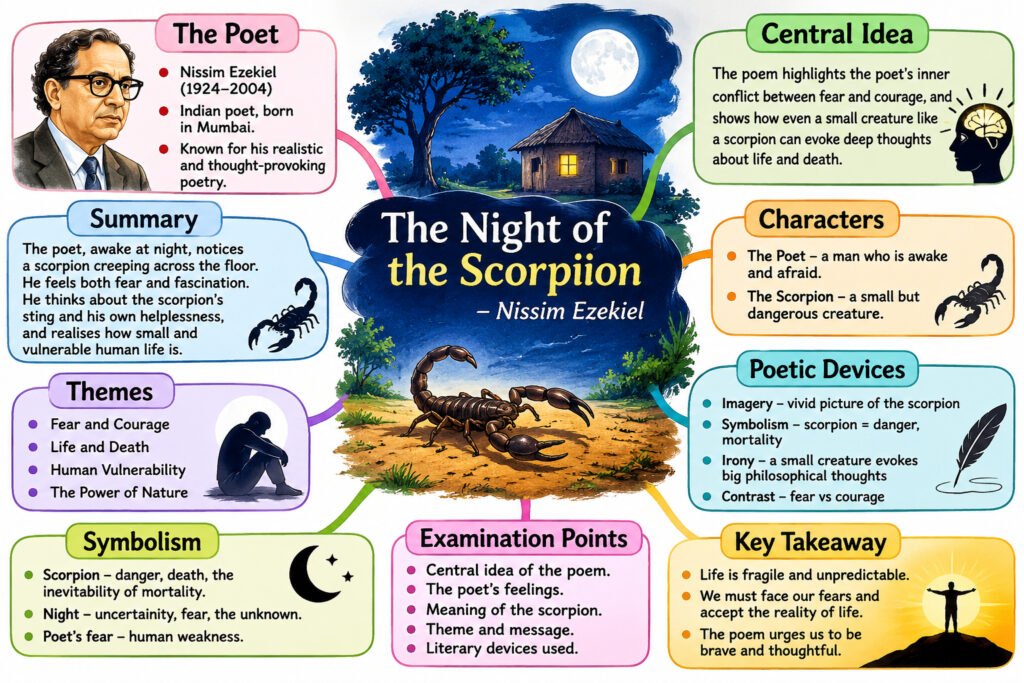
Poetic devices. For your exam, note these techniques. The poem is written in free verse, with no fixed rhyme scheme, so it reads like natural speech. It is rich in imagery, especially of light and darkness, and of shadows that grow large on the walls. There are similes (the neighbours like flies) and personification (the scorpion treated almost as an evil force). The poet uses irony because the crowd, who want to help, bring noise and confusion, while the one who suffers shows the greatest calm and love. The tone is calm and almost observational, as though a grown-up speaker is recalling the night from a distance. The speaker is a child at the time, which lets the poet describe events simply, without judging anyone.
Themes. To summarise the themes: first, the conflict between faith and reason; second, superstition and the human wish to find meaning in pain; third, the strength of community in a crisis, even when its remedies are unscientific; and fourth, and most important, a mother’s selfless love. This last theme gives the poem its heart.
Conclusion. “Night of the Scorpion” is a short poem with a long reach. It begins as a small incident in a village hut. By the end it becomes a reflection on how people face pain and fear, and on how a mother’s love stands above all explanations. When you write your answers, remember this sequence: the sting, the crowd, the rituals, the father, the recovery and the mother’s words.

Table of Contents
ToggleA Answer the following questions.
Ans:The poet remembers the night his mother was stung by a scorpion, which bit the mother because of its predatory impulse, while hiding beneath a bag of rice to escape from the rain.
Ans:They uttered the name of the God to paralyze the Evil One that had entered the mother's body.
Ans:The peasants of the village believe in Karma theory. They believe that the sins committed in the previous birth will be purified if only the concerned person suffers in this birth. They say that the mother’s suffering by the scorpion burns away her sins in the previous birth.
Ans:The father was a sceptic. He was a rationalist. So he did not compromise with the beliefs of the villagers. He applied different kinds of medicinal herbs and a certain curative powder. He also melted paraffin and poured it on the bitten toe and set fire to it. The father tested every scientific way to find the recovery. After twenty hours, the mother was saved. Again the writer keeps a neutral position. He doesn’t say whether the father’s treatment cured the mother or the belief and rites of the villagers.
Ans:The mother found recovery after 20 hours of treatment. We don’t know whether the father’s treatment cured the mother or the belief and rites of the villagers. But the poet implies that it is the mother’s love for her children that saved her. She thanks God because the scorpion has bitten her, not her children.
Ans:The key theme of "Night of the Scorpion" is community, as demonstrated through the selfless dedication of the hordes of villagers who spend their time praying over the woman who has been stung by a scorpion.
Ans:Ten hours' of steady rain had filled the scorpion's hiding place with water; saving its life it hid under the sack of rice in the kitchen. When the poet's mother went to the kitchen, it accidentally stung her.
Ans:The scorpion parted with its poison by stinging the toe of the poet's mother, thus injecting its poison into her veins.
Ans:The comparison is the poet’s expression of discontent with the peasants. He hated them because they made the night a hell for him, his father and most importantly, for his mother.
Ans:The Evil One is the scorpion that stung the poet's mother. It is considered Evil because the people associated the sting of scorpions with that of the evil power.
Ans:Though the peasants meant good and swarmed around the poet’s house to help the family and the victim of the sting, their actions and intentions brought endless pain to the poet’s mother.
B Explain the following statements with reference to their context.
Ans:"He" refers to the scorpion. He came inside the house to seek protection and shelter from the rain. He hid himself beneath a sack of rice. The sting of the scorpion's tail caused much pain to the poet's mother. He is therefore calling its tail diabolic or devilish. The poem starts with the reminiscence of a terrible event in the childhood of the poet when his mother was stung by a scorpion. This incident in retrospect brings forth the poet’s gall of criticism against the irrationality of the average uneducated person. The poet brings out the unavoidable circumstance in which the insect had come into contact with the mother. The rains had flooded the nests of the insect and thus to save itself it hid under a sack of rice. When the mother had gone there to fetch rice the insect afraid of its life had stung the mother in self-defense. The sting was quick and the insect ran away but the news brought more nuisances in the form of the peasants.
Ans:"They" in the above passage refers to the villagers. They attributed the mother's sufferings to her sins in some previous birth. They said that her present suffering would burn away her sins of her previous birth. They thought that the poison in the mother's blood moved swiftly as the scorpion moved. They, therefore wanted the scorpion to sit still. These peasants who were uneducated village folk could do nothing but to make a tiny incident snowball into a big issue where these people found fertile ground to propound their stupid superstitions. Some people said that the more the scorpion moves the quicker the poison will spread in the body of the victim. In fact, the villagers actually take their candles and lanterns to search for the Scorpion. From this absolutely foolish assumption, the people soon moved onto philosophy where in the metaphysical scale of universe acts of redemption balances sins.
Ans:The scorpion had stung the mother on her toe and thus the poison entered the mother's body. The villagers hoped that the poison would purify the mother's body of desire and her spirit of ambition. These peasants who were uneducated village folk could do nothing but to make a tiny incident snowball into a big issue where these people found fertile ground to propound their stupid superstitions. Some people said that the more the scorpion moves the quicker the poison will spread in the body of the victim. In fact, the villagers actually take their candles and lanterns to search for the Scorpion. From this absolutely foolish assumption, the people soon moved onto philosophy where in the metaphysical scale of universe acts of redemption balances sins. Although the villagers were sad to see the mother suffering, the understanding that it was doing some good to both her body and her spirit - brought peace on their faces.
Ans:Although the poet's father was a sceptic and rationalist, he was too grieved with the mother's situation to think practically. So, he tried whatever anyone around suggested to him which would help to relieve the mother's pain and suffering. It shows that during a crisis, human beings will do anything suggested to them, by others, to help them overcome the crisis. The people wax more philosophy by saying that the sufferings of this birth would mitigate the sufferings of the next. According to them, pain is directly proportional to the sins of the past life and inversely proportional to coming life. While the mother was in mortal pain some people pretended to understand her pain and do nothing. But the father was very much a rational man who instead of taking the mother to a doctor actually tries various herbs and medicines to get rid of the poison. In fact, he burns the toe of the mother. Yet all the all patient earth she forebears and to our amazement thanks the heavens since it was her that was stung and not her children. The father put a little paraffin upon the bitten toe and put a match to it (lit it) because it was thought that it would burn the poison of the wound.
Ans:"I" here is the poet who is the narrator. "The flame" probably reminds the poet of the funeral or burning or cremation of a dead body according to funeral rites. In it, the dead body is consigned to flames. So the burning of the mother's toe, probably reminds the poet of that. After twenty hours of suffering in pain, the poison finally subsided, and the mother got relief. While the mother was in mortal pain some people pretended to understand her pain and do nothing. But the father was very much a rational man who instead of taking the mother to a doctor actually tries various herbs and medicines to get rid of the poison. In fact, he burns the toe of the mother. Yet all the all patient earth she forebears and to our amazement thanks the heavens since it was her that was stung and not her children.
C Answer the following questions.
Ans:The father is logical and scientific in his thinking and does not believe in superstitions and blind beliefs. Yet when his wife is bitten by the scorpion he is anything but logical. He tries out every curse and blessing, every possible antidote. He summons the holy man to perform his rites and even pours paraffin on the bitten to and ignites it. The mother suffers the bite of the scorpion. She groans and moans on the mat twisting and turning in pain. As soon as the poison loses its effect she thanks god for sparing her children. She epitomizes motherhood and like a typical Indian mother is selfless in her love for her children.
Ans:The theme of the poem is presented through an incident in which the poet's mother is bitten by a scorpion on rainy night. The villagers on hearing of this unfortunate event come to see her, praying to god and giving all kinds of justifications for her suffering. With their prayers and words they try to console the victim. The victim’s husband who is otherwise a sceptic and a rationalist also gives in to every curse and blessing. The poem shows how when a critical situation arises, human beings are always willing to help one another. Common villagers show their simplicity and sympathy; though they are not of much help, and give in to superstitions and false beliefs, they try to help out. The father, though a sceptic and rationalist in normal circumstances, yet in this moment of crisis, he gives in to the villagers' advice. The mother bears the pain and suffering for twenty hours, writhing in pain and when she recovers, she is thankful that she was bitten and not her children, bringing out the maternal love of a mother for her children.
Ans:The peasants believed that the suffering would cleanse some of her sins of the poet birth or of the next birth. With her suffering the balance of evil in this world would be reduced. It would cleanse her soul and kill the spirit of desire which is the root cause of suffering in the world. The hunt that the peasants embark on in an effort to find the scorpion. They search with both candles and lanterns, which throw shadows on the wall in the shape of a scorpion. This image of the scorpion still being in the room (only in the form of shadow) helps set the scene for the next lines as the peasants struggle to help the mother. The shadow is representative of their primitive fears, that something Evil is lurking just where they cannot see it. The search for the scorpion has failed, they do not know, as the reader does, that the scorpion fled the house at the beginning of the poem. This puts the reader in a position above those in the poem; he/she has a greater knowledge of the situation than those experiencing it.
Ans:Here Nissim Ezekiel in his poem night of the Scorpion, depicts a are very tender situation of every Indian family. But though dealing with a very sensitive theme - the theme of the speaker's mother, stung by a Scorpion, is given multiple treatment, bringing in its sweep the world of magic and superstition, science and rationality and above all material affection. He deliberately withholds his own emotional colouring and this he does only to make us aware, while reading the poem, of a traditional world of superstitions as against another of scepticism and rationalism.
Ans:The poem "Night of the Scorpion by Nissim Ezekiel depicts the selflessness and unconditional love of a mother who is stung by a scorpion. It also explains the care and affection of the villagers and their efforts to comfort the pain of the mother. In the poem poet tells about the love of a mother for her children. He depicts the love in a very aesthetic way. The poet tells that once a mother was bite by a scorpion due to which was in the pain but she was still very happy that her child was not bite by the scorpion. After hearing the news about it the people gathered and search for the scorpion but did not find it. In the end poet tells about the views of the about mother's suffering of people. Everyone had the own opinion. The poet shows that the love of a mother is countless no matter what happens and a mother never think twice if she has to face situation like this. This poem shows the value of the love in the world.
D The Lake Isle of Innisfree — Short Answer Questions
Ans:The poet wants to go to Innisfree. He wants to grow nine rows of beans there and have a hive for honeybee. He wishes to enjoy peaceful moments at Innisfree.
Ans:The poet is fascinated by the beauty and peace at Innisfree. He finds it an ideal place. He shall hear the lake water lapping the shore with low sounds. At night, he shall look and enjoy the glimmer. He shall enjoy seeing the moon glow purple. His stay at Innisfree will be joyful.
Ans:The poet wants to go to Innisfree, an ideal peaceful island. He celebrates the beauty of the place. The expression, “I hear the lake water lapping with sounds by shore” describes the beautiful natural environment in Isle of Innisfree.
Ans:The poet is far away from the Island of Innisfree in London. He hears the lake water lapping the shore with low sounds in his heart’s core.
Ans:The poet would enjoy his mornings, evenings, and midnights in the lap of nature. The midnight would look glimmering like the glowing of the glowworms and stars. He would enjoy his evenings watching the colourful wings of the flying linnets.
E The Lake Isle of Innisfree — Long Answer Questions
Ans:The poet’s desire to return to a peaceful, quiet, and natural place, away from the bustle of urban life, brings forth the governing positive value of his life. He emerges as a peace-loving fellow who is sick of the hectic, restless, noisy, and materialistic life of the cities. His strong nostalgia for the beautiful sights and sounds on Lake Isle and his desire to lead a simple life of unbroken solitude and peace on the island reveals the simplicity of his heart and mind.
He can hear the sounds of the bees, the cricket, the linnet, and the sea waves. He can visualise the tranquil glade, the glimmering light of midnight, and the purple glow of the afternoon. He can also hear the loud, unpleasant sounds of the traffic in cities and contrast it with the captivating and soothing music of the waves.
Further, the poet lacks a materialistic attitude towards life. He wants to evade the hectic activities of the materialistic life of the cities and live in a small cabin of clay and wattles. He wants to have only enough to fulfil the basic needs of life. Thus, the poet comes forth as a person with a profound imagination, minute observation, strong memories, and a deep love for nature. He is inspired by the value of contentment and harmony.
Ans:The Isle of Innisfree is a tiny uninhabited island within Lake Lough Gill in County Sligo in northwestern Ireland. The poet, William Butler Yeats, spent his summers over here when he was a young boy. The calm, quiet, soothing environment of this isle impressed him so much that he developed a spiritual kinship with this place. He can now hear voices calling within himself just as he heard the sounds of nature in Innisfree.
The existence of Innisfree as the poet’s state of mind is as true as the real Innisfree. The images of this place haunt the poet in such a manner that he can visualize everything not in his mind but in his heart. The real place has given him such beautiful memories that he cherishes them even when he is amidst the roadways and pavements of a city. His desire to escape to Innisfree is so strong that his thoughts are overpowered by it. Thus, Innisfree is the poet’s state of mind itself which stands as a symbol of peaceful existence amidst nature.

Founder of Englishfry.com, a captivating and knowledge-driven blog & Founder of Android app/website Studyfunnel.com, an online Mock Test Series Portal. With a wealth of experience spanning over 20+ years, he has excelled as an Ex-Asst.Professor, Teacher, Amazon published author, Website Developer, Graphic Designer,Blogger,Poet, and Creative academic content writer publisher of 4 academic books available Online on Amazon & Flipkart.Internationally Certified as the World’s Top 100 admired Educator 2021 by theexcelligent.com,National Award recipient-Golden Quill award for Best English educator 2024,Receipent of Indian Literature Award 2026.His tryst in Literature helped him realize his love for writing and telling stories. A tech-savvy language nerd by day and, a passionate writer by night, he now translates his experiences into tales of wisdom served with a side of humor.His widely recognized profound insights ,captivating writing style of weaving words make him contribute to prestigious publications and a sought-after authority in the field that transport readers to extraordinary worlds.