
Table of Contents
ToggleIntroduction
In the CBSE Class 10 English curriculum (First Flight), poetry plays a massive role in testing a student’s analytical and analytical thinking skills. One of the most beautiful and deeply moving poems in this syllabus is “A Tiger in the Zoo” composed by the acclaimed poet Leslie Norris.
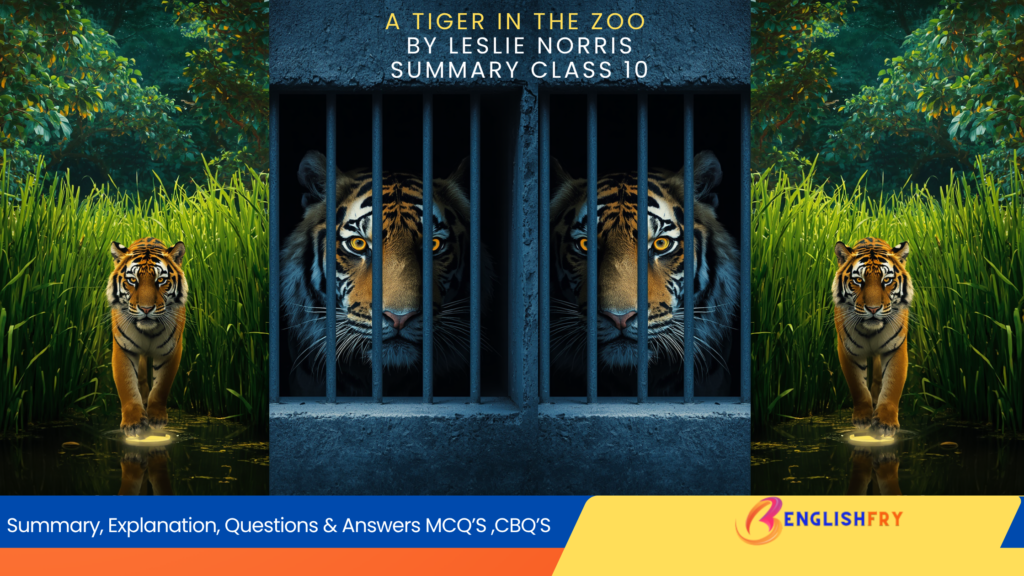
This poem serves as a powerful critique of human cruelty and the commercial exploitation of wildlife. By shifting the setting back and forth between a cramped enclosure and a wild forest, the poet highlights the agonizing contrast between a life of forced captivity and a life of absolute freedom.
For a Class 10 student aiming to score full marks in the 2026 board examinations, understanding the subtle emotional shifts and literary patterns of this poem is essential. This master guide on EnglishFry.com gives you everything you need—from summaries and translations to competency-based questions—to ace your literature section.
About the Author: Leslie Norris
-
Full Name: George Leslie Norris (1921–2006)
-
Nationality: Welsh (Born in Merthyr Tydfil, Wales)
-
Writing Style: Highly descriptive, lyrical, and deeply rooted in nature. He often focuses on the striking sensory details of the natural environment and the emotional worlds of animals.
-
Literary Significance: Norris was a prize-winning poet and short-story writer. His works are taught worldwide due to their profound humanitarian themes, simple vocabulary, and ability to evoke strong empathy for animals stripped of their natural rights.
Core Structural Shift: Zoo vs. Jungle
Before diving into the text, a student must understand the structural blueprint of the poem. Leslie Norris uses a cyclical structural pattern that moves the reader back and forth between two opposing worlds:
  ┌─────────────────────────────────────────────────────────────┐
  │                 POETIC SETTING ROTATION MAP                 │
  ├─────────────────────────────────────────────────────────────┤
  │  • Stanza 1: The Zoo Enclosure (Captivity)                  │
  │  • Stanza 2: The Wild Jungle / Water Hole (Freedom)         │
  │  • Stanza 3: The Jungle Edge / Village Boundary (Freedom)   │
  │  • Stanza 4: The Concrete Cell Enclosure (Captivity)        │
  │  • Stanza 5: The Zoo at Night Enclosure (Captivity)         │
  └─────────────────────────────────────────────────────────────┘
Full Summary of A Tiger in the Zoo
Easy Summary in English
The poem “A Tiger in the Zoo” presents a pathetic picture of a majestic tiger confined within a small concrete cage in a zoo. The poet contrasts this miserable state with the magnificent life the tiger would have led if he were free in his natural habitat. In the cage, the apex predator can take only a few steps. His immense power is locked behind iron bars, and he spends his days helplessly ignoring the crowds of arriving tourists.
Conversely, in the wild forest, the tiger would be a symbol of untamed strength—lurking in the shadows of long grass, hunting plump deer near water bodies, and terrorizing nearby villages with his sharp claws and fangs. The poem closes with a tragic image: at night, the captive tiger listens to the artificial noise of patrolling police cars, staring blankly at the shining stars, trapped forever in a world that does not belong to him.

Summary in Hindi (हिंदी अनुवाद)
यह कविता एक चिड़ियाघर के पिंजरे में बंद बाघ की दयनीय स्थिति की तुलना उसके प्राकृतिक जंगल के जीवन से करती है। पिंजरे में बाघ बेहद मजबूर है, उसकी ताकत सलाखों के पीछे कैद है और वह शांत गुस्से में अपने छोटे से पिंजरे में कुछ कदम ही चल पाता है। कवि कहते हैं कि यदि यह बाघ आज़ाद होता, तो वह जंगल में घनी घास के पीछे छिपकर पानी के स्रोत के पास मोटे हिरणों का शिकार कर रहा होता और अपनी दहाड़ से गाँव वालों को डरा रहा होता। लेकिन वास्तविकता में, वह एक कंक्रीट की कोठरी में बंद है, जहाँ रात को वह गश्त लगाने वाली गाड़ियों की आवाज़ सुनता है और बेबसी से अपनी चमकदार आँखों से आसमान के तारों को देखता है।
Summary in Assamese (অসমীয়া অনুবাদ)
‘এ টাইগাৰ ইন দা জু’ কবিতাটিত চিৰিয়াখানাৰ এটা সংকীৰ্ণ সঁজাত আবদ্ধ হৈ থকা এটা বাঘৰ কৰুণ অৱস্থাৰ কথা বৰ্ণনা কৰা হৈছে আৰু তাৰ সৈতে মুক্ত অৰণ্যৰ স্বাভাৱিক জীৱনৰ তুলনা কৰা হৈছে। সঁজাত বাঘটো অত্যন্ত অসহায়, তাৰ অপৰিসীম শক্তি লোৰ শলাখাৰ পিছত বন্দী হৈ আছে। সি কেৱল শান্ত খঙেৰে সঁজাটোৰ ভিতৰতে কেইখোজমান খোজ কাঢ়িব পাৰে। কবিৰ মতে, বাঘটো যদি মুক্ত হ’লহেঁতেন, তেন্তে সি অৰণ্যৰ ওখ ঘাঁহৰ আঁৰত লুকাই থাকি পানীৰ উৎসৰ ওচৰত হৰিণা চিকাৰ কৰিলেহেঁতেন। কিন্তু বাস্তৱত সি এটা কংক্ৰীটৰ কোঠাত আৱদ্ধ হৈ আছে, য’ত নিশাটো সি পহলীবাকী গাড়ীৰ শব্দ শুনে আৰু অসহায়ভাৱে নিজৰ উজ্জ্বল চকুৰে আকাশৰ তৰাবোৰলৈ চাই ৰয়।

Line-by-Line Detailed Explanation
Stanza 1: The Captive Enclosure
He stalks in his vivid stripes
The few steps of his cage,
On pads of velvet quiet,
In his quiet rage.
Explanation: The poem opens inside the zoo. The tiger possesses bright, distinct colorful stripes on his skin. However, his majestic movement is restricted to just a few short steps because the cage is incredibly small. His paws are as soft as premium velvet, meaning his movements make absolutely no sound. The tiger is consumed by an intense, burning anger (“rage”), but he is forced to keep it suppressed (“quiet”) because he knows he is completely powerless against his stone enclosure.
Sliding Stanza 2: The Ideal Jungle Habitat
He should be lurking in shadow,
through long grass
Near the water hole
Where plump deer pass.
Explanation: The poet instantly shifts our focus to the wild jungle. If the tiger were free, he would not be walking on artificial floors. Instead, he would be hiding safely (“lurking”) in the dark shadows of trees, moving silently and smoothly (“sliding”) through the tall natural grass. He would position himself strategically near a freshwater source (“water hole”), patiently waiting to ambush fat, healthy (“plump”) deer for his food. This is his true, natural role as an apex predator.
Stanza 3: The Wild Boundary
He should be snarling around houses
At the jungle’s edge,
Baring his white fangs, his claws,
Terrorising the village!
Explanation: Continuing the vision of freedom, the poet states that the tiger would move along the boundary lines where the wild forest meets human settlements (“jungle’s edge”). He would show his untamed dominance by warning people with aggressive low growls (“snarling”). By showing off his sharp white teeth (“fangs”) and deadly nails (“claws”), he would maintain natural boundaries, creating a sense of awe and terror among the villagers. The poet implies that the tiger does not hunt humans out of malice; he simply asserts his majestic authority.
Stanza 4: The Harsh Reality
But he’s locked in a concrete cell,
His strength behind bars,
Stalking the length of his cage,
Ignoring visitors.
Explanation: The word “But” shatters the dream of freedom and brings the reader back to reality. The tiger is trapped inside a heavy, solid room made of bricks and cement (“concrete cell”). His massive physical strength is completely useless because it is trapped behind iron rods. He slowly paces back and forth along the limited length of his enclosure. He completely ignores the noisy human tourists (“visitors”) who come to look at him, viewing them as unfeeling creatures who enjoy his captivity.
Stanza 5: The Lonely Night
He hears the last voice at night,
The patrolling cars,
And stares with his brilliant eyes
At the brilliant stars.
Explanation: The final stanza depicts the absolute loneliness of the animal at the close of the day. Late at night, the tiger does not hear the sounds of the jungle. Instead, he hears the artificial sirens of the zoo security vehicles (“patrolling cars”). Left alone with his thoughts, he uses his glowing, beautiful (“brilliant”) eyes to look up at the shining (“brilliant”) stars in the sky. This final look represents a silent, unspoken prayer for freedom, connecting his trapped soul to the infinite, free universe above.
Themes & Messages
The Inherent Value of Liberty: The central theme of the poem is that freedom is a fundamental right for all living beings. No amount of regular food or safety inside a zoo can compensate for the loss of one’s natural environment.
Human Cruelty and Commercialization: The poem exposes how humanity locks up majestic wild animals in unnatural settings simply for entertainment and profit, completely disregarding their emotional and physical well-being.
The Broken Eco-Chain: By showing what the tiger should be doing (hunting deer, roaming the forest), Norris reminds us that caging predators disrupts the natural ecological balance.
Literary Devices Master Directory
To score high marks on extract questions, memorize these specific figures of speech used by Leslie Norris:
Personification: The poet consistently uses the personal pronoun “He” instead of “It” to refer to the tiger. This gives the animal human-like dignity, emotions, and consciousness.
Oxymoron: The use of two completely contradictory words side-by-side.
Example: “Quiet rage” (Rage is usually loud, but here it is suppressed).
Metaphor: A direct comparison without using ‘like’ or ‘as’.
Example: “Pads of velvet” (The tiger’s paws are directly compared to soft velvet fabric).
Imagery: Vivid descriptive language that helps the reader visualize a scene.
Visual Imagery: “Vivid stripes”, “concrete cell”, “brilliant stars”.
Auditory Imagery: “Snarling around houses”, “hears the last voice”.
Enjambment: When a sentence continues into the next line without any punctuation mark at the end.
Example: “Sliding through long grass / Near the water hole…”
Rhyme Scheme: The poem follows a highly consistent ABCB rhyme scheme across all five stanzas (e.g., cage/rage, grass/pass, edge/village, bars/visitors, cars/stars).
Word Meanings & Vocabulary-Building Section
Stalks (Verb): To move silently, slowly, and menacingly up to someone or something.
Sentence: “The majestic predator stalks along the perimeter of its boundary.”
Vivid (Adjective): Producing powerful, exceptionally bright, or clear impressions in the mind.
Sentence: “The tiger’s fur boasts vivid yellow and black markings.”
Lurk (Verb): To remain hidden, waiting in ambush for a target.
Sentence: “Crocodiles often lurk just beneath the surface of the river water.”
Snarling (Verb): Making an aggressive, warning growl while showing teeth.
Sentence: “The guard dog started snarling as soon as the stranger neared the gate.”
Fangs (Noun): Large, sharp, prominent teeth used by predators to tear meat.
Sentence: “The viper bared its venomous fangs when it felt cornered.”
Comprehensive Textual Questions & Answers
Q1. What does the phrase “quiet rage” signify about the tiger’s state of mind inside the enclosure?
Answer: The phrase “quiet rage” is a powerful oxymoron that perfectly captures the tiger’s trapped mental state. The word “rage” indicates that the tiger is incredibly angry about being locked up, as his predatory nature longs to run free. However, this anger is “quiet” because he is completely helpless against the solid concrete walls and iron bars of his cage. He suppresses his fury because he realizes that showing aggression toward visitors will not break his confinement.
Q2. Contrast the type of sounds the tiger hears during the day and night inside the zoo.
Answer: During the daytime, the tiger’s environment is filled with the unfeeling, chaotic noises of human tourists and visitors who arrive to look at him as an entertainment object. The tiger shows his disapproval by completely ignoring them. In contrast, at late night, the human voices fade away, and he hears the mechanical, sharp sirens of the zoo’s patrolling security cars. This sound emphasizes his complete isolation from the natural world.
Extra Important & Competency-Based Questions
Q1. Read the following extract and answer the question that follows:
“He should be snarling around houses
At the jungle’s edge,
Baring his white fangs, his claws,
Terrorising the village!”
An environment analyst argues that the tiger’s presence at the ‘jungle’s edge’ is a direct result of human expansion. Explain how Leslie Norris uses these lines to hint at the real-world issue of man-animal conflict.
Answer:
Leslie Norris uses this stanza as an intelligent commentary on human encroachment and the resulting man-animal conflict. By stating that the tiger is snarling around houses at the “jungle’s edge,” the poet hints that human civilization has expanded right up to the borders of natural forest reserves.
When humans clear forest land for agriculture and houses, they shrink the tiger’s hunting grounds. The tiger does not enter villages out of malicious intent to harm humans; he is simply moving through his natural boundary zone. His snarling and baring of fangs serve as a warning to protect his territory, reminding readers that humanity’s constant expansion forces wild animals into dangerous proximity with human settlements.
Extra Short Answer Questions (20–30 Words)
Q1. What does the poet mean by “vivid stripes”?
Answer: The phrase refers to the bright, clear, and strikingly intense yellow and black lines on the tiger’s body. These stripes make him look exceptionally majestic and visible, creating a sharp contrast with the dull, gray concrete walls of his cage.
Q2. Why are the tiger’s paws described as “pads of velvet quiet”?
Answer: The poet uses a metaphor comparing the tiger’s paws to soft velvet. This texture ensures that his heavy footsteps are completely silent, emphasizing his inability to make his powerful presence felt inside the limited space of the cage.
Q3. Where should the tiger be lurking according to the poet, and why?
Answer: The tiger should be hiding in the dark shadows near a freshwater source (water hole) in the jungle. He belongs there to smoothly slide through the long grass and hunt healthy deer that pass by for food.
Q4. What is the significance of the “last voice” heard by the tiger?
Answer: The “last voice” refers to the mechanical sound of the zoo’s patrolling security cars late at night. This voice highlights the tiger’s complete isolation from nature and confirms that he is under constant human surveillance even in darkness.
Q5. Why does the tiger stare at the stars?
Answer: The tiger stares at the brilliant stars because they are free and unconfined, just like he longs to be. It shows a silent, emotional connection between his trapped soul and the vastness of the natural universe.
Short Answer Questions (40–50 Words)
Q1. How does the poem contrast the freedom of a tiger with his captivity?
Answer: The poem presents a sharp contrast by shifting settings. In captivity, the tiger is locked in a concrete cell, his immense strength is useless behind iron bars, and he can only take a few footsteps. In total freedom, he would roam the vast jungle, hunt deer near the water hole, growl around houses, and assert his natural dominance over the entire landscape.
Q2. Describe the irony presented in the fourth stanza of the poem.
Answer: The irony lies in the fact that one of the most powerful and terrifying apex predators on Earth is locked helplessly inside a small concrete room. His immense natural strength is locked behind fragile iron bars, rendering him so weak and small that he has no choice but to completely ignore the human visitors he would otherwise terrify.
Q3. What message is Leslie Norris trying to convey through the tiger’s attitude toward the visitors?
Answer: By showing that the tiger completely ignores the tourists, the poet conveys that the animal feels deep contempt and apathy toward humanity. He views the visitors as cruel, unsympathetic creatures who treat his suffering and loss of freedom as a source of cheap entertainment.
Q4. Explain the poetic device used in the line “In his quiet rage”.
Answer: The poetic device used is an Oxymoron, where two contradictory terms, “quiet” and “rage,” are placed side by side. It highlights that the tiger is furious about his confinement, but because he is completely trapped, he cannot express his anger out loud, forcing him to keep it entirely suppressed inside.
Competency-Based & Analytical Questions (Class 10 Board Pattern)
Q1. Read the following line from the poem:
“He should be snarling around houses at the jungle’s edge…”
An animal behaviorist notes: “A predator near human territory is a cry for space, not a declaration of war.” Evaluate how the poet uses the tiger’s movement at the forest boundary to support this perspective.
Answer:
Leslie Norris uses the third stanza to illustrate that the tiger’s presence at the “jungle’s edge” is a natural assertion of his territory rather than an act of unprovoked aggression against humans. The tiger is growling around houses that are built right on the boundary lines of his forest.
This behavior highlights that human civilization has expanded into wild habitats, shrinking the tiger’s home. The tiger bared his fangs and claws to create natural boundaries and warn humans to stay back, keeping the ecological balance intact. The poet proves that when the predator is given his rightful space in the wild, he naturally avoids entering human areas to cause harm.
Q2. Analyze the use of the word “brilliant” twice in the final lines of the poem. How does this repetition enhance the emotional impact of the climax?
Answer:
The repetition of the word “brilliant” to describe both the tiger’s eyes and the stars is an intentional poetic device used to create a deep emotional contrast.
The “brilliant eyes” represent the tiger’s intact pride, sharp intelligence, and untamed spirit, which human bars have failed to crush.
The “brilliant stars” represent the vast, beautifully free, and untamed natural universe.
By connecting his glowing eyes to the shining stars, the poet shows that the captive tiger finds his only true comfort in looking at a free world. The repetition emphasizes his silent longing to break away from the artificial zoo and merge back into the beautiful freedom of the natural world.
Q3. Read the two extract descriptions below:
Extract A: Stalking the length of his cage, ignoring visitors.
Extract B: Baring his white fangs, his claws, terrorising the village!
Contrast the psychological state of the tiger in Extract A with that in Extract B. How does the setting alter his identity?
Answer:
The psychological state of the tiger undergoes a complete transformation based on his physical environment.
In Extract A, the setting is a cramped concrete cage. Here, the tiger’s state of mind is one of absolute helplessness, suppressed anger, and deep depression. His identity as a kingly predator is stripped away, reducing him to a tragic exhibition piece. He becomes completely indifferent to his surroundings, choosing to ignore visitors because he feels utterly powerless.
In Extract B, the setting is the untamed wild at the edge of the forest. Free from human control, the tiger’s psychological state is filled with absolute confidence, pride, and supreme dominance. He actively interacts with his environment by snarling and flashing his fangs. In the wild, his true identity as a majestic ruler of the forest is restored, allowing him to command respect and evoke fear.
Long Answer & Value-Based Questions (100–120 Words)
Q1. “Locking up wild animals in zoos to educate children and promote tourism is an act of systemic cruelty.” Discuss this statement with reference to ‘A Tiger in the Zoo’, highlighting the conflict between human entertainment and animal rights.
Answer:
Introduction: The Price of Entertainment
Leslie Norris’s poem A Tiger in the Zoo serves as a powerful critique of how modern society prioritizes human entertainment over the fundamental rights of wild animals. Zoos are often defended as educational centers, but they hide a harsh reality of emotional distress and physical confinement.
The Core Argument
The poem vividly illustrates that a zoo strips a majestic animal of its natural purpose and dignity. A tiger designed to sprint through long grass and maintain ecological balance is reduced to pacing a few short steps inside a dull concrete cell. His immense physical strength becomes entirely useless behind iron bars.
Captivity replaces his natural instincts with deep depression, forcing him to keep his anger entirely quiet and ignore the daily crowds of tourists. Using living, breathing beings as commercial exhibits teaches humanity a harmful lesson of dominance rather than empathy.
Conclusion
True education lies in understanding that wildlife belongs in its natural environment. Protecting animals means preserving their natural habitats, ensuring that the magnificent rulers of the wild are never turned into helpless prisoners for human amusement.

Founder of Englishfry.com, a captivating and knowledge-driven blog & Founder of Android app/website Studyfunnel.com, an online Mock Test Series Portal. With a wealth of experience spanning over 20+ years, he has excelled as an Ex-Asst.Professor, Teacher, Amazon published author, Website Developer, Graphic Designer,Blogger,Poet, and Creative academic content writer publisher of 4 academic books available Online on Amazon & Flipkart.Internationally Certified as the World’s Top 100 admired Educator 2021 by theexcelligent.com,National Award recipient-Golden Quill award for Best English educator 2024,Receipent of Indian Literature Award 2026.His tryst in Literature helped him realize his love for writing and telling stories. A tech-savvy language nerd by day and, a passionate writer by night, he now translates his experiences into tales of wisdom served with a side of humor.His widely recognized profound insights ,captivating writing style of weaving words make him contribute to prestigious publications and a sought-after authority in the field that transport readers to extraordinary worlds.