Table of Contents
ToggleIntroduction
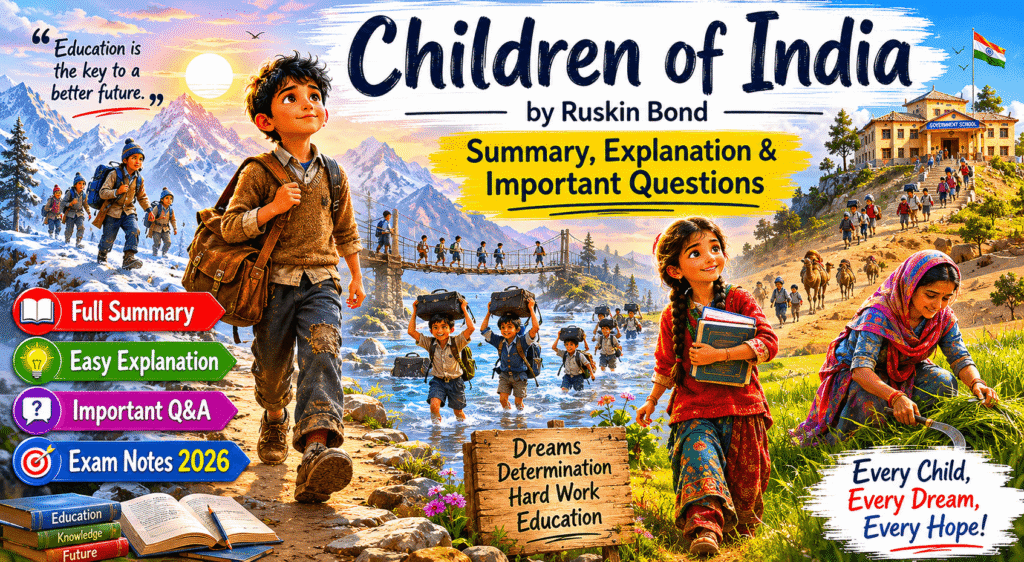
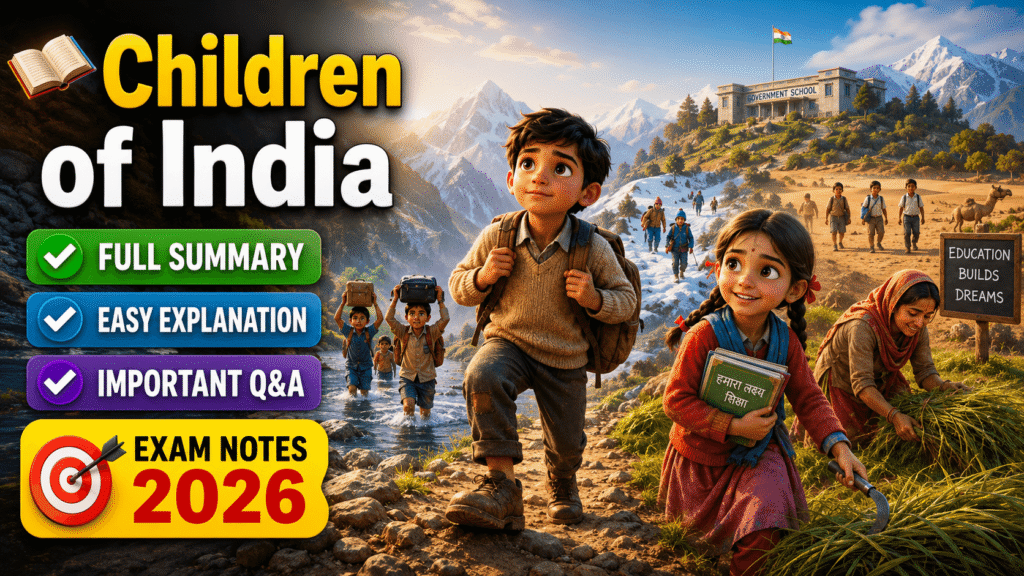
Children of India is an inspiring lesson written by Ruskin Bond. The lesson presents the lives of children living in rural and remote areas of India. Through the experiences of Ranbir, Bindra, and many other children, the author highlights the difficulties they face in reaching school and obtaining an education.
The lesson teaches us that education is valuable and that many children overcome great hardships every day to learn and build a better future.
About the Author – Ruskin Bond
Ruskin Bond is one of India’s most loved writers. He is famous for writing stories about nature, villages, mountains, and ordinary people.
Short Biography
- Born in 1934
- Lives in Landour, Mussoorie
- Known for simple and heart-touching stories
- Recipient of Padma Shri and Padma Bhushan
Writing Style
- Simple language
- Real-life characters
- Strong observation of nature
- Emotional and inspiring storytelling
Children of India Summary (English)
The author sees many children walking to school every day through the hills around Landour.
One such child is Ranbir, a ten-year-old boy who walks nearly four miles from his village to school. He climbs steep mountain paths wearing old shoes that are almost worn out.
Ranbir often brings cucumbers from his father’s field to sell. The money helps him buy books and other necessities. Although his family is poor, they value education.
The author learns that many children in the villages cannot afford expensive private schools and therefore attend government schools with basic facilities.
Ranbir dreams of seeing the world one day. Though he has never seen a train, he often watches airplanes flying overhead. He hopes to buy a plane and travel around the world.
The author also talks about Bindra, a cheerful fourteen-year-old girl. Sometimes she misses school because she helps her mother cut and store grass for cattle before winter.
The lesson further describes the difficulties faced by children in various parts of India. Some cross rivers, some walk through forests, and others travel through deserts and snowy regions.
Despite poor school buildings and limited facilities, children continue to attend school with determination. The author concludes by expressing hope that education will help these children build a brighter future.

बच्चों का भारत (Hindi Summary)
यह पाठ भारत के ग्रामीण बच्चों के जीवन की कठिनाइयों को दर्शाता है।
रणबीर नाम का एक लड़का पहाड़ी रास्तों से कई किलोमीटर पैदल चलकर स्कूल जाता है। उसका परिवार गरीब है, लेकिन शिक्षा को बहुत महत्व देता है।
बिंद्रा नाम की लड़की अपनी माँ की खेती और पशुओं के काम में मदद करती है। फिर भी वह पढ़ाई जारी रखने की कोशिश करती है।
भारत के कई हिस्सों में बच्चों को नदियाँ पार करनी पड़ती हैं, जंगलों से होकर जाना पड़ता है और कठिन मौसम का सामना करना पड़ता है।
लेखक यह संदेश देता है कि कठिनाइयों के बावजूद शिक्षा बच्चों के जीवन को बेहतर बना सकती है।
Children of India Summary in Assamese
এই পাঠটোত ৰাস্কিন বণ্ডে ভাৰতৰ গ্ৰাম্য অঞ্চলৰ শিশুসকলৰ জীৱনৰ কষ্টৰ কথা বৰ্ণনা কৰিছে।
ৰণবীৰ নামৰ এটি ল’ৰাই দূৰ পাহাৰৰ পথ খোজকাঢ়ি বিদ্যালয়লৈ যায়। দৰিদ্ৰ পৰিয়ালৰ সন্তান হ’লেও তেওঁ শিক্ষাৰ মূল্য বুজে।
বিন্দ্ৰা নামৰ ছোৱালীজনীয়ে মাকক ঘৰৰ কামত সহায় কৰে। তথাপিও তাই পঢ়াশুনা অব্যাহত ৰাখিবলৈ চেষ্টা কৰে।
দেশৰ বহু ঠাইত শিশুসকলে নদী পাৰ হৈ, জংঘলৰ মাজেৰে বা কঠিন পৰিৱেশত বিদ্যালয়লৈ যায়।
লেখকে শিক্ষা জীৱন সলনি কৰাৰ এক শক্তিশালী মাধ্যম বুলি বুজাইছে।
Detailed Explanation
Ranbir’s Journey to School
Ranbir walks four miles every day to attend school. The route is steep and difficult. He wears old shoes and comes from a poor family.
This shows his determination and love for education.
Exam Point
Ranbir represents thousands of rural children who struggle daily for education.
Ranbir’s Dreams
Although Ranbir has never seen a train, he watches airplanes flying above the mountains.
When the author tells him that planes can travel across the world, Ranbir becomes excited and dreams of owning a plane one day.
Message
Dreams are not limited by poverty.
Bindra’s Responsibilities
Bindra is a cheerful and confident girl.
She sometimes misses school because she must help her mother collect grass for cattle.
This shows that many girls balance household duties with education.
Children Across India Face Challenges
The author explains that children in different regions face different obstacles:
In Mountain Areas
- Long walks
- Steep roads
- Forest paths
In Desert Areas
- Dust storms
- Extreme heat
In Snowy Areas
- Blizzards
- Cold weather
In River Regions
- Crossing rivers
- Swimming to school
Condition of Schools
Many government schools lack:
- Proper classrooms
- Good roofs
- Adequate facilities
Yet children continue learning.
This reflects their determination and hope.
Character Sketch of Ranbir
Ranbir is a hardworking, cheerful, and ambitious boy. He belongs to a poor family but never complains about his difficult life. Every day he walks several miles through the hills to attend school. He helps his family by selling cucumbers and uses the money for books and other necessities.
Ranbir dreams of travelling around the world someday. His curiosity, determination, and positive attitude make him an inspiring character. He represents millions of rural children who believe that education can change their lives.
Character Sketch of Bindra
Bindra is a confident and responsible fourteen-year-old girl. She helps her family by cutting grass and taking care of household responsibilities. Despite her work at home, she values education.
She is hardworking, cheerful, and mature for her age. Bindra symbolizes the strength and determination of rural girls who overcome social and economic challenges to pursue education.
Themes of the Lesson
1. Importance of Education
Education gives children hope and opportunities.
2. Hard Work
Children work hard to attend school despite difficulties.
3. Dreams and Aspirations
Ranbir’s dream shows that everyone can aim high.
4. Equality
Both boys and girls deserve education.
5. Hope for a Better Future
Education helps build a brighter tomorrow.
Moral of the Lesson
The lesson teaches us that determination and education can overcome poverty and hardship. Every child deserves access to quality education regardless of their background.
Difficult Word Meanings
| Word | Meaning |
|---|---|
| Defiant | Bold and fearless |
| Extrovert | Friendly and outgoing person |
| Trudge | Walk slowly with effort |
| Eerie | Strange and frightening |
| Enchanting | Delightfully charming |
| Blizzard | Severe snowstorm |
| Aloft | High in the air |
| Proliferate | Increase rapidly |
| Hardship | Difficulty or suffering |
| Scruffy | Untidy appearance |

Short Answer Questions
1. Why do the children in the story walk to school?
Answer:
There are no school buses for them. They live in villages and remote hill areas, so they have to walk long distances to reach school.
2. Who is Ranbir?
Answer:
Ranbir is a ten-year-old boy who climbs a mountain every day to attend school. He lives in a village near Landour.
3. How far is Ranbir’s school from his village?
Answer:
His school is about four miles away and nearly two thousand feet below his village.
4. What kind of boy is Ranbir?
Answer:
Ranbir is cheerful, determined, hardworking and hopeful about his future.
5. What does Ranbir dream of doing one day?
Answer:
He dreams of travelling around the world and buying a plane.
6. Who is Bindra?
Answer:
Bindra is a confident and cheerful fourteen-year-old girl who walks to school with her companions.
7. Why was Bindra absent from school for a week?
Answer:
She was helping her mother cut and store grass for the cows before winter.
8. What difficulties do children face while returning home in winter?
Answer:
They often have to walk in darkness through forests where they hear bats, flying foxes and owls.
9. How do the boys overcome their fear in the forest?
Answer:
They walk together and sing loudly on their way home.
10. How do some children in Odisha reach school?
Answer:
They swim or wade across the Dhanei River because there is no bridge.
11. Why do many children attend government schools?
Answer:
Their parents cannot afford expensive private schools.
12. What does the author mean by “Hardship makes brothers of us all”?
Answer:
It means that difficulties bring people together and teach them to help one another.

1.Who did the narrator regularly meet? Where did those people go?
Answer:The narrator regularly met boys and girls from the surrounding villages and the outskirts of the hill station. They were on their way to school every day.
2.What do you know about Ranbir? What kind of life did he lead?
Answer:Ranbir was a cheerful ten-year-old boy who lived in a village near Landour. He walked about four miles and climbed down the mountain every day to attend school. He came in all kinds of weather wearing a pair of cheap shoes that were almost worn out. Though he belonged to a poor family and faced many hardships, he remained determined and hopeful about his future.
3.Why was Bindra not going to school for a week?
Answer:Bindra was not going to school for a week because she was helping her mother cut and store grass for the cows before winter. Since the monsoon had ended, the family needed to save fodder for the winter season.
4.Why did the children need to get home before dark during winters?
Answer:During winters the days became shorter and darkness fell early. The children had to cross forests and difficult paths while returning home. The forests were dark and frightening, with bats, flying foxes, and owls, so they needed to reach home before it got dark.
5.What are the obstacles that children around India face while going to their schools?
Answer:Children across India face many obstacles while going to school. Some have to walk long distances through hills and forests, while others face extreme weather conditions such as dust storms in Rajasthan and blizzards in Ladakh and Kashmir. In some places, children even have to cross rivers because there are no bridges.
6.According to the narrator, why are children going to private schools fortunate?
Answer:According to the narrator, children going to private schools are fortunate because these schools usually provide better facilities, better education, and a more comfortable learning environment. However, only wealthier families can afford them.
7.Why do you think there are no school buses?
Answer:There are no school buses because many villages are located in remote and hilly areas with poor roads and difficult terrain. Providing transportation to such places is often difficult and expensive.
8.How do you think the lack of basic transportation to school affects the academic life of children across India?
Answer:The lack of transportation makes children walk long distances every day, which is tiring and time-consuming. It may cause irregular attendance, lateness, and reduced time for study and rest. Some children may even drop out of school because of these difficulties.
9.Is it fair for the girl to help at home while the boy goes to play? Explain.
Answer:No, it is not fair. Household responsibilities should be shared equally by boys and girls. While Bindra helped her mother cut grass, her brother went to play cricket. Both children should contribute to family work and also have time for education and recreation. Equal responsibilities promote fairness and gender equality.

Founder of Englishfry.com, a captivating and knowledge-driven blog & Founder of Android app/website Studyfunnel.com, an online Mock Test Series Portal. With a wealth of experience spanning over 20+ years, he has excelled as an Ex-Asst.Professor, Teacher, Amazon published author, Website Developer, Graphic Designer,Blogger,Poet, and Creative academic content writer publisher of 4 academic books available Online on Amazon & Flipkart.Internationally Certified as the World’s Top 100 admired Educator 2021 by theexcelligent.com,National Award recipient-Golden Quill award for Best English educator 2024,Receipent of Indian Literature Award 2026.His tryst in Literature helped him realize his love for writing and telling stories. A tech-savvy language nerd by day and, a passionate writer by night, he now translates his experiences into tales of wisdom served with a side of humor.His widely recognized profound insights ,captivating writing style of weaving words make him contribute to prestigious publications and a sought-after authority in the field that transport readers to extraordinary worlds.