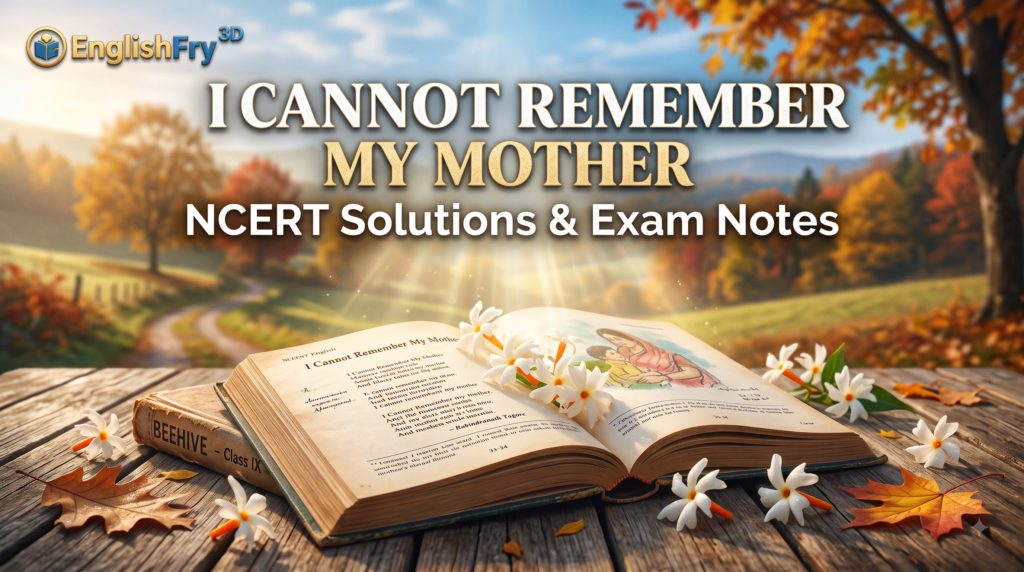
Hello students! Welcome back to EnglishFry. Today, we are tackling the official textbook exercises for Rabindranath Tagore’s deeply moving poem, “I Cannot Remember My Mother.”
Many of you requested the exact answers for the textbook questions you shared. As always, to score the absolute best marks in your CBSE or State Board exams, we must answer these questions using the exact vocabulary and “sensory imagery” found in the poem.
Let us quickly review the summaries and then dive straight into the perfect, keyword-rich narrative answers for your NCERT textbook questions.

Table of Contents
ToggleSummary in English
The poem explores a child’s profound subconscious memory of his deceased mother. The poet states he cannot physically remember her face, yet he feels her presence everywhere through his senses. While playing, a familiar tune seems to hover over his toys, echoing the song she hummed by his cradle. During early autumn, the sweet smell of shiuli flowers floating in the air brings back the divine scent of the temple’s morning service, reminding him of her. Finally, looking into the distant blue sky, he feels the stillness of his mother’s protective gaze watching over him forever.
Summary in Hindi (हिंदी सारांश)
यह कविता एक बच्चे की अपनी मृत माँ की गहरी अवचेतन यादों को दर्शाती है। कवि कहते हैं कि उन्हें अपनी माँ का चेहरा याद नहीं है, लेकिन वह हर जगह अपनी इंद्रियों के माध्यम से उनकी उपस्थिति महसूस करते हैं। खेलते समय, उनके खिलौनों के ऊपर एक जानी-पहचानी धुन मंडराती है, जो उस गीत की याद दिलाती है जो वह पालने के पास गुनगुनाती थीं। शरद ऋतु की शुरुआत में, हवा में तैरती शिउली के फूलों की मीठी महक उन्हें मंदिर की सुबह की पूजा की याद दिलाती है, जो उन्हें माँ का एहसास कराती है। अंत में, दूर नीले आसमान में देखकर, उन्हें महसूस होता है कि उनकी माँ की शांत, रक्षात्मक नज़रें हमेशा उन पर बनी हुई हैं।
Summary in Assamese (অসমীয়া সাৰাংশ)
এই কবিতাটোত এজন শিশুৱে নিজৰ মৃত মাতৃক কেনেদৰে অৱচেতনভাৱে সুঁৱৰিছে, তাক বৰ্ণনা কৰা হৈছে। কবিয়ে কৈছে যে তেওঁ মাকৰ মুখখন মনত পেলাব নোৱাৰে, কিন্তু তেওঁৰ উপস্থিতিক সকলোতে অনুভৱ কৰে। খেলি থকাৰ সময়ত তেওঁৰ পুতলাবোৰৰ ওপৰত এটা পৰিচিত সুৰ ভাঁহি আহে, যিয়ে মাকৰ নিচুকনি গীতৰ কথা মনত পেলাই দিয়ে। শৰৎ কালৰ পুৱা বতাহত ভাঁহি অহা শিউলি ফুলৰ সুগন্ধিয়ে মন্দিৰৰ প্ৰাৰ্থনাৰ পৱিত্ৰ সুবাসলৈ মনত পেলাই দিয়ে, যিয়ে মাকৰ স্মৃতি কঢ়িয়াই আনে। শেষত, দূৰৰ নীলা আকাশখনলৈ চাই তেওঁ অনুভৱ কৰে যে মাকৰ শান্ত, সুৰক্ষাদায়ক দৃষ্টিয়ে তেওঁক সদায় পহৰা দি আছে।

A. Textual & Extra Questions
Q1. What is the emotional impact of the refrain, ‘I cannot remember my mother’? The refrain creates a deep emotional impact of tragic loss and intense longing. By repeating the phrase “I cannot remember my mother” at the very beginning of every stanza, the poet emphasizes his physical separation and childhood grief. However, this line acts as a brilliant emotional contrast to the rest of the stanza. It highlights the beautiful paradox that while his mind has forgotten her physical face, his heart and senses still feel her spiritual presence everywhere in his daily life.
Q2. Interpret the connection between the poet’s mother and the following: (i) shiuli flowers (ii) humming tune.
(i) Shiuli flowers: The poet establishes a deeply spiritual connection between his mother and the shiuli flowers. During the early autumn morning, the distinct “smell of the shiuli flowers floats in the air,” triggering a powerful sensory memory. He equates this pure, natural fragrance to the holy “scent of the morning service in the temple.” By doing this, he elevates his mother’s memory from a simple human bond to a divine and sacred presence in his life.
(ii) Humming tune: The humming tune connects the poet directly to his earliest, most comforting childhood memories of safety and warmth. Even when he is distracted in the “midst of my play,” this familiar, imaginary tune seems to “hover over my playthings.” It serves as a subconscious reminder of the gentle, loving song she used to “hum while rocking my cradle,” proving that her maternal comfort never truly left him.
Q3. What role does nature play in the poet’s description of the memory of his mother? Nature acts as the ultimate, eternal canvas for the poet’s lingering memories of his mother. Because he lost her at such a young age, he subconsciously projects her protective essence onto the vast natural world around him. He feels her physical closeness in the autumn breeze through the “smell of the shiuli flowers.” Furthermore, when he sends his eyes into the “blue of the distant sky,” nature transforms into his mother’s watchful eyes, allowing the “stillness of my mother’s gaze” to protect him from above.
Q4. What can be inferred about the poet’s perception of the mother–child relationship? From this deeply nostalgic poem, it can be inferred that the poet perceives the mother-child relationship as an unbreakable, eternal, and almost divine bond. Even without physical memories or photographs, the child’s subconscious mind vividly retains her love through powerful sensory triggers like smell, sound, and sight. The relationship completely transcends death, showing that a mother’s protective “gaze” and comforting “scent” become a permanent, living part of the child’s universe.
Q5. Why does the poet feel that a tune seems to “hover over my playthings”? The poet feels this because his subconscious mind vividly remembers the warmth of his infancy. Even when he is distracted in the “midst of my play,” his toys trigger a deep emotional memory of safety. The imaginary music he hears is actually the loving song that his mother used to “hum while rocking my cradle” when he was just a helpless baby.
Q6. How does the poet experience his mother’s presence through the sense of sight? In the final stanza, the poet powerfully experiences his mother’s presence simply by looking out of his bedroom window. As he gazes into the vast “blue of the distant sky,” he does not feel empty or alone. Instead, he strongly feels that the peaceful “stillness of my mother’s gaze” has spread across the entire sky, silently watching over and protecting him.
B. Long & Value-Based Questions (5 Marks)
Q7. “A mother’s love transcends physical presence.” Justify this statement based on Tagore’s poem. Tagore’s poem is a brilliant testament to the fact that a mother’s love is immortal and easily transcends physical boundaries. The poet honestly admits right at the beginning of every stanza that he cannot visually remember his mother’s face. However, this lack of physical memory does not erase her profound impact on his life or his heart.
Instead of a physical body, her love transforms into the omnipresent elements of nature. She is always with him in the form of a familiar tune that seems to “hover over my playthings.” She surrounds him deeply through the sweet “smell of the shiuli flowers” that perfectly mirrors the sacred “scent of the morning service in the temple.”
Ultimately, her love provides him with eternal protection from above. When he looks into the vast “blue of the distant sky,” he is immediately comforted by the “stillness of my mother’s gaze.” This proves that while death took her physical form away, her pure love remains eternally woven into his daily life.
Q8. Describe the underlying theme of nostalgia and loss in the poem “I Cannot Remember My Mother.” The underlying theme of the poem heavily revolves around intense childhood nostalgia paired with the tragic loss of a parent. Tagore lost his mother at a very young age, leaving a massive emotional void in his life. The repetitive line, “I cannot remember my mother,” acts as a painful, echoing reminder of this irreplaceable loss.
However, the nostalgia in the poem is not entirely sad or bitter. It is a highly comforting nostalgia driven by powerful sensory memories. The poet finds immense peace in the smallest things, like the lullaby she used to “hum while rocking my cradle” or the “smell of the shiuli flowers” floating in the crisp autumn air.
This poem teaches students a beautiful value: grief can be transformed into peace. By projecting his mother’s memory onto the vast “blue of the distant sky,” the poet learns to cope with his loss gracefully. He turns his childhood tragedy into a deeply spiritual and comforting relationship that will last a lifetime.

Founder of Englishfry.com, a captivating and knowledge-driven blog & Founder of Android app/website Studyfunnel.com, an online Mock Test Series Portal. With a wealth of experience spanning over 20+ years, he has excelled as an Ex-Asst.Professor, Teacher, Amazon published author, Website Developer, Graphic Designer,Blogger,Poet, and Creative academic content writer publisher of 4 academic books available Online on Amazon & Flipkart.Internationally Certified as the World’s Top 100 admired Educator 2021 by theexcelligent.com,National Award recipient-Golden Quill award for Best English educator 2024,Receipent of Indian Literature Award 2026.His tryst in Literature helped him realize his love for writing and telling stories. A tech-savvy language nerd by day and, a passionate writer by night, he now translates his experiences into tales of wisdom served with a side of humor.His widely recognized profound insights ,captivating writing style of weaving words make him contribute to prestigious publications and a sought-after authority in the field that transport readers to extraordinary worlds.