Hello students! Today, we are diving into a beautiful, nostalgic chapter from your English syllabus: “Memoirs of a Chota Sahib” by John Rowntree.
John Rowntree was the last British Senior Conservator of Forests of Assam. In this lighthearted excerpt, he recounts his experiences living in Gauhati (Guwahati) and its neighboring areas just before India’s Independence in 1947. From thrilling river crossings on horseback to eerie bat-infested bungalows, Rowntree paints a vivid picture of Assam’s wild, untamed beauty.
Let us break down this chapter step-by-step. We will explore the core vocabulary, provide our signature multi-lingual summaries, and answer all your textbook questions to help you score full marks in your board exams.
Table of Contents
ToggleSummary in English
John Rowntree shares his memories as a British Forest Officer in Assam before 1947. He describes his first home in Gauhati with a view of Peacock Island. He contrasts the two banks of the Brahmaputra: the North Bank was a vast, remote, and ageless land prone to severe monsoon floods, making travel difficult via horseback or “mar boats.” The South Bank, however, was more homely, featuring sal forests that resembled English woodlands. Rowntree fondly recalls the forest bungalows at Kulsi and Rajapara, detailing his humorous and sometimes macabre encounters with slippery muddy roads, wild animals, and massive fruit-eating bats.

Summary in Hindi (हिंदी सारांश)
जॉन राउनट्री, जो असम के अंतिम ब्रिटिश वन संरक्षक थे, 1947 से पहले गुवाहाटी में बिताए अपने संस्मरण साझा करते हैं। वे ब्रह्मपुत्र के उत्तरी और दक्षिणी किनारों के विपरीत परिदृश्यों का वर्णन करते हैं। उत्तरी किनारा एक विशाल और दूरस्थ भूमि थी, जहाँ भारी मानसून की बाढ़ आती थी, जिससे घोड़े या “मार नावों” (mar boats) के माध्यम से यात्रा करना बहुत कठिन हो जाता था। इसके विपरीत, दक्षिणी किनारा अंग्रेजी जंगलों (English woodlands) जैसा महसूस होता था। वे कुलसी और राजापाड़ा के वन बंगलों, चमगादड़ों (bats) के अजीब और डरावने (macabre) अनुभव, और असम की अनोखी वनस्पतियों और वन्यजीवों को हास्यपूर्ण तरीके से याद करते हैं।
Summary in Assamese (অসমীয়া সাৰাংশ)
অসমৰ অন্তিম ব্ৰিটিছ বন সংৰক্ষক জন ৰাউনট্ৰীয়ে ১৯৪৭ চনৰ পূৰ্বে গুৱাহাটীত কটোৱা সময়ৰ স্মৃতিচাৰণ কৰিছে। তেওঁ ব্ৰহ্মপুত্ৰৰ উত্তৰ আৰু দক্ষিণ পাৰৰ বিপৰীত দৃশ্যৰ বৰ্ণনা দিছে। উত্তৰ পাৰ আছিল বিশাল আৰু দুৰ্গম, য’ত প্ৰচণ্ড বানপানীৰ সময়ত ঘোঁৰা বা ‘মাৰ নাও’ৰ (mar boat) সহায়ত যাতায়াত কৰা হৈছিল। আনহাতে, দক্ষিণ পাৰৰ শাল গছৰ হাবিবোৰ ইংলেণ্ডৰ বনাঞ্চলৰ দৰে আছিল। তেওঁ কুলচী আৰু ৰাজাপাৰাৰ বন বঙলা, বাদুলিৰ ভয়ানক (macabre) অভিজ্ঞতা, বোকাময় ৰাস্তা আৰু অসমৰ অনন্য জীৱ-জন্তু আৰু উদ্ভিদৰ কথা সুন্দৰকৈ বৰ্ণনা কৰিছে।

A. Short Answer Questions (30-40 Words | 2-3 Marks)
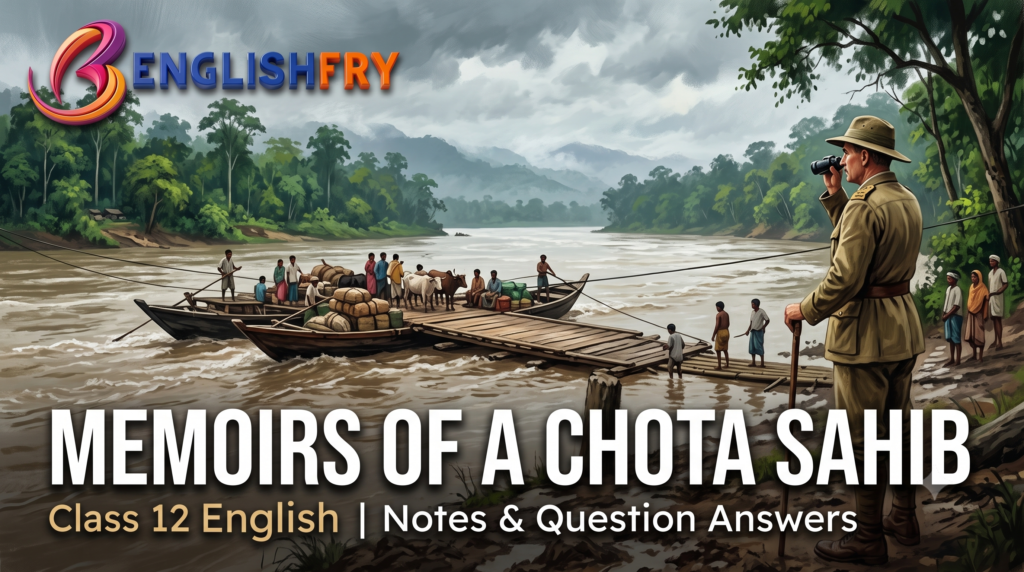
Q1. Give an account of the author’s experiences of the floods on the North Bank of the Brahmaputra during the monsoon. The monsoon floods turned the North Bank into a hot bed of malaria. Bamboo bridges were quickly washed away, forcing travelers to dangerously ford flooded rivers on horseback—using the horse’s tail as a rudder—or use traditional mar boat ferries.
Q2. Relate the author’s observation on the use of mar boats as a mode of river transport in Assam. A mar boat was an ingenious ferry consisting of a plank platform covering two open boats. It was propelled across the river by the force of the current along a cable, requiring constant adjustments to accommodate rising and falling river levels.
Q3. Describe the author’s experience with bats in the Rajapara forest bungalow. The Rajapara bungalow had a constant fusty smell due to bats living in the roof. Additionally, huge fruit-eating bats with five-foot wingspans glided outside at dusk, giving the place very eerie and macabre associations.
Q4. What was the status of Guwahati like in the period around 1947? Around 1947, Gauhati served primarily as a “port of entry” into Assam. Most travelers simply passed through en route to Calcutta, Shillong, or districts further up the valley, rarely staying overnight unless they were delayed by floods.

Long & Value-Based Questions (100-120 Words | 5 Marks)
Q5. Contrast the features of the North Bank and the South Bank as described by John Rowntree. The North Bank of the Brahmaputra was a vast, remote stretch of flat, ageless land bordering the Himalayas. It was characterized by rivers that suddenly disappeared, bheels replete with wildfowl, and extreme monsoon floods that made it a hot bed of malaria. Travel here was intensely difficult, relying on horseback or ingenious mar boats. In stark contrast, the South Bank was much more homely and compact. It featured a landscape of low hills, valleys, and villages. Its forests, primarily composed of sal trees, deeply resembled the character of English woodland. With comfortable forest bungalows at Rajapara and Kulsi, the South Bank offered a far more familiar and manageable terrain for the British officer.
Q6. Describe the author’s terrifying yet humorous experiences while traveling by car on the dirt tracks of Assam. Traveling by car in Assam presented immense challenges depending on the season. Before the rains broke, the dirt roads were completely invisible under thick clouds of dust. Rowntree vividly recalls hitting a concealed six-inch ramp that violently jolted his heavily packed car, almost breaking their bones. Conversely, during the monsoon, travel became distinctly dicy. The narrow, single-track main roads built on embankments became incredibly greasy. One skid led to another until Rowntree’s car slithered completely over the edge into a bumpy paddy field below. Ultimately, whether facing blinding dry dust or treacherous monsoon mud, driving in Assam required immense patience and highly durable vehicles to survive the journey.

Founder of Englishfry.com, a captivating and knowledge-driven blog & Founder of Android app/website Studyfunnel.com, an online Mock Test Series Portal. With a wealth of experience spanning over 20+ years, he has excelled as an Ex-Asst.Professor, Teacher, Amazon published author, Website Developer, Graphic Designer,Blogger,Poet, and Creative academic content writer publisher of 4 academic books available Online on Amazon & Flipkart.Internationally Certified as the World’s Top 100 admired Educator 2021 by theexcelligent.com,National Award recipient-Golden Quill award for Best English educator 2024,Receipent of Indian Literature Award 2026.His tryst in Literature helped him realize his love for writing and telling stories. A tech-savvy language nerd by day and, a passionate writer by night, he now translates his experiences into tales of wisdom served with a side of humor.His widely recognized profound insights ,captivating writing style of weaving words make him contribute to prestigious publications and a sought-after authority in the field that transport readers to extraordinary worlds.