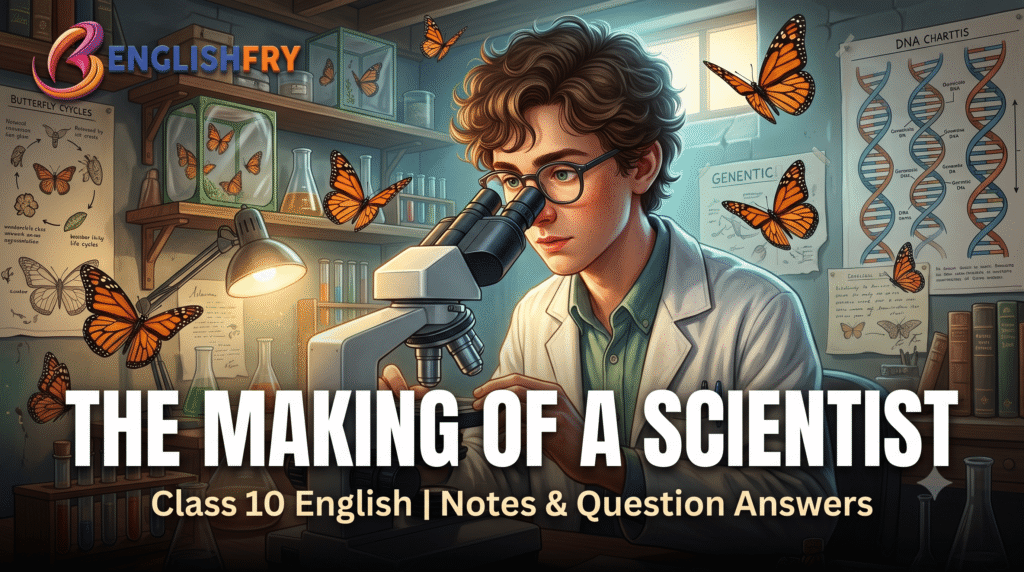
Today, we are exploring a highly inspiring chapter from your Class 10 English syllabus (Footprints Without Feet): “The Making of a Scientist” by Robert W. Peterson.
This chapter chronicles the fascinating real-life journey of Richard H. Ebright, a renowned biochemist. It shows how a young boy’s simple hobby of collecting butterflies, fueled by his mother’s unwavering support and his own driving curiosity, led to a groundbreaking theory on how cells work. It teaches us the true essence of scientific discovery and the qualities required to achieve greatness.
Let us break down this chapter step-by-step. We will explore the core vocabulary, provide our signature multi-lingual summaries, and answer all your textbook and extra exam questions to help you score full marks in your board exams.
Table of Contents
ToggleSummary in English
Richard Ebright grew up in Pennsylvania as a curious only child who loved collecting things, especially butterflies. His supportive mother was his early companion and bought him scientific equipment. Her gift of a book, The Travels of Monarch X, became a turning point, connecting him with Dr. Frederick A. Urquhart and sparking his interest in tagging butterflies. After losing at a seventh-grade science fair, Ebright realized that true science requires real experiments, not just neat displays. Over the years, he conducted award-winning research on monarch caterpillars, proved that viceroy butterflies copy monarchs to avoid birds, and discovered that the twelve gold spots on a monarch pupa produce a vital developmental hormone. Ultimately, this research led him to a groundbreaking theory explaining how a cell reads the blueprint of its DNA.
Summary in Hindi (हिंदी सारांश)
रिचर्ड एब्राइट पेंसिल्वेनिया में एक जिज्ञासु इकलौते बच्चे के रूप में बड़े हुए, जिन्हें चीजें, विशेषकर तितलियाँ, इकट्ठा करना बहुत पसंद था। उनकी माँ ने उनका पूरा समर्थन किया और उनके लिए वैज्ञानिक उपकरण खरीदे। उनकी माँ द्वारा दी गई एक किताब, द ट्रैवल्स ऑफ मोनार्क एक्स, उनके जीवन में एक महत्वपूर्ण मोड़ बन गई, जिसने उन्हें डॉ. फ्रेडरिक ए. उर्कहार्ट से जोड़ा। सातवीं कक्षा के विज्ञान मेले में हारने के बाद, एब्राइट को एहसास हुआ कि असली विज्ञान केवल सुंदर प्रदर्शन नहीं है, बल्कि वास्तविक प्रयोग (real experiments) करना है। वर्षों तक, उन्होंने मोनार्क तितलियों पर कई पुरस्कार विजेता शोध किए, यह साबित किया कि वाइसरॉय तितलियाँ पक्षियों से बचने के लिए मोनार्क की नकल करती हैं, और यह खोजा कि मोनार्क प्यूपा पर बारह सुनहरे धब्बे एक महत्वपूर्ण हार्मोन का उत्पादन करते हैं। अंततः, इसी शोध ने उन्हें एक अभूतपूर्व सिद्धांत तक पहुँचाया जो बताता है कि कोशिका (cell) अपने डीएनए (DNA) के ब्लूप्रिंट को कैसे पढ़ती है।
Summary in Assamese (অসমীয়া সাৰাংশ)
পেনচিলভেনিয়াত ডাঙৰ-দীঘল হোৱা ৰিচাৰ্ড এব্ৰাইট আছিল এগৰাকী অনুসন্ধিৎসু একমাত্ৰ সন্তান, যিয়ে বস্তু, বিশেষকৈ পখিলা সংগ্ৰহ কৰি ভাল পাইছিল। তেওঁৰ মাতৃয়ে তেওঁক যথেষ্ট সমৰ্থন কৰিছিল আৰু বৈজ্ঞানিক সঁজুলি কিনি দিছিল। মাতৃয়ে উপহাৰ দিয়া এখন কিতাপ, দ্য ট্ৰেভেলছ অৱ মনাৰ্ক এক্স, তেওঁৰ জীৱনৰ এক ডাঙৰ মোৰ হৈ পৰিছিল। সপ্তম শ্ৰেণীৰ বিজ্ঞান মেলাত পৰাজিত হোৱাৰ পিছত এব্ৰাইটে উপলব্ধি কৰিছিল যে প্ৰকৃত বিজ্ঞান কেৱল ধুনীয়া প্ৰদৰ্শন নহয়, ই হৈছে প্ৰকৃত পৰীক্ষা (real experiments)। বছৰ বছৰ ধৰি তেওঁ মনাৰ্ক পখিলাৰ ওপৰত বহুতো পুৰস্কাৰপ্ৰাপ্ত গৱেষণা কৰিছিল। তেওঁ প্ৰমাণ কৰিছিল যে ভাইচৰয় পখিলাই চৰাইৰ পৰা বাচিবলৈ মনাৰ্কৰ নকল কৰে, আৰু আৱিষ্কাৰ কৰিছিল যে মনাৰ্ক পিউপাৰ গাত থকা বাৰটা সোণালী দাগে এক গুৰুত্বপূৰ্ণ হৰম’ন উৎপন্ন কৰে। অৱশেষত, এই গৱেষণাই তেওঁক এক যুগান্তকাৰী তত্ত্বলৈ লৈ গৈছিল যিয়ে বুজাই দিয়ে যে কোষে (cell) কেনেকৈ ইয়াৰ ডিএনএ (DNA)-ৰ ব্লুপ্ৰিণ্ট পঢ়িব পাৰে।
Answer in 20-30 words
1. Do you think Richard’s mother was too indulgent when she bought him things like cameras, telescopes, microscopes? Give two reasons to support your answer.
Ans: No, she was not indulgent. First, these tools channeled his driving curiosity constructively. Second, they provided essential intellectual engagement for an only child lacking local playmates.
2. Suggest two ways by which you feel scientific temperament can be developed in a child.
Ans: We can develop scientific temperament by encouraging driving curiosity through hands-on real experiments, and by providing access to inspiring educational resources like scientific books.
3. Do you think we always need sophisticated instruments for all science experiments? Why/ Why not?
Ans: No, sophisticated instruments aren’t always needed. Ebright’s early, prize-winning experiments on viceroy butterflies relied purely on keen observation, basic setups, and his driving curiosity.
4. Richard’s mother was his companion and spent a lot of time with him. A parent should try to be a companion to a child. Justify.
Ans: Yes, a parent’s companionship provides crucial emotional support and intellectual stimulation. Ebright’s mother constructively channeled his lonely energy into learning, shaping his brilliant scientific journey.
5. The book, ‘The Travels of Monarch X’ ignited Richard’s curiosity in butterflies further. Do you think sometimes, people or things around us can act as catalysts to shape our lives? Explain how.
Ans: Yes, catalysts like inspiring books or mentors introduce fresh ideas. The Travels of Monarch X transformed Ebright’s simple hobby into serious scientific research by providing direct research goals.
Answer in 40-50 words
6. The will to win, for the right reasons, was a quality that Richard had. Do you think this quality alone can help us accomplish great feats? Why/ Why not?
Ans: No, the will to win alone is insufficient. As the text states, achieving great feats requires a blend of specific traits. One must start with a “first-rate mind,” add a deep, driving “curiosity,” and then mix in the competitive “will to win for the right reasons.”
7. Richard’s mother had been invited to a talk show after Richard’s graduation. Write the most memorable thing she spoke and what you think it reveals about her.
Ans: She memorably stated, “If he didn’t have things to do, I found work for him—not physical work, but learning things.” This reveals her proactive, deeply supportive nature. She actively fueled his “driving curiosity,” proving herself to be the ultimate catalyst behind his brilliant scientific journey.
Answer in 100-120 words
8. Albert Einstein said, ‘The important thing is to never stop questioning.’ Richard was a genius who proved this quote true. Justify.
Ans: Richard Ebright’s journey perfectly embodies Einstein’s quote. Possessing a “driving curiosity” and a “first-rate mind,” he never stopped at merely collecting butterflies. When he lost at a science fair, he questioned how to succeed, realizing he needed to conduct “real experiments.” Later, while others blindly assumed the twelve gold spots on a monarch pupa were merely ornamental, Ebright relentlessly questioned their true purpose. This led him to discover they produced a vital developmental hormone. Furthermore, by questioning how a cell reads the “blueprint of its DNA,” he developed a groundbreaking theory on cell life. His phenomenal success proves that endless questioning, rather than simple memorization, is the true foundation of a scientific genius.
9. Imagine you are Richard. You have been invited by Mr Weiherer to deliver a short address to the students at your erstwhile school. Write that short speech encouraging them to study Science.
Ans: Good morning,respected Principal ,Vice-principal our teaching fraternity and my dear seniors and adorable Juniors ! It is an absolute honor to be back here, standing before my greatest mentor, Mr. Weiherer. When I was sitting in your seats, my journey began simply by collecting butterflies and asking questions. Science isn’t just about reading textbooks; it is about nurturing a “driving curiosity” and doing “real experiments” to uncover the unknown. By combining a “first-rate mind” with the “will to win for the right reasons,” you can genuinely change the world. My basic research on a monarch pupa eventually led to a theory on how cells read the “blueprint of life.” Your research today could lead to preventing cancer and other diseases tomorrow. So, never stop questioning! Thank you.

Founder of Englishfry.com, a captivating and knowledge-driven blog & Founder of Android app/website Studyfunnel.com, an online Mock Test Series Portal. With a wealth of experience spanning over 20+ years, he has excelled as an Ex-Asst.Professor, Teacher, Amazon published author, Website Developer, Graphic Designer,Blogger,Poet, and Creative academic content writer publisher of 4 academic books available Online on Amazon & Flipkart.Internationally Certified as the World’s Top 100 admired Educator 2021 by theexcelligent.com,National Award recipient-Golden Quill award for Best English educator 2024,Receipent of Indian Literature Award 2026.His tryst in Literature helped him realize his love for writing and telling stories. A tech-savvy language nerd by day and, a passionate writer by night, he now translates his experiences into tales of wisdom served with a side of humor.His widely recognized profound insights ,captivating writing style of weaving words make him contribute to prestigious publications and a sought-after authority in the field that transport readers to extraordinary worlds.