
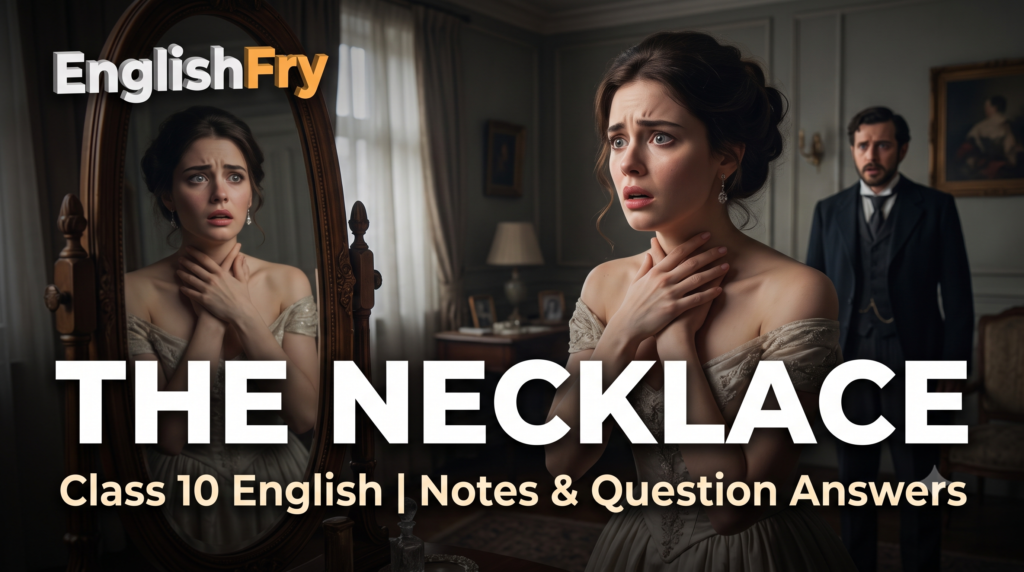
Today, we are exploring one of the most famous and thought-provoking short stories in your Class 10 English syllabus (Footprints Without Feet): “The Necklace” by Guy de Maupassant.
This chapter tells the tragic ironical story of Matilda Loisel, a young woman who destroys her own life because of her extreme vanity and dissatisfaction with her middle-class status. It teaches a powerful lesson about honesty, contentment, and the dangers of false pride.
Let us break down this classic story step-by-step. We will explore the core vocabulary, provide our signature multi-lingual summaries, and answer all your textbook and extra exam questions to help you score full marks in your board exams.
Table of Contents
ToggleSummary in English
Matilda Loisel is a pretty but deeply dissatisfied woman married to a petty clerk. She constantly dreams of a luxurious life and feels tortured by her middle-class reality. When invited to a grand Minister’s ball, she borrows a stunning diamond necklace from her wealthy friend, Madame Forestier, but tragically loses it on the way home. To buy a replacement that looks exactly the same, her husband borrows 36,000 francs, plunging them into a massive debt. They spend the next ten years living in severe poverty, doing exhausting physical labor to pay off the lenders. After ruining her youth and beauty, Matilda finally confesses to Madame Forestier, only to discover a heartbreaking irony: the original borrowed necklace was completely fake and worth a mere 500 francs.

Summary in Hindi (हिंदी सारांश)
मटिल्डा लॉइसेल एक बहुत सुंदर लेकिन अत्यधिक असंतुष्ट महिला है, जिसकी शादी शिक्षा बोर्ड के एक साधारण क्लर्क से हुई है। वह लगातार एक शानदार जीवन का सपना देखती है और अपनी मध्यमवर्गीय वास्तविकता से परेशान रहती है। मंत्री की एक भव्य पार्टी के लिए, वह अपनी अमीर दोस्त मैडम फॉरेस्टर से एक शानदार हीरे का हार उधार लेती है, लेकिन घर लौटते समय उसे खो देती है। बिल्कुल वैसा ही नया हार खरीदने के लिए, उसका पति 36,000 फ़्रैंक उधार लेता है, जिससे वे भारी कर्ज में डूब जाते हैं। अगले दस साल वे घोर गरीबी में बिताते हैं और कर्ज चुकाने के लिए मटिल्डा को कठोर शारीरिक श्रम करना पड़ता है। अपनी जवानी और सुंदरता बर्बाद करने के बाद, जब मटिल्डा मैडम फॉरेस्टर को सच्चाई बताती है, तो उसे एक चौंकाने वाला सच पता चलता है: वह मूल हार पूरी तरह से नकली था और उसकी कीमत केवल 500 फ़्रैंक थी।
Summary in Assamese (অসমীয়া সাৰাংশ)
মেটিল্ডা লয়চেল এগৰাকী ধুনীয়া কিন্তু নিজৰ জীৱনক লৈ অতি অসন্তুষ্ট মহিলা, যাৰ বিয়া এজন সাধাৰণ কেৰাণীৰ সৈতে হৈছিল। তাই সদায় এক বিলাসী জীৱনৰ সপোন দেখে আৰু নিজৰ মধ্যবিত্ত অৱস্থাক লৈ হতাশাত ভোগে। মন্ত্ৰীৰ এক ডাঙৰ অনুষ্ঠানৰ বাবে, তাই তাইৰ ধনী বন্ধু মেটাম ফৰেষ্টিয়াৰৰ পৰা এডাল হীৰাৰ নেক্লেছ ধাৰলৈ লয়, কিন্তু দুৰ্ভাগ্যৱশত ঘৰলৈ উভতি অহাৰ পথত সেইডাল হেৰুৱাই পেলায়। একেবাৰে একেখিনি নেক্লেছ কিনিবলৈ, তাইৰ স্বামীয়ে ৩৬,০০০ ফ্ৰেংক ধাৰলৈ লয়, যাৰ ফলত তেওঁলোক এক বৃহৎ ঋণৰ সন্মুখীন হয়। পৰৱৰ্তী দহ বছৰ তেওঁলোকে তীব্ৰ দৰিদ্ৰতাত কটায় আৰু ঋণ পৰিশোধ কৰিবলৈ কঠোৰ পৰিশ্ৰম কৰে। নিজৰ যৌৱন আৰু সৌন্দৰ্য হেৰুৱাই পেলোৱাৰ পিছত, মেটিল্ডাই অৱশেষত মেটাম ফৰেষ্টিয়াৰক সত্যটো স্বীকাৰ কৰে আৰু জানিব পাৰে যে আচল নেক্লেছডাল সম্পূৰ্ণ নকল আছিল আৰু তাৰ মূল্য মাত্ৰ ৫০০ ফ্ৰেংকহে আছিল।

Short Answer Questions (2-3 Marks)
Q1: What kind of a person is Mme Loisel and why is she always unhappy? Mme Loisel is a pretty, young woman born into a family of clerks. She is perpetually unhappy because she firmly believes she was born for all delicacies and luxuries. The poverty of her apartment, the shabby walls, and her lack of fine clothes and jewels constantly torture and anger her.
Q2: What kind of a person is her husband? Her husband, M. Loisel, is a simple, caring, and economical petty clerk at the Board of Education. Unlike his wife, he is content with his life, finding joy in simple things like a good potpie. He is deeply devoted to Matilda, sacrificing his savings of 400 francs—which he had kept for a hunting gun—just to buy her a dress.
Q3: What fresh problem disturbs Mme Loisel after her husband gives her the money for the dress, and how is it solved? As the ball approaches, Matilda is distressed because she has no jewelry to wear and fears looking poverty-stricken among rich women. Her husband solves the problem by suggesting she borrow some jewelry from her wealthy schoolmate, Mme Forestier.
Long Answer Questions (5 Marks)
Q4: The course of the Loisels’ life changed due to the necklace. Comment. The loss of the necklace plunged the Loisels into a life of severe hardship. To replace the jewelry, they had to borrow 36,000 francs, making ruinous promises and taking money from usurers. To pay off this massive debt, they dismissed their maid, rented a small attic, and took on exhausting labor. Matilda learned the heavy, odious work of a kitchen and household, while her husband worked late into the night doing copying work. This grueling life lasted for ten years, aging Matilda prematurely and turning her into a hard, crude woman of a poor household.
Q5: What was the cause of Matilda’s ruin? How could she have avoided it? Matilda’s ruin was caused by her intense vanity, discontentment with her middle-class life, and her obsession with looking rich. She could have avoided her ruin in several ways: by accepting her reality and wearing natural flowers as her husband suggested, or, most importantly, by being honest with Mme Forestier. If she had simply told the truth about losing the necklace, she would have discovered it was a fake.
Q6: What would have happened to Matilda if she had confessed to her friend that she had lost her necklace? If Matilda had confessed the loss immediately, Mme Forestier would have revealed that the necklace was made of false diamonds and was worth only about 500 francs. The Loisels could have easily paid for a replacement without borrowing vast sums of money, completely avoiding the ten years of poverty, physical exhaustion, and misery that ruined their youth.
Q: Write a detailed character sketch of Matilda Loisel from the story “The Necklace.”
Matilda Loisel is a pretty young woman who believes she was born into a middle-class family through an “error of destiny.” Highly dissatisfied, she suffers incessantly, feeling she is meant for “delicacies and luxuries.” Her vanity makes her selfish; she spitefully reacts to a grand invitation, demanding a costly dress and borrowed jewels to avoid a “poverty-stricken look.” Matilda’s tragic flaw is her false pride, which prevents her from confessing the truth after losing her friend’s necklace.
However, when faced with a massive replacement debt, she shows surprising resilience. Accepting the “horrible life of necessity” heroically, she endures ten years of grueling physical labor, transforming into a strong, “crude woman of the poor household,” tragically sacrificing her youth.
0000Q: Write a detailed character sketch of Matilda Loisel from the story “The Necklace.”
Matilda Loisel is introduced as a pretty and young lady who firmly believes she was born into a family of clerks through an “error of destiny.” She is highly dissatisfied with her middle-class reality and suffers incessantly, feeling she is meant for all “delicacies and luxuries.” The “poverty of her apartment,” the shabby walls, and her lack of fine clothes constantly torture and anger her, revealing her deep vanity and materialistic nature.
Her obsession with looking wealthy makes her somewhat selfish and inconsiderate towards her loving husband. Instead of being happy about the Minister’s invitation, she throws it spitefully on the table and demands four hundred francs for a dress. Furthermore, she refuses to attend the ball unless she has jewels to avoid a “poverty-stricken look.” Her ultimate tragic flaw is her false pride, which prevents her from simply confessing the truth to Madame Forestier after losing the borrowed necklace.
However, the second half of the story reveals a surprising hidden resilience in Matilda’s character. When faced with the massive debt of thirty-six thousand francs, she accepts the “horrible life of necessity” and does her part “completely, heroically.” Over ten years, she performs the odious work of a kitchen, haggles for every penny, and transforms into a strong, hard, and “crude woman of the poor household.” She pays a heavy physical and emotional price for her foolish vanity, losing her youth and beauty in the process.
Q: Write a detailed character sketch of Mr. Loisel from the story “The Necklace.”
Mr. Loisel is a simple, caring, and highly contented man who works as a “petty clerk in the office of the Board of Education.” In stark contrast to his vain and dissatisfied wife, Matilda, he finds genuine happiness in the small, everyday realities of his middle-class life. While Matilda dreams of shining silver and exquisite food, Mr. Loisel is completely delighted by uncovering a simple “good potpie” at the dinner table, proving his grounded and practical nature.
As a husband, he is incredibly loving, patient, and deeply sacrificial. He constantly tries to bring joy to his unhappy wife, returning home “elated” with the exclusive Minister’s invitation just to see her smile. When she throws a tantrum about not having a dress, he selflessly sacrifices the “four hundred francs” he had been carefully saving to buy a hunting gun, giving it to her without hesitation so she can buy a “pretty dress.” He even tries to offer practical solutions to her jewelry problem, suggesting she wear “natural flowers” because they are very chic.
Furthermore, Mr. Loisel is a man of immense responsibility, loyalty, and resilience. When the necklace is lost, he does not abandon his wife or solely blame her. Instead, he searches the streets hopelessly, visits the police and cab offices, and puts an advertisement in the newspapers. To pay off their “frightful debt,” he willingly sacrifices a decade of his life. He works exhausting “evenings, putting the books of some merchants in order,” and spends his nights doing copying work at “five sous a page.” Through his silent suffering and unwavering support for ten years, Mr. Loisel emerges as the true, unsung hero of the story.
Q: What is the central theme and moral lesson of the story ‘The Necklace’?
The central theme of Guy de Maupassant’s “The Necklace” revolves heavily around the destructive nature of vanity, false pride, and extreme materialism. The story highlights how a relentless obsession with wealth can lead to one’s ultimate downfall. Matilda Loisel’s “incessant” suffering and deep discontentment with her middle-class life, despite having a loving husband, demonstrate the dangers of living in illusions. Her blind belief that she was born for “all delicacies and luxuries” drives her to borrow the diamond necklace merely to avoid a “poverty-stricken look” among rich women.
Furthermore, the story brilliantly explores the theme of appearance versus reality. The borrowed necklace, which glitters beautifully and makes Matilda feel “intoxicated with pleasure” and “elegant” at the ball, turns out to be completely false. This fake jewelry perfectly symbolizes Matilda’s own temporary, borrowed wealthy status for that single night—both were beautiful on the outside but entirely worthless in reality.
The ultimate moral lesson of the story is the absolute necessity of honesty and the value of contentment. If Matilda had simply put aside her false pride and honestly confessed to Madame Forestier that she had lost the jewelry, she would have quickly learned it was fake and worth barely “five hundred francs.” Instead, her foolish vanity and fear of losing face forced her and her husband to endure ten years of a “horrible life of necessity,” permanently turning her into a “crude woman of the poor household.” The story teaches us that we must be content with our reality and that a single lie or moment of pride can ruin an entire life.

Founder of Englishfry.com, a captivating and knowledge-driven blog & Founder of Android app/website Studyfunnel.com, an online Mock Test Series Portal. With a wealth of experience spanning over 20+ years, he has excelled as an Ex-Asst.Professor, Teacher, Amazon published author, Website Developer, Graphic Designer,Blogger,Poet, and Creative academic content writer publisher of 4 academic books available Online on Amazon & Flipkart.Internationally Certified as the World’s Top 100 admired Educator 2021 by theexcelligent.com,National Award recipient-Golden Quill award for Best English educator 2024,Receipent of Indian Literature Award 2026.His tryst in Literature helped him realize his love for writing and telling stories. A tech-savvy language nerd by day and, a passionate writer by night, he now translates his experiences into tales of wisdom served with a side of humor.His widely recognized profound insights ,captivating writing style of weaving words make him contribute to prestigious publications and a sought-after authority in the field that transport readers to extraordinary worlds.