Today’s children are growing up in a world where content is available at the swipe of a finger. They watch, scroll, stream, like, share, and increasingly ask artificial intelligence to generate answers in seconds. Never before has a generation had such unlimited access to regurgitate information. Yet this abundance raises an important question for educators: Are we nurturing creators or merely producing consumers?
Consumption is effortless. Creation requires thought. It demands curiosity, imagination, perseverance, and the willingness to embrace uncertainty. While consuming information has its place, true learning begins when students move beyond receiving knowledge to questioning it, applying it, and creating something meaningful from it.
Beyond Passive Learning
For decades, education has focused on helping students acquire knowledge. Today, knowledge is no longer scarce. Facts, explanations, and even complete essays can be generated almost instantly. What cannot be automated as easily is originality, the ability to connect ideas, rationally solve authentic problems, and produce work that reflects individual thought and purpose.
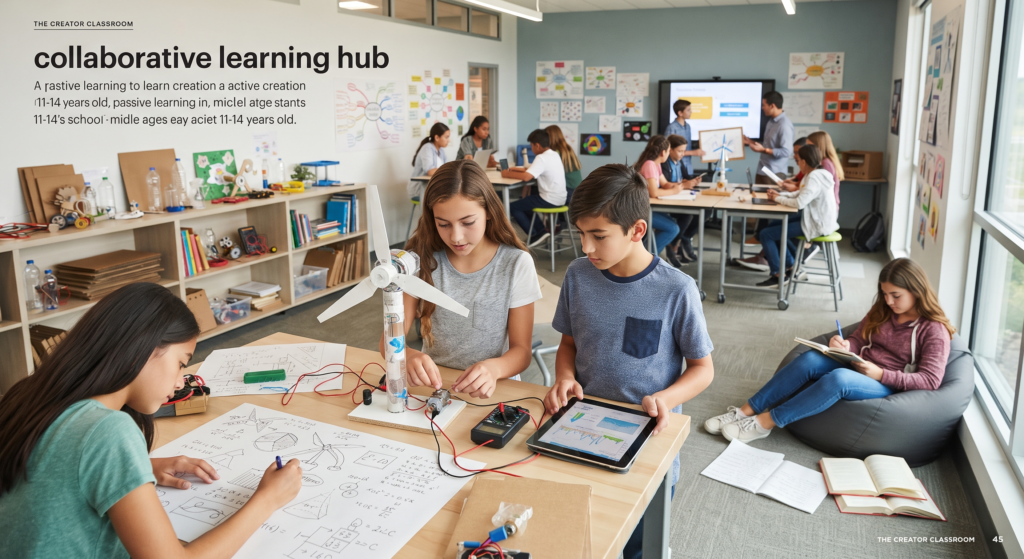
The classrooms of tomorrow must therefore evolve from places where information is delivered to spaces where ideas are discovered, tested, refined, and shared. Students should not simply learn about science; they should investigate real-world problems. They should not only study literature but write stories that express their own perspectives. Mathematics should extend beyond solving textbook exercises to analysing real-life situations. Every subject offers opportunities for students to become active participants rather than passive recipients.
Instead of simply memorizing the steps of the scientific method or reading about ecosystems from a textbook, students can investigate actual local problems, such as testing water quality in a nearby stream or designing energy-efficient models for their school. Similarly, rather than just analyzing a classic novel for an exam, they can write their own stories, poetry, or essays that reflect their unique cultural perspectives and lived experiences, thereby building empathy and original expression. Mathematics also shifts far beyond abstract equations into analyzing real-life situations, allowing learners to model financial budgets, track community trends with data, or calculate probabilities for practical scenarios.
When classrooms evolve into interactive workshops, the dynamic between teacher and student changes entirely. Students stop viewing learning as something that is simply done to them and start seeing themselves as active agents capable of creating solutions. Because testing ideas inevitably involves trial, error, and failure, this environment teaches learners that setbacks are not grades to be feared, but rather essential data for refinement. Ultimately, while you can easily forget a fact memorized overnight, you rarely forget a concept you had to test, build, and share with your peers, ensuring that school prepares children not just for the next grade level, but for the complex, unpredictable world waiting beyond graduation.
The Creator Mindset
A creator mindset is not limited to artists, inventors, or entrepreneurs. It is an approach to learning that encourages students to ask meaningful questions, sustain a curious mind, experiment with different solutions, and view setbacks as opportunities for improvement instead of living in the bubble of comfort zone. It nurtures confidence because learners begin to see themselves as contributors rather than spectators.
When students create, they take ownership of their learning. They write blogs, produce podcasts, build prototypes, design campaigns, develop community initiatives, compose music, conduct research, or present innovative solutions to local challenges.
Each experience develops critical thinking, collaboration, communication, and resilience: competencies that remain valuable regardless of how technology evolves.
Perhaps more importantly, creation fosters purpose. Students realize that learning is not merely about securing marks but about making an impact.
For decades, the Indian education system has prioritized academic scores, textbook theory, and degree acquisition—a legacy originally built to produce stable job-seekers rather than financially independent innovators. Financial literacy is much like oxygen: while money is not the ultimate purpose or definition of life, it is the invisible element required to sustain every choice, opportunity, and safety net we build. Without it, even the most brilliant graduates find themselves suffocating under economic stress, debt loops, and poor planning, proving that modern education is incomplete until it teaches students how to navigate the financial realities of the world they inherit.
AI: A Partner, Not a Substitute
Artificial intelligence has transformed how information is accessed and organised. Used wisely, it can become a powerful learning companion. It can help students brainstorm ideas, provide instant feedback, simplify complex concepts, and encourage exploration.
However, there is a significant difference between using AI to enhance thinking and allowing it to replace thinking. If learners rely entirely on technology to generate every answer, they risk losing the very abilities that education seeks to develop: judgement, creativity, ethical reasoning, and independent thought.
The role of schools is therefore not to compete with AI but to teach students how to work alongside it responsibly. The emphasis should shift from asking, “Can AI do this?” to “What unique value can I add that AI cannot?” That question encourages originality and reminds learners that technology is most effective when guided by human insight.
Designing Classrooms That Inspire Creation
Moving students from consumers to creators does not require expensive infrastructure or sophisticated technology. It requires a shift in mindset. Teachers can encourage creation through inquiry-based projects, design challenges, debates, student-led exhibitions,community service initiatives, digital storytelling, entrepreneurial ventures, and interdisciplinary learning experiences etc.
Reflection should become an integral part of every activity, allowing students to evaluate what they created, what they learned, and how they might improve. Assessment, too, must evolve. Alongside examinations, schools should value portfolios, presentations, prototypes, performances, and collaborative projects that showcase authentic learning. Such approaches recognise not only what students know but also what they can create with their knowledge.
Parents have an equally important role. Encouraging children to cook a meal, build something from recycled materials, maintain a journal, start a small neighbourhood initiative, or solve everyday family challenges develops confidence and resourcefulness. The objective is not perfection but participation.
Creating the Future
The future will reward those who can imagine possibilities, solve complex problems, create meaningful value and contribute back to society. These qualities cannot be downloaded, memorized, or outsourced. They are developed through opportunities to explore , experiment, fail, learn,unlearn,reflect, and try again being resilient.
Education has always been about preparing children for the world they will inherit. Today, that responsibility extends further. We must prepare them to shape the world they will create.
In an age overflowing with information, the true measure of learning will not be how much students consume, but what they choose to create. When schools nurture curious minds, courageous thinkers, and compassionate innovators, they are not simply educating children—they are empowering the architects of tomorrow.

Founder of Englishfry.com, a captivating and knowledge-driven blog & Founder of Android app/website Studyfunnel.com, an online Mock Test Series Portal. With a wealth of experience spanning over 20+ years, he has excelled as an Ex-Asst.Professor, Teacher, Amazon published author, Website Developer, Graphic Designer,Blogger,Poet, and Creative academic content writer publisher of 4 academic books available Online on Amazon & Flipkart.Internationally Certified as the World’s Top 100 admired Educator 2021 by theexcelligent.com,National Award recipient-Golden Quill award for Best English educator 2024,Receipent of Indian Literature Award 2026.His tryst in Literature helped him realize his love for writing and telling stories. A tech-savvy language nerd by day and, a passionate writer by night, he now translates his experiences into tales of wisdom served with a side of humor.His widely recognized profound insights ,captivating writing style of weaving words make him contribute to prestigious publications and a sought-after authority in the field that transport readers to extraordinary worlds.