
Table of Contents
ToggleAbout the Poet: Phoebe Cary
Phoebe Cary (1824–1871) was an American poet. She was born near Cincinnati, Ohio, and grew up on a farm with her elder sister Alice Cary, who was also a well-known poet. The two sisters began writing young, and in 1850 they moved to New York City, where they kept a literary home that was visited by many writers and reformers of the time.
Phoebe Cary wrote serious poems, hymns and humorous verse. She is best remembered for the hymn “Nearer Home” (“One sweetly solemn thought”) and for her witty parodies of famous poets. Her books include Poems and Parodies (1854) and Poems of Faith, Hope and Love (1868). She supported social causes such as the abolition of slavery and women’s rights. She died in 1871 in Newport, Rhode Island, only a few months after her sister Alice. “A Legend of the Northland” shows her gift for telling simple folk tales in verse with a clear moral.

“A Legend of the Northland” is a narrative poem by the American poet Phoebe Cary. It retells an old folk legend that explains why the woodpecker has a red cap, black feathers and a habit of boring into wood all day. In this article you will find the summary in English, Assamese and Hindi, a stanza-wise paraphrase and explanation in the manner of an English teacher, the literary devices, difficult words, exam questions with answers (short and long) and a short note on the poet.
Summary of the Poem in English
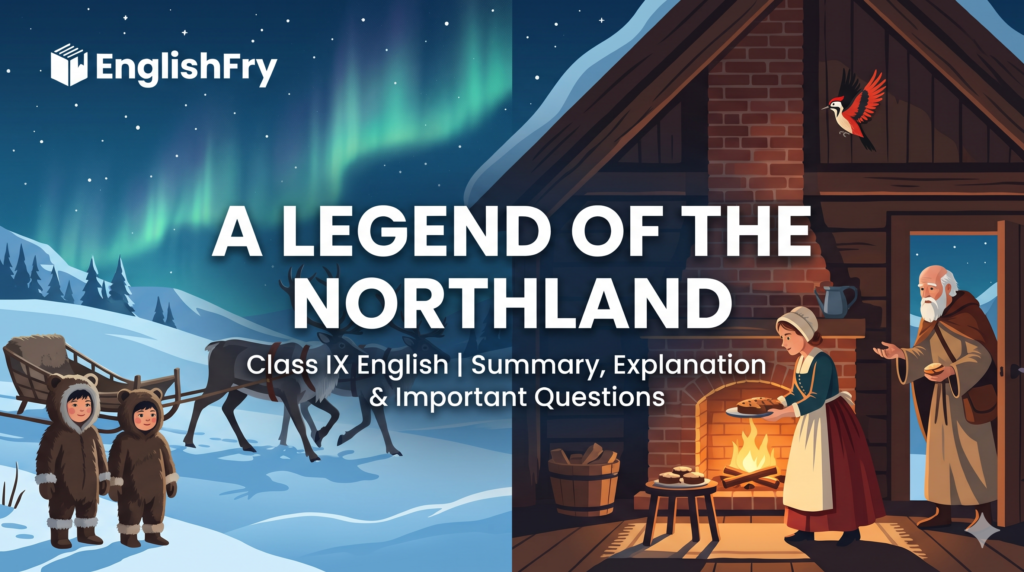
The poem begins in the Northland, a region near the North Pole where winter days are very short and the nights are so long that people cannot sleep through them. People harness swift reindeer to sledges, and the children, wrapped in furry clothes, look like bear cubs. The elders of this land tell their children a curious story. The poet says he does not believe it is true, but it carries a lesson.
The story is about Saint Peter, who once walked on earth preaching. Weak with hunger at the end of a day of fasting, he came to a cottage where a little woman was baking cakes, and asked her for one. The selfish woman made a small cake, but it seemed too big to give away. She made a smaller one, and then a still smaller one, rolled as thin as a wafer, but she could not part with even that. She put all the cakes on the shelf.
Angered by her greed, Saint Peter declared that she was too selfish to live in human form, with food, shelter and fire. She would become a bird that builds its home and finds scanty food by boring into dry wood all day. She flew up the chimney and out came a woodpecker. Her scarlet cap remained on her head, but the rest of her clothes were burnt black as coal. Country children still see her in the woods, “boring and boring for food”. The poem teaches us that greed and selfishness are punished, and that we must share what we have with the needy.
Summary of the Poem in Assamese
‘A Legend of the Northland’ ফোবি কেৰীয়ে ৰচনা কৰা এটা কাহিনীমূলক কবিতা। কবিতাটোত উত্তৰ মেৰুৰ ওচৰৰ নৰ্থলেণ্ড অঞ্চলৰ বৰ্ণনা আছে, য’ত দিন অতি চুটি আৰু জাৱৰ ৰাতি অতি দীঘল। তাৰ মানুহে বৰফত চলা স্লেজ গাড়ীত দ্ৰুতগামী ৰেণ্ডিয়াৰ যোতে, আৰু ফাৰৰ কাপোৰ পিন্ধা ল’ৰা-ছোৱালীবোৰ ভালুকৰ পোৱালিৰ দৰে দেখা যায়। তাৰ ডাঙৰসকলে ল’ৰা-ছোৱালীক এটা অদ্ভুত সাধু কয়।
সাধুটো এনেদৰে: এবাৰ সন্ত পিটাৰে পৃথিৱীত ঘূৰি ফুৰি ধৰ্ম প্ৰচাৰ কৰি আছিল। সেইদিনা তেওঁ একো খোৱা নাছিল, সেয়ে ভোকত দুৰ্বল হৈ পৰিছিল। এখন কুঁৰিঘৰ পাই তেওঁ তাত পিঠা (কেক) বনাই থকা এগৰাকী সৰু মহিলাৰ ওচৰত এখন পিঠা খুজিলে। লোভী মহিলাগৰাকীয়ে প্ৰথমে এখন সৰু পিঠা বনালে, কিন্তু সেইখন দিবলৈ ডাঙৰ যেন লাগিল; দ্বিতীয়বাৰ আৰু সৰু বনালে, সেইখনো ডাঙৰ যেন লাগিল; তৃতীয়বাৰ অলপ ময়দাৰে অতি পাতল পিঠা বনালে, তথাপিও দিব নোৱাৰিলে। শেষত সকলো পিঠা তাকত থৈ দিলে।
ক্ৰোধিত হৈ সন্ত পিটাৰে তাইক শাও দিলে—“তুমি মানুহৰ ৰূপত থাকিবলৈ যোগ্য নহয়; তুমি চৰাই হৈ শুকান কাঠত ফুটা কৰি অলপ খাদ্য সংগ্ৰহ কৰিবা।” তাই চিমনিৰে উৰি গৈ কাঠঠোকৰা চৰাই হ’ল। তাইৰ মূৰৰ ৰঙা টুপীটো থাকিল, আনবোৰ কাপোৰ জ্বলি কয়লাৰ দৰে ক’লা হ’ল। কবিতাটোৱে আমাক লোভ আৰু স্বাৰ্থপৰতা পৰিহাৰ কৰি আনক সহায় কৰিবলৈ শিকায়।
Summary of the Poem in Hindi
‘ए लेजेंड ऑफ द नॉर्थलैंड’ फोबे कैरी द्वारा रचित एक कथात्मक कविता है। कविता की शुरुआत उत्तरी ध्रुव के पास स्थित नॉर्थलैंड के वर्णन से होती है, जहाँ दिन बहुत छोटे और सर्दियों की रातें बहुत लंबी होती हैं। वहाँ के लोग बर्फ़ पर चलने वाली स्लेज गाड़ियों में तेज़ रेनडियर जोतते हैं और बच्चे फर के कपड़े पहनकर भालू के बच्चों जैसे लगते हैं। वहाँ के बड़े-बूढ़े बच्चों को एक अनोखी कहानी सुनाते हैं।
कहानी के अनुसार संत पीटर एक बार धरती पर उपदेश देते हुए घूम रहे थे। दिन भर के उपवास से वे भूखे और कमज़ोर हो चुके थे। वे एक झोपड़ी पर पहुँचे जहाँ एक छोटी-सी स्त्री केक बना रही थी। उन्होंने उससे एक केक माँगा। लालची स्त्री ने पहले एक छोटा केक बनाया, पर उसे बड़ा समझकर दूसरा, उससे भी छोटा बनाया। फिर तीसरी बार आटे का बहुत छोटा टुकड़ा बेलकर वेफ़र जैसा पतला केक बनाया, फिर भी वह उसे देने को तैयार न हुई और सारे केक अलमारी में रख दिए।
क्रोधित होकर संत पीटर ने उसे शाप दिया कि वह पक्षी बन जाए और सूखी लकड़ी में छेद करके थोड़ा-सा भोजन पाए। वह चिमनी से उड़कर कठफोड़वा (वुडपेकर) बन गई। उसके सिर की लाल टोपी वैसी ही रही और बाकी कपड़े जलकर कोयले जैसे काले हो गए। कविता हमें सिखाती है कि लालच और स्वार्थ बुरे हैं और हमें ज़रूरतमंद की सहायता करनी चाहिए।

Stanza-wise Paraphrase and Explanation
Stanza 1
Away, away in the Northland,
Where the hours of the day are few,
And the nights are so long in winter
That they cannot sleep them through;
Paraphrase: Far away in the Northland, daylight lasts only a few hours. In winter the nights are so long that people cannot sleep through the whole night.
Explanation: Near the North Pole the sun’s rays reach for a very short time in winter, so days are brief and nights are very long. “They” in line 4 refers to the people of the region. The poet opens with a distant, fairy-tale setting, and the repeated word “away” stresses how remote the land is. This prepares the reader for a legend.
Stanza 2
Where they harness the swift reindeer
To the sledges, when it snows;
And the children look like bear’s cubs
In their funny, furry clothes:
Paraphrase: In this land people tie fast reindeer to sledges when it snows, and the children in their funny fur clothes look like baby bears.
Explanation: The reindeer is a polar animal used to pull sledges over snow. The thick fur clothing shows how severe the cold is. The simile “like bear’s cubs” gives a lively, humorous picture, and the alliteration of “funny, furry” adds to the playful tone.
Stanza 3
They tell them a curious story —
I don’t believe ’tis true;
And yet you may learn a lesson
If I tell the tale to you.
Paraphrase: The elders tell the children a strange story. The poet does not think it is true, but you may still learn a lesson from it.
Explanation: “They” means the parents and elders; “them” means the children. The poet makes it clear that this is folklore, not fact, yet he values its moral. Notice that a story need not be true to teach a truth. This stanza is the hinge between the setting and the tale.
Stanza 4
Once, when the good Saint Peter
Lived in the world below,
And walked about it, preaching,
Just as he did, you know,
Paraphrase: Once, when the good Saint Peter lived on earth and travelled about preaching, as he used to do, …
Explanation: The story begins. Saint Peter, an apostle of Christ, is introduced as “good”. The phrase “you know” is a conversational touch, as if the poet is telling the tale aloud to a child. The sentence runs on into the next stanza (enjambment), building curiosity.
Stanza 5
He came to the door of a cottage,
In travelling round the earth,
Where a little woman was making cakes,
And baking them on the hearth;
Paraphrase: In the course of his travels he reached the door of a cottage where a little woman was making cakes and baking them on the fireplace.
Explanation: The humble cottage and the homely act of baking give the legend a simple village setting. The saint arrives as a traveller seeking hospitality, a test of the woman’s character. The alliteration in “woman was” and the rhyme of “earth” and “hearth” keep the verse musical.
Stanza 6
And being faint with fasting,
For the day was almost done,
He asked her, from her store of cakes,
To give him a single one.
Paraphrase: Since he was weak from fasting all day, he asked her to give him just one cake from her many cakes.
Explanation: Saint Peter’s request is modest: only one cake from a whole stock. The poet stresses his weakness (“faint with fasting”) to win our sympathy and to make the woman’s refusal look more shameful. The alliteration of “f” is worth noting.
Stanza 7
So she made a very little cake,
But as it baking lay,
She looked at it, and thought it seemed
Too large to give away.
Paraphrase: She made a very small cake, but while it was baking she felt that it looked too big to give away.
Explanation: The woman does not give from her store; she makes a special tiny cake, showing that she is already unwilling to share. Her mind then turns against even that. The poem now reveals her miserly nature through action, not description, which is a mark of good storytelling.
Stanza 8
Therefore she kneaded another,
And still a smaller one;
But it looked, when she turned it over,
As large as the first had done.
Paraphrase: So she kneaded another, even smaller cake, but when she turned it over it seemed as big as the first one.
Explanation: Her greed distorts her perception: whatever she makes seems too large to give. The simile-like comparison “as large as the first” shows that the problem is not the size of the cake but the smallness of her heart. The repetition of the process creates a humorous and ironic effect.
Stanza 9
Then she took a tiny scrap of dough,
And rolled and rolled it flat;
And baked it thin as a wafer —
But she couldn’t part with that.
Paraphrase: Then she took a tiny bit of dough, rolled it again and again until it was flat, and baked it as thin as a wafer, but she still could not give it away.
Explanation: This is the climax of her miserliness. The repetition “rolled and rolled” shows her tireless effort to make the cake smaller; the simile “thin as a wafer” shows how little she was ready to offer. Even this paper-thin piece was too much for her. The stanza is a fine example of exaggeration used to mock greed.
Stanza 10
For she said, “My cakes that seem too small
When I eat of them myself
Are yet too large to give away.”
So she put them on the shelf.
Paraphrase: She said that cakes which look small when she eats them look too big when she has to give them away, and she put them all on the shelf.
Explanation: This is the woman’s own self-justification, and its irony is clear: the same cake is small for herself but large for others. It exposes the double standard of the selfish. She finally refuses the hungry saint altogether.
Stanza 11
Then good Saint Peter grew angry,
For he was hungry and faint;
And surely such a woman
Was enough to provoke a saint.
Paraphrase: Good Saint Peter grew angry, for he was hungry and weak, and such a woman was enough to anger even a saint.
Explanation: Even a saint, who is patient and gentle by nature, loses his temper. The poet’s comment “enough to provoke a saint” tells us how extreme her selfishness was. The poet’s sympathy is clearly with the saint.
Stanza 12
And he said, “You are far too selfish
To dwell in a human form,
To have both food and shelter,
And fire to keep you warm.
Paraphrase: He said, “You are too selfish to live as a human being, with food, a home and a fire to keep you warm.”
Explanation: Saint Peter lists the blessings she enjoys: food, shelter and warmth. A person who has so much and still will not share does not deserve a human life. Being human means kindness and sharing, so he decides to take her human form away.
Stanza 13
Now, you shall build as the birds do,
And shall get your scanty food
By boring, and boring, and boring,
All day in the hard, dry wood.”
Paraphrase: “From now on you will build your home like the birds, and gain your little food by boring into hard, dry wood all day.”
Explanation: This is the curse and the punishment. The woman who refused a little food will now struggle for a little food. The threefold repetition of “boring” imitates the woodpecker’s endless pecking and also suggests monotonous labour. The punishment fits the crime, a classic feature of moral legends.
Stanza 14
Then up she went through the chimney,
Never speaking a word,
And out of the top flew a woodpecker,
For she was changed to a bird.
Paraphrase: She went up the chimney without saying a word and a woodpecker flew out of the top, for she had been changed into a bird.
Explanation: The transformation is sudden and silent. She does not even plead or defend herself, which suggests that she has no answer to the charge. The chimney, a part of the home she was so proud of, becomes her exit from human life.
Stanza 15
She had a scarlet cap on her head,
And that was left the same;
But all the rest of her clothes were burned
Black as a coal in the flame.
Paraphrase: The red cap on her head stayed as it was, but the rest of her clothes were burnt as black as coal in the flame.
Explanation: The legend explains the appearance of the woodpecker: a red crest and black body. The simile “black as a coal” gives a vivid colour image. The detail is an example of an aetiological tale, one that explains how something in nature came to be.
Stanza 16
And every country schoolboy
Has seen her in the wood,
Where she lives in the trees till this very day,
Boring and boring for food.
Paraphrase: Every village schoolboy has seen her in the woods, where she still lives in the trees, boring and boring for food.
Explanation: The poet links the legend to the present: the woodpecker is still there for anyone to see. The repetition of “boring” returns as a refrain. When children see the bird, their elders remind them of the story, and the lesson is passed down: do not be greedy or selfish.
Theme and Message
The central theme is the punishment of greed and selfishness. The woman had food, shelter and fire, yet she would not share even a thin wafer with a hungry traveller. Her punishment mirrors her fault: she who would not give a little food must now labour all day for a little food. The poem teaches us to be generous, to help the needy, and to value kindness over possessions. It is also an aetiological legend: a folk tale that explains why the woodpecker looks and behaves as it does.
Literary Devices Used in the Poem
Device | Example from the poem |
|---|---|
Rhyme scheme | abcb in every stanza (e.g. “few” / “through” in stanza 1) |
Alliteration | “funny, furry” (st. 2); “faint with fasting” (st. 6); “build as the birds” (st. 13); “boring, and boring” (st. 13) |
Repetition | “Away, away” (st. 1); “rolled and rolled” (st. 9); “boring” (st. 13 and 16) |
Simile | “children look like bear’s cubs” (st. 2); “thin as a wafer” (st. 9); “Black as a coal” (st. 15) |
Enjambment | st. 1 (lines 3–4); st. 4 (lines 1–2 and 3–4); st. 10 (lines 1–3); st. 11 (lines 1–2) |
Irony | The cake looks “too small” to eat but “too large” to give (st. 10) |
Imagery | Snow, sledges, reindeer, the scarlet cap and the coal-black clothes |
Important Questions and Answers
Q1. Where is the Northland and what is special about its days and nights?
The Northland is the region near the North Pole. In winter its days are very short and the nights are so long that people cannot sleep them through.
Q2. Why do the children of the Northland look like bear’s cubs?
They wear funny, furry clothes made of fur to protect themselves from the severe cold, so they look like young bears.
Q3. What do the people of the Northland do with reindeer?
They harness the swift reindeer to sledges, which carry them over the snow.
Q4. What does the poet say about the story told by the elders?
He says that he does not believe it is true, but it contains a lesson for the reader.
Q5. Who was Saint Peter?
He was an apostle of Christ who, in the legend, walked about the earth preaching to people.
Q6. Why did Saint Peter ask the woman for a cake?
He was faint with fasting because he had eaten nothing all day and the day was almost over.
Q7. Why did the woman make the cake smaller each time?
She was selfish, so every cake she baked seemed too large to give away.
Q8. What did the woman finally do with the cakes?
She refused to give any of them to Saint Peter and put them all on the shelf.
Q9. What curse did Saint Peter put on the woman?
He said she would live like a bird and get her scanty food by boring into dry, hard wood all day.
Q10. What remained unchanged when the woman became a woodpecker?
The scarlet cap on her head remained the same, while the rest of her clothes were burnt black as coal.
Q11. What does the repetition of the word “boring” show?
It shows the endless, tiring work of the woodpecker and stresses the woman’s punishment.
Q12. Identify the simile in stanza 9.
“Baked it thin as a wafer” compares the thinness of the cake to a wafer.
B. Long Answer Questions (5–6 marks each)
Q1. Narrate the legend told in the poem in your own words.
In the Northland the elders tell children a legend about Saint Peter. Once he was walking about the world preaching and, weak with hunger, reached a cottage where a woman was baking cakes. He asked her for one. She first baked a small cake but thought it too big to give; she baked a smaller one, which seemed just as large; at last she rolled a tiny scrap of dough as thin as a wafer, yet could not part with it. She put all the cakes on the shelf. Angry at her greed, Saint Peter cursed her to live as a bird, boring into dry wood for her scanty food. She flew up the chimney as a woodpecker. Her red cap stayed on her head, and her burnt clothes turned black. Country children still see her in the woods today.
Q2. Describe the Northland as presented in the first two stanzas.
The Northland is a cold, snowy region near the North Pole. In winter the days are short and the nights so long that people cannot sleep them through. The people use swift reindeer to pull sledges across the snow. Children wear funny, furry clothes and look like bear cubs. The picture is of a harsh but lively place where storytelling by the elders is a custom, which sets the scene for the legend.
Q3. Describe the character of the woman. How does the poet reveal her selfishness?
The woman is miserly, selfish and self-deceiving. Instead of giving a cake from her store, she bakes a special small one, and each time she thinks it too large to give. She makes a third cake as thin as a wafer and still refuses. Her own words, “My cakes that seem too small when I eat of them myself are yet too large to give away”, expose her double standard. She has food, shelter and fire, yet will not share even a little with a hungry man, so she is a figure of pure greed.
Q4. Why was Saint Peter angry? Was his punishment justified?
Saint Peter was hungry and weak, and had asked for only one cake. The woman’s refusal, repeated three times, showed a lack of kindness and hospitality. His anger is described as natural: such a woman was “enough to provoke a saint”. The punishment is poetic justice: she who would not give a little food must now toil all day for a little food. Some readers may find the curse harsh, but within the logic of a legend it serves to teach a moral lesson strongly.
Q5. What lesson does the poem teach?
The poem teaches that greed and selfishness are punished and that we must share what we have, especially with those in need. True humanity lies in kindness and generosity, not in hoarding. The poet says that although the story may not be true, one may learn a lesson from it. The elders tell the story to children so that they grow up generous.
Q6. How does the poem explain the appearance and habits of the woodpecker?
The legend says the woodpecker was once a greedy woman. The scarlet cap she wore remained as the bird’s red crest, her clothes burnt black in the chimney and became its dark feathers, and her curse of boring into dry wood for food is the bird’s habit of pecking tree trunks. In this way a natural fact is explained through a story, which is the nature of a legend.
Q7. Comment on the poet’s use of repetition and alliteration.
Repetition emphasises key ideas: “Away, away” stresses the distance of the Northland, “rolled and rolled” the woman’s effort to make the cake smaller, and “boring, and boring, and boring” the woodpecker’s endless labour and the woman’s punishment. Alliteration gives music and humour: “funny, furry”, “faint with fasting”, “build as the birds”. Together these devices make the poem pleasant to read aloud and easy to remember.
Q8. Why is the poem called “A Legend of the Northland”?
A legend is an old traditional story handed down from generation to generation. The poem retells a story told by the elders of the Northland about Saint Peter and the woman, and it explains the origin of the woodpecker. Since it is a folk tale told in a particular land and not a proven fact, the title is apt.
Q9. How does the poet connect the legend to the present day?
In the last stanza the poet says that every country schoolboy has seen the woodpecker in the wood, where she lives to this day, boring and boring for food. This makes the story feel alive: whenever children see the bird, they recall the legend and its lesson against greed.
Q10. Write a short note on the tone and style of the poem.
The poem is written in a simple, conversational ballad style, with four-line stanzas and the rhyme scheme abcb. The tone is light and humorous at the start (children like bear cubs) and becomes moralising towards the end. The poet speaks directly to the reader (“you know”, “I tell the tale to you”), as an elder telling a story to children.

Founder of Englishfry.com, a captivating and knowledge-driven blog & Founder of Android app/website Studyfunnel.com, an online Mock Test Series Portal. With a wealth of experience spanning over 20+ years, he has excelled as an Ex-Asst.Professor, Teacher, Amazon published author, Website Developer, Graphic Designer,Blogger,Poet, and Creative academic content writer publisher of 4 academic books available Online on Amazon & Flipkart.Internationally Certified as the World’s Top 100 admired Educator 2021 by theexcelligent.com,National Award recipient-Golden Quill award for Best English educator 2024,Receipent of Indian Literature Award 2026.His tryst in Literature helped him realize his love for writing and telling stories. A tech-savvy language nerd by day and, a passionate writer by night, he now translates his experiences into tales of wisdom served with a side of humor.His widely recognized profound insights ,captivating writing style of weaving words make him contribute to prestigious publications and a sought-after authority in the field that transport readers to extraordinary worlds.