The Happy Prince Class 9 Summary: Explanation, Translations & NCERT Question Bank
EnglishFry Study Notes | Class IX English Moments (Chapter 5) | CBSE • SEBA • State Boards 2026
Hello students! Welcome back to EnglishFry. Today, we are studying one of the most touching and unforgettable stories in your Class 9 English Moments textbook (Chapter 5): "The Happy Prince" by Oscar Wilde.
At first glance, it reads like a simple fairy tale about a golden statue and a tiny migrating bird. Yet beneath the surface, Oscar Wilde delivers a powerful lesson on selfless love, compassion, and the sharp divide between the rich and the poor.
In this complete The Happy Prince Class 9 Summary and exam guide, you will get English, Hindi, and Assamese summaries, character sketches, core textual keywords, solved NCERT questions, and CBSE 2026 competency-based answers—everything you need to score full marks.
Table of Contents
Toggle★ About the Author: Oscar Wilde
Oscar Wilde (1854–1900) was a famous Irish poet, playwright, and storyteller known for his sharp wit and deeply emotional fairy tales. Published in 1888 in his collection The Happy Prince and Other Tales, this story gently mocks the vanity and selfishness of wealthy city officials while celebrating genuine sacrifice.
Wilde's prose is musical, vivid, and rich in contrast—putting gleaming gold and glittering jewels directly beside starving children and freezing winters so readers never forget the message.
1 Multi-Lingual Summary Vault
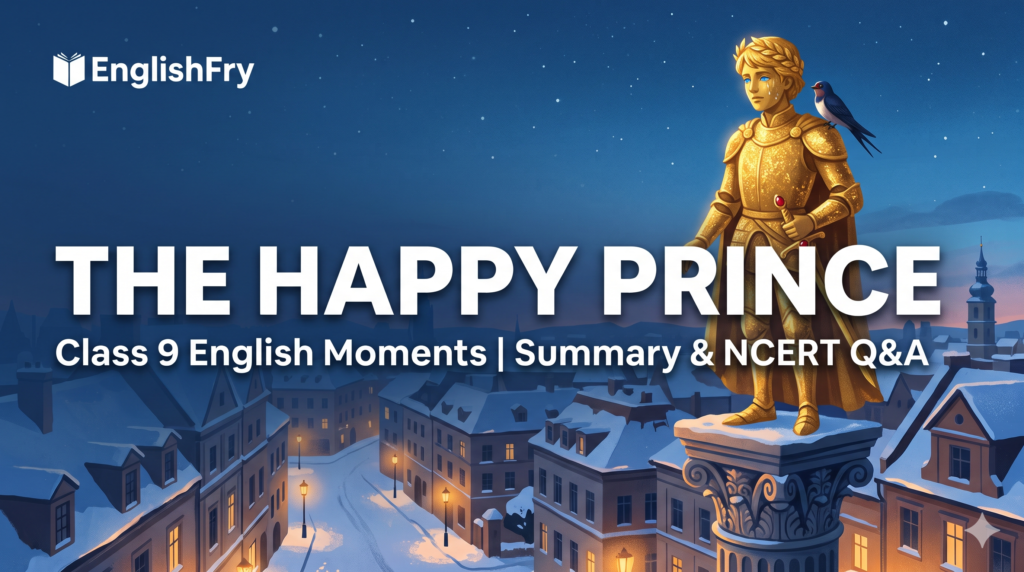
High above a city stood the magnificent statue of the Happy Prince, gilded all over with thin leaves of fine gold, with two bright sapphires for eyes and a large red ruby on his sword hilt. One night, a little swallow—flying late to Egypt to join his friends—settled between the statue's feet for shelter. To his surprise, warm drops fell on him under a cloudless sky: the Happy Prince was weeping.
The Prince explained that while he was alive in the Palace, sorrow was never allowed to enter, so his courtiers called him "the Happy Prince." Now, placed high on a tall column, he could see all the ugliness and misery of his city, and even though his heart was made of lead, he could not stop weeping.
Moved by pity, the swallow agreed to stay and act as his messenger. First, he carried the great ruby from the Prince's sword hilt to a poor, exhausted seamstress whose feverish little boy was crying for oranges, gently fanning the boy's forehead with his wings. Next, he plucked out one of the Prince's rare sapphire eyes for a freezing, hungry young playwright struggling to finish a play in his garret.
On the third night, the swallow plucked out the Prince's other sapphire eye and slipped it into the palm of a crying little matchgirl whose matches had fallen into the gutter. Because the Prince was now completely blind, the devoted swallow gave up his trip to Egypt and promised to stay with him forever.
Flying over the city, the swallow saw the rich making merry while starving children shivered under bridge archways. At the Prince's command, the bird peeled off leaf after leaf of the statue's fine gold to feed the poor until the Prince looked dull and grey. When bitter snow and frost arrived, the little swallow kissed the Prince on the lips and died at his feet, causing the Prince's leaden heart to snap right in two.
The next morning, the vain Mayor and Town Councillors declared the statue shabby and "little better than a beggar," pulling it down to melt in a furnace. Because the broken lead heart would not melt, the workmen threw it on a dust heap beside the dead swallow. When God asked His Angel to bring the two most precious things in the city, the Angel brought the leaden heart and the dead bird, and God welcomed them forever into His garden of Paradise and city of gold.
'द हैप्पी प्रिंस' (The Happy Prince) ऑस्कर वाइल्ड द्वारा लिखित एक हृदयस्पर्शी और शिक्षाप्रद कहानी है। शहर के ऊपर एक ऊंचे स्तंभ पर 'हैप्पी प्रिंस' की सुंदर मूर्ति खड़ी थी, जो सोने की पतली पत्तियों से ढकी थी। उसकी आंखों में दो चमकदार नीलम (sapphires) जड़े थे और तलवार की मूठ पर एक बड़ा लाल माणिक (ruby) चमकता था।
एक रात, मिस्र (Egypt) जा रहा एक छोटा अबाबील पक्षी (swallow) आराम करने के लिए मूर्ति के पैरों के बीच बैठ गया। तभी उस पर आंसुओं की बूंदें गिरीं। राजकुमार ने बताया कि जब वह जीवित था और महल में रहता था, तब उसने कभी दुख नहीं देखा था। लेकिन अब ऊंचाई से उसे पूरे शहर की गरीबी और दुख दिखाई देता है, जिससे उसका सीसे का बना दिल (leaden heart) रो उठता है।
राजकुमार के कहने पर अबाबील उसका संदेशवाहक बन गया। सबसे पहले उसने तलवार का माणिक एक गरीब दर्जिन (seamstress) को दिया जिसका बेटा बुखार से तड़प रहा था। इसके बाद उसने राजकुमार की एक नीलम की आंख एक भूखे और ठिठुरते युवा नाटककार (playwright) को दी, और दूसरी आंख एक गरीब माचिस बेचने वाली लड़की (matchgirl) को दी जिसकी माचिसें नाली में गिर गई थीं।
अब राजकुमार पूरी तरह अंधा हो चुका था, इसलिए दयालु अबाबील ने मिस्र जाने का विचार छोड़ दिया और हमेशा उसके पास रहने का फैसला किया। राजकुमार के आदेश पर उसने मूर्ति पर चढ़ा सारा सोना एक-एक पत्ती करके गरीबों और भूखे बच्चों में बांट दिया। कड़ाके की ठंड और बर्फबारी में अबाबील ने राजकुमार को अलविदा कहकर उसके पैरों में दम तोड़ दिया, और उसी पल राजकुमार का सीसे का दिल दो टुकड़ों में टूट गया।
अगली सुबह घमंडी मेयर और नगर पार्षदों ने बदसूरत दिख रही मूर्ति को तुड़वाकर भट्टी में गलवा दिया। लेकिन टूटा हुआ सीसे का दिल भट्टी में नहीं गला, इसलिए मजदूरों ने उसे मरे हुए अबाबील के साथ कूड़े के ढेर पर फेंक दिया। जब भगवान ने अपने देवदूत से शहर की दो सबसे कीमती चीजें लाने को कहा, तो देवदूत वही सीसे का दिल और मृत पक्षी ले गया। भगवान ने उन्हें स्वर्ग में अनंत स्थान दिया।
অস্কাৰ ৱাইল্ডৰ দ্বাৰা ৰচিত 'দ্য হেপী প্ৰিন্স' (The Happy Prince) ত্যাগ, দয়া আৰু নিস্বাৰ্থ প্ৰেমৰ এক অপূৰ্ব কাহিনী। এখন চহৰৰ ওপৰত এটা ওখ স্তম্ভত 'হেপী প্ৰিন্স'ৰ এটা সুন্দৰ মূৰ্তি থিয় হৈ আছিল। মূৰ্তিটোৰ গাত সোণৰ পাতল পাত লগোৱা আছিল, চকু দুটা আছিল উজ্জ্বল নীলমণিৰে (sapphires) গঢ়া, আৰু তৰোৱালৰ নালত জিলিকি আছিল এটা ডাঙৰ ৰঙা মাণিক (ruby)।
এদিন ৰাতি ইজিপ্তলৈ (Egypt) যাবলৈ ওলোৱা এটা সৰু শালিকা বা চুৱেলো চৰাই (swallow) জিৰণি ল'বলৈ মূৰ্তিটোৰ ভৰিৰ মাজত বহিল। তেতিয়াই তাৰ গাত চকুপানীৰ টোপাল পৰিল। ৰাজকুমাৰে ক'লে যে জীৱিত অৱস্থাত প্ৰাসাদত থকাৰ সময়ত তেওঁ কেতিয়াও দুখ দেখা নাছিল। কিন্তু এতিয়া ওখ স্তম্ভৰ পৰা চহৰখনৰ দৰিদ্ৰতা আৰু দুৰ্দশা দেখি তেওঁৰ সীহৰ হৃদয়খনে (leaden heart) কান্দি উঠে।
ৰাজকুমাৰৰ অনুৰোধত চৰাইটোৱে তেওঁৰ বাৰ্তাবাহক হিচাপে সহায় কৰিবলৈ মান্তি হ'ল। প্ৰথমে সি তৰোৱালৰ মাণিকটো এগৰাকী দৰিদ্ৰ দৰ্জীক (seamstress) দিলে যাৰ কণমানি ল'ৰাটো জ্বৰত ভুগি আছিল। তাৰ পিছত সি ৰাজকুমাৰৰ এটা নীলমণি চকু এজন ঠাণ্ডা আৰু ভোকত কাতৰ হৈ থকা যুৱ নাট্যকাৰক (playwright) দিলে, আৰু আনটো চকু এজনী দুখীয়া জুইশলা বেচা ছোৱালীক (matchgirl) দিলে।
ৰাজকুমাৰ সম্পূৰ্ণ অন্ধ হৈ পৰাত মৰমিয়াল চৰাইটোৱে ইজিপ্তলৈ নাযাই সদায় তেওঁৰ লগতে থকাৰ সিদ্ধান্ত ল'লে। ৰাজকুমাৰৰ নিৰ্দেশত সি মূৰ্তিটোৰ গাত থকা সোণৰ পাতবোৰ এখিলা-এখিলাকৈ এৰুৱাই চহৰৰ দৰিদ্ৰ আৰু ভোকাতুৰ ল'ৰা-ছোৱালীবোৰক বিলাই দিলে। অৱশেষত তীব্ৰ শীত আৰু তুষাৰপাত সহিব নোৱাৰি চৰাইটোৱে ৰাজকুমাৰৰ ওঁঠত চুমা খাই তেওঁৰ ভৰিৰ তলত প্ৰাণ ত্যাগ কৰিলে, আৰু সেই মুহূৰ্ততে ৰাজকুমাৰৰ সীহৰ হৃদয়খন দুটুকুৰা হৈ ফাটি গ'ল।
পিছদিনা ৰাতিপুৱা অহংকাৰী মেয়ৰ আৰু পাৰিষদসকলে মূৰ্তিটো দেখিবলৈ বেয়া হোৱা বুলি ভাঙি ভাতীত গলাই দিলে। কিন্তু ভঙা সীহৰ হৃদয়খন নগলাত শ্ৰমিকসকলে তাক মৰা চৰাইটোৰ সৈতে জাবৰৰ দ'মত পেলাই দিলে। যেতিয়া ঈশ্বৰে দেৱদূতক চহৰখনৰ আটাইতকৈ মূল্যৱান বস্তু দুটা আনিবলৈ ক'লে, দেৱদূতে সেই সীহৰ হৃদয়খন আৰু মৰা চৰাইটোক লৈ গ'ল, আৰু ঈশ্বৰে দুয়োকে স্বৰ্গত চিৰস্থায়ী স্থান দিলে।
2 Teacher’s Deep Dive: Keywords, Themes, Characters & Vocabulary
Examiners reward students who use Oscar Wilde's exact expressions. Anchor your answers with these phrases: "gilded all over with thin leaves of fine gold", "two bright sapphires", "large red ruby", "heart is made of lead", "coarse, red hands, all pricked by the needle", "withered violets", "There is no Mystery so great as Misery", "dull and grey", "House of Death", "snapped right in two", "little better than a beggar", and "two most precious things in the city."
- Outward Beauty vs. Inner Goodness: The Mayor and Art Professor judge worth strictly by shiny gold and jewels, discarding the statue once it turns dull and grey. God, however, sees true beauty in a broken leaden heart and a dead bird.
- Selfless Love and Sacrifice: Both the Prince and the swallow give away everything they possess—treasures, eyesight, comfort, and even life itself—to ease the pain of strangers.
- Social Inequality and Hypocrisy: Oscar Wilde sharply contrasts the rich making merry in warm palaces with starving children shivering under bridge archways while officials ignore their misery.
- The Happy Prince: Compassionate, deeply empathetic, and selfless. Sheltered from sorrow in life, he develops immense moral courage after death, stripping away his ruby, sapphires, and fine gold so the poor can have bread and warmth.
- The Little Swallow: Initially playful, impatient, and eager to reach warm Egypt, he grows into a loyal, noble, and loving friend. Staying back out of devotion to the blind Prince, he willingly faces the freezing frost and "House of Death."
- The Mayor and Town Councillors: Vain, shallow, and sycophantic. The councillors blindly echo every word the Mayor speaks, valuing superficial beauty over charity and even proposing an absurd proclamation banning birds from dying near the statue.
| Word | Simple Meaning |
|---|---|
| Gilded | Covered thinly with gold leaf or gold paint |
| Hilt | The handle of a sword |
| Seamstress | A woman who earns her living by sewing |
| Garret | A small, cramped attic room at the top of a house |
| Listlessly | Lacking energy, enthusiasm, or strength (due to hunger) |
| Proclamation | A public or official announcement |
| Foundry | A workshop or factory where metal is melted and cast |
A Very Short Answer Questions (1 Mark)
Ans:The statue of the Happy Prince stood high above the city on a tall column, gilded all over with thin leaves of fine gold.
Ans:The little swallow's friends had flown away to Egypt six weeks earlier, where they were flying up and down the Nile among lotus flowers.
Ans:The feverish little boy asked his mother to give him oranges, but she was so poor that she had nothing to offer him except river water.
Ans:The swallow darted through a hole in the garret roof and placed one of the Prince's rare sapphire eyes upon the playwright's withered violets.
Ans:When they melted the statue in a furnace at the foundry, the broken leaden heart refused to melt, so the overseer ordered it thrown onto a dust heap beside the dead swallow.
B Extract-Based Questions (5 Marks)
Ans:(i) The swallow had been telling the Prince fascinating stories of strange lands and warm places like Egypt. (ii) The Prince says this because human suffering is deeper, more baffling, and more urgent to understand than any exotic wonder in the world. (iii) The Prince can no longer see the city himself because he gave away both of his sapphire eyes to help the young playwright and the little matchgirl. (iv) Flying over the city, the swallow sees the rich making merry in fine houses while beggars sit at the gates and starving children shiver under a bridge. (v) The Prince orders the swallow to peel off his fine gold leaf by leaf and distribute it among the poor.
Ans:(i) The Angel found the broken leaden heart and the dead swallow lying together on a dust heap outside the foundry. (ii) The leaden heart had snapped right in two out of unbearable grief the exact moment the loyal swallow died at the Prince's feet. (iii) God called them the most precious things because they embodied pure, selfless sacrifice and unconditional love for the poor. (iv) In stark contrast, the shallow Mayor and Art Professor viewed the stripped statue as shabby and useless, and treated the dead bird as a public nuisance. (v) God rewarded them by declaring that the little bird would sing forever in His garden of Paradise and the Happy Prince would praise Him in His city of gold.
C NCERT & Extra Short Answer Questions (30-40 Words | 2-3 Marks)
Ans:The courtiers called him 'the Happy Prince' because while alive in the Palace, sorrow was never allowed to enter. No, he is not happy now; set high above the city, he sees all its ugliness and misery, making him weep.
Ans:He sends the ruby because the exhausted seamstress has nothing but river water for her feverish boy asking for oranges. The swallow lays the ruby beside her thimble and gently fans the boy's forehead with his wings until he sleeps.
Ans:The Prince sends one sapphire eye to a freezing, starving young playwright in a garret so he can buy firewood and finish his play. He sends the second sapphire to a crying matchgirl whose spoiled matches would earn her a beating.
Ans:The swallow witnesses sharp inequality: the rich making merry in beautiful houses while beggars sit at their gates. In dark lanes, starving children look out listlessly, and two hungry boys huddled under a bridge are chased into the rain.
Ans:After giving away both sapphire eyes to help the needy, the Happy Prince became completely blind. Deeply moved by the Prince's boundless kindness and love, the loyal swallow refused to abandon him and stayed until the bitter end.
Ans:The two most precious things are the broken leaden heart of the Happy Prince and the dead swallow. They are precious in God's eyes because both sacrificed their treasures, comfort, and lives out of pure compassion for the poor.
Ans:After delivering the great ruby to the seamstress and fanning her sick child's forehead, the swallow felt strangely warm despite the freezing night. As the Prince explained, that inner warmth came purely from having performed a genuinely good action.
Ans:The shallow Mayor and sycophantic Town Councillors called the stripped statue shabby and "little better than a beggar." Agreeing with the Art Professor that it was no longer beautiful or useful, they pulled it down to melt in a furnace.
D Long, Value-Based & Competency-Based Questions (100-120 Words | 5 Marks)
Ans:Oscar Wilde’s poignant ending proves that genuine goodness outlives material wealth and worldly power. After sacrificing his red ruby, sapphire eyes, and fine gold leaves to relieve human suffering, the Happy Prince looked dull and grey, while his loyal swallow died from the bitter frost. The vain Mayor, Town Councillors, and Art Professor judged the statue strictly by its outward appearance, pulling it down as useless and melting it in a foundry furnace. Yet, symbolically, the Prince’s broken leaden heart refused to melt in the fire. Even when workmen tossed it onto a dust heap beside the dead bird, God’s Angel recognized them as the two most precious things in the city, granting them eternal glory in Paradise.
Ans:At the start of the story, the little swallow appears playful, self-centred, and impatient. Resting between the Prince's feet for a "golden bed-room," he initially complains about getting wet and hesitates to help the seamstress because he wants to join his friends in warm Egypt. However, performing one good action—fanning the feverish boy—awakens an unexpected inner warmth inside him. Night after night, witnessing the Prince's boundless compassion transforms the bird completely. When the Prince sacrifices both sapphire eyes and goes blind, the swallow abandons Egypt forever out of pure devotion. He tirelessly distributes the statue's fine gold to starving children and stays through snow and frost, willingly entering the "House of Death" beside his beloved friend.
Ans:Through sharp irony, Oscar Wilde exposes the deep social inequality and moral blindness of the privileged class. While a tired seamstress with coarse, needle-pricked hands cannot buy oranges for her sick son, a wealthy maid of honour complains lazily about her ball gown on a palace balcony. Later, the swallow sees the rich making merry inside warm houses while beggars sit at their gates and starving children huddle under a bridge, only to be chased into the rain by a heartless watchman. The Mayor, Town Councillors, and Art Professor embody this hypocrisy completely. Blind to the city's misery, they worship only gold and outward beauty, discarding the selfless Prince as "little better than a beggar" once his riches are gone.
Ans:The Prince's remark highlights a profound truth about human survival versus spiritual joy. When he lived in the Palace surrounded by luxury, he mistook ignorance of sorrow for real happiness. After death, seeing starving children looking out listlessly at black streets, he understands that while wealth cannot buy true inner peace, gold is urgently needed by the destitute to buy bread, warmth, and medicine. By ordering the swallow to strip away his fine gold leaf by leaf, the Prince turns dead ornament into living relief—bringing rosy cheeks and laughter back to hungry children. Paradoxically, the Prince finds far deeper fulfillment in becoming dull, grey, and empty-handed than he ever experienced while gilded in idle luxury.
Ans:Oscar Wilde closes the story by placing earthly vanity side by side with divine justice. The Mayor, the sycophantic Town Councillors, and the Art Professor measure value entirely through surface appearances and utility. To them, the Happy Prince was admirable only while covered in fine gold, sapphires, and a glowing ruby; the moment he sacrificed those riches for the poor, they declared him shabby, useless, and fit only for the furnace. God's standard of worth is the exact opposite. Ignoring the rich palaces and proud officials, God asks His Angel for the two most precious things in the city and rejoices over the unmeltable leaden heart and the dead swallow—proving that mercy, loyalty, and sacrifice are the only true treasures.
FAQ Frequently Asked Questions (Quick Exam Revision)
The moral lesson of The Happy Prince is that true beauty and greatness lie in compassion, charity, and selfless sacrifice—not in outward wealth or status. Helping those in suffering brings lasting warmth and divine reward.
Although the narrator humorously mentions the "dreadfully hard frost," the Happy Prince's leaden heart actually snapped in two out of deep grief and love the very moment his faithful little swallow kissed him on the lips and died at his feet.
The Happy Prince gave his red ruby to the poor seamstress, his first sapphire eye to the freezing young playwright, his second sapphire eye to the crying matchgirl, and his fine gold leaves to the starving children and poor of the city.
★ Internal Linking Vault for Class 9 Students
Boost your CBSE & SEBA Class 9 English preparation with these complete EnglishFry study guides:
• A Slumber Did My Spirit Seal Class 9 Summary & Q&A
• The Bond of Love Class 9 Summary & Notes
• The Lake Isle of Innisfree Class 9 Explanation & Questions
• English Grammar: Complete Guide to Transformation of Sentences
With this complete The Happy Prince Class 9 Summary, multi-lingual translations, character sketches, and NCERT plus CBSE 2026 question bank, you are fully prepared to ace your literature exam. Keep key phrases like "leaden heart," "There is no Mystery so great as Misery," and "two most precious things in the city" ready in your mind, and write your answers with confidence!

Founder of Englishfry.com, a captivating and knowledge-driven blog & Founder of Android app/website Studyfunnel.com, an online Mock Test Series Portal. With a wealth of experience spanning over 20+ years, he has excelled as an Ex-Asst.Professor, Teacher, Amazon published author, Website Developer, Graphic Designer,Blogger,Poet, and Creative academic content writer publisher of 4 academic books available Online on Amazon & Flipkart.Internationally Certified as the World’s Top 100 admired Educator 2021 by theexcelligent.com,National Award recipient-Golden Quill award for Best English educator 2024,Receipent of Indian Literature Award 2026.His tryst in Literature helped him realize his love for writing and telling stories. A tech-savvy language nerd by day and, a passionate writer by night, he now translates his experiences into tales of wisdom served with a side of humor.His widely recognized profound insights ,captivating writing style of weaving words make him contribute to prestigious publications and a sought-after authority in the field that transport readers to extraordinary worlds.