
Table of Contents
ToggleA Photograph Summary Class 11: Stanzawise Explanation, Themes & Important Questions
Hello dear students! Welcome back to EnglishFry. Today, we are unlocking one of the most touching, nostalgic, and deeply emotional poems in your CBSE Class 11 English syllabus—“A Photograph” by Shirley Toulson.
In my decades of interacting with young minds in the classroom, I have often noticed that students struggle to grasp the heavy emotional transitions in this poem. It’s easy to memorize line endings, but to score a perfect 100% in your literature section, you need to understand the hidden pain between the lines.
Grab your notebooks and a warm cup of tea. Let’s dissect this beautiful piece of literature together, structural pillar by structural pillar, to ensure you are completely cognizant of every concept for your upcoming exams.
About the Author: Shirley Toulson
Shirley Toulson (1924–2018) was a prominent English writer, poet, and journalist. Known for her deeply evocative, reflective style, she possessed a unique talent for translating complex human emotions into simple yet profound verse. In A Photograph, she handles the theme of personal grief with an elite level of poetic restraint, showing us how inanimate objects can hold the immense weight of our memories.
The Summary Section
English Summary: A Photograph Class 11
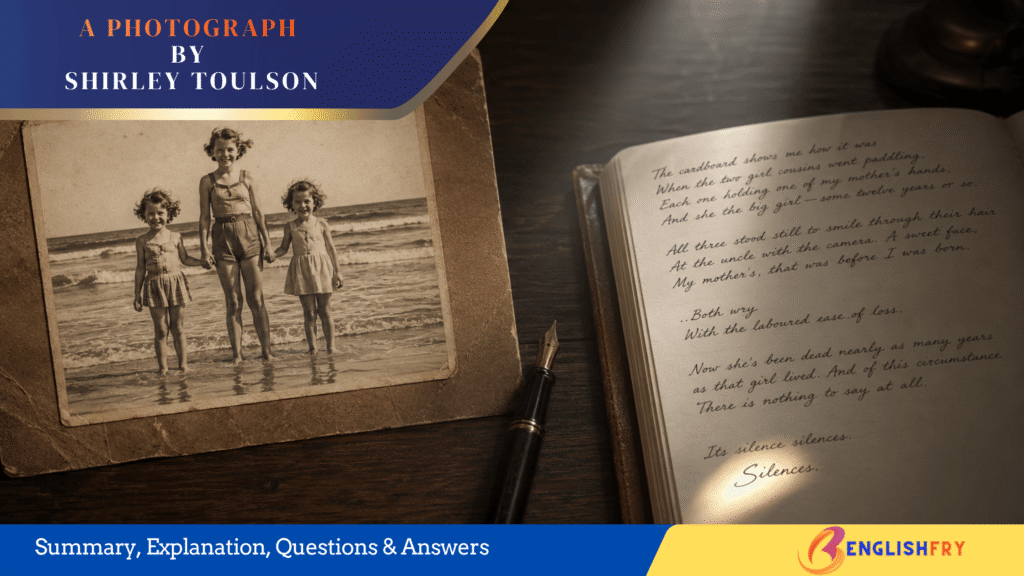
A Photograph is a poignant tribute by Shirley Toulson to her deceased mother. The poem revolves around an old, cardboard-mounted snapshot capturing a joyful beach holiday. In the picture, the poet’s mother, aged about twelve, is seen paddling in the sea alongside her two cousins, Betty and Dolly. Decades later, the mother would look at the snapshot and laugh at their old-fashioned beach dresses, finding joy in her past. However, in the present phase, the mother has been dead for nearly twelve years. The poet is left with an aching void, looking at the silent photograph. The poem beautifully contrasts the permanence of nature (the sea) with the fleeting, transient nature of human life, culminating in a heavy, inescapable silence.

Hindi Summary (हिंदी सारांश)
शर्ली टौल्सन द्वारा रचित कविता ‘A Photograph’ उनकी स्वर्गीय माता जी को एक भावभीनी श्रद्धांजलि है। यह पूरी कविता कार्डबोर्ड पर चिपकी एक पुरानी तस्वीर के इर्द-गिर्द घूमती है, जो समुद्र के किनारे बिताई गई एक पुरानी छुट्टियों की याद दिलाती है। तस्वीर में कवयित्री की मां (जब वह लगभग 12 वर्ष की थीं) अपनी दो चचेरी बहनों, बेट्टी और डॉली के साथ समुद्र में मस्ती करती दिख रही हैं। कई सालों बाद, मां उस तस्वीर को देखकर हंसती थीं कि वे बचपन में कैसे कपड़े पहनती थीं। लेकिन आज वर्तमान में, मां को गुजरे हुए लगभग 12 साल हो चुके हैं। कवयित्री अब पूरी तरह अकेली हैं और उस तस्वीर के सन्नाटे को महसूस कर रही हैं। यह कविता प्रकृति (समुद्र) की अमरता और मानव जीवन के क्षणभंगुर (क्षणिक) स्वभाव के बीच के अंतर को दर्शाती है।
Detailed Stanzawise Teacher Explanation
Let’s slow down and look at the poem through a holistic lens. The text is structured into three distinct chronological phases of time. Let’s map them out line by line.
Phase 1: The Beach Holiday (The Bright Past)
“The cardboard shows me how it was / When the two girl cousins went paddling…”
In the opening lines, the poet introduces an old picture. Notice the word “cardboard”. The author deliberately avoids saying a luxury frame; it’s a cheap, fragile piece of cardboard. This immediately underscores the vulnerability of human existence.
The image captures a beautiful memory: the poet’s mother at twelve years old, flanked by her younger cousins, Betty and Dolly. They are holding her hands, looking up to her as the “big girl.” They stand still, their hair blowing across their faces in the sea breeze, smiling sweetly at the uncle who clicks the camera.
The poet reflects on her mother’s “sweet face” from a time before she was even born. Then comes a heavy, monumental line:
“And the sea, which appears to have changed less, / Washed their terribly transient feet.”
Here, Shirley Toulson uses a beautiful juxtaposition. The sea remains virtually unchanged across generations. It represents the permanent, eternal forces of nature. Conversely, the human feet are “terribly transient”—meaning temporarily present, moving steadily toward aging and death.
Phase 2: The Mother’s Laughter (The Bitter-Sweet Middle)
“Some twenty — thirty — years later / She’d laugh at the snapshot…”
We fast-forward three decades. The little girl in the photo is now a mother. She sits with her daughter (the poet) and looks at the old snapshot.
She laughs out loud, pointing at the cousins: “See Betty and Dolly, and look how they dressed us for the beach!” For the mother, that sea holiday was a distant, treasured past. But look at how the narrative perspective shifts for the poet:
“The sea holiday / Was her past, mine is her laughter. Both wry / With the laboured ease of loss.”
This is the intellectual heart of the poem. The sea holiday was the mother’s lost past; the mother’s beautiful, ringing laughter is now the poet’s lost past. Both mother and daughter are dealing with an intense delineated sense of loss. They look back at their respective pasts with a wry (bitter-sweet or ironic) expression, trying to navigate the painful “laboured ease of loss”—an oxymoron showing how hard it is to make the heavy burden of grief look easy and natural.
Phase 3: The Heavy Void (The Silent Present)
“Now she’s been dead nearly as many years / As that girl lived…”
We arrive at the cold, clinical present day. The poet’s mother has been dead for nearly twelve years—the exact age the girl was in the opening snapshot. The cycle of life has closed, leaving behind an absolute vacuum.
When the poet looks at the cardboard frame now, there are no more stories, no more shared laughs, and no comforting words.
“And of this circumstance / There is nothing to say at all. / Its silence silences.”
The poet concludes that faced with the absolute, unchanging reality of death (“this circumstance”), words lose all utility. Human rhetoric fails. The profound silence of the photograph, and of death itself, completely galvanizes the atmosphere, leaving the poet utterly speechless. It is an extraordinary, heart-rending climax.
Literary Devices in the Poem
To secure maximum marks in your CBSE reference-to-context questions, make sure to memorize these key poetic devices:
Alliteration: The repetition of identical consonant sounds at the start of close words.
“Stood still to smile” (Repetition of the ‘S’ sound)
“Terribly transient” (Repetition of the ‘T’ sound)
“Silence silences” (Repetition of the ‘S’ sound)
Oxymoron: A figure of speech combining two completely contradictory terms to describe a complex truth.
“Laboured ease” — ‘Laboured’ implies immense hard work, while ‘ease’ implies effortless comfort. Together, they describe the difficult process of accepting life’s losses.
Transferred Epithet: An adjective placed alongside a noun it doesn’t logically modify, but describes the metaphoric context.
“Transient feet” — The feet themselves aren’t transient; it is the human life cycle that is fleeting and temporary.

Essential Word Meanings (Student-Friendly Vocabulary)
| Word | Contextual Meaning | सरल हिंदी अर्थ |
| Cardboard | A stiff, thick paper board used as a cheap photo mount | गत्ता / पुराना फ्रेम |
| Paddling | Walking with bare feet through shallow water at the beach | पानी में छपाछप करना |
| Transient | Lasting only for a short time; impermanent | क्षणभंगुर / अस्थायी |
| Snapshot | An informal photograph taken quickly | झटपट ली गई तस्वीर |
| Wry | Disappointed, ironic, or mocking in a bitter-sweet way | व्यंग्यात्मक / कड़वा-मीठा |
| Laboured | Achieved with immense difficulty and effort | कठिन / प्रयासपूर्वक |
| Circumstance | A specific fact or condition connected with or relevant to an event | परिस्थिति / यथार्थ |
.
NCERT “Think It Out” Solutions
Q1. What does the word ‘cardboard’ denote in the poem? Why has this word been used?
Ans: The word ‘cardboard’ denotes the stiff, thick paper backing onto which the old photograph of the poet’s mother was pasted.
The poet intentionally uses this specific word instead of sophisticated terms like “luxury frame” or “album” to underscore the fragile, cheap, and perishable nature of man-made things. It serves as a stark material metaphor: while the human being captured on the paper has long passed away, the fragile piece of cardboard has outlived her, highlighting the painful paradigm of human mortality.
Q2. What has the camera captured?
Ans: The camera has captured a joyful, golden moment from the past—a family beach holiday involving three young girls. It shows the poet’s mother as a blooming twelve-year-old “big girl,” holding the hands of her two younger cousins, Betty and Dolly, as they enjoy a day of paddling in the shallow waters of the sea. They are standing still, their hair tousled by the sea breeze, smiling happily at their uncle who operates the camera shutter.
Q3. What has not changed over the years? Does this suggest something to you?
Ans: The vast sea rolling in the background of the photograph has not changed at all over the decades.
Upon closer reflection, this striking permanence stands in sharp contrast to the perilous, mutable nature of human life. It suggests a profound existential dichotomy: nature is eternal, vast, and indifferent to time, whereas human life is fleeting, vulnerable, and bound to decay. The waves continue to wash the shore exactly as they did seventy years ago, even though the little girl whose feet they washed has been reduced to ashes.
Q4. The poet’s mother laughed at the snapshot. What did this laugh indicate?
Ans: The mother’s laughter, echoing twenty to thirty years after the holiday, indicated a nostalgic amusement mixed with a gentle acceptance of time’s passing. She laughed at the quaint, old-fashioned beach dresses their parents had chosen for them, and the innocent joy of her carefree childhood. This laugh showed that while she was fully cognizant of her lost youth, she could still look back at her memories with fondness rather than despair.
Q5. What is the meaning of the line “Both wry with the laboured ease of loss.”
Ans: This line describes the common emotional state shared by both the mother and the daughter regarding their respective pasts. The sea holiday was the mother’s lost past; the mother’s beautiful laugh is now the poet’s lost past.
The phrase “laboured ease of loss” is a brilliant oxymoron. It indicates that over time, both individuals have had to struggle immensely (laboured) to accept their heavy emotional voids, eventually reaching a state of artificial comfort or numbness (ease). It highlights how humans are forced to make the agonizing process of grieving look completely natural and manageable.
Q6. What does “this circumstance” refer to?
Ans: “This circumstance” refers directly to the grim, irreversible reality of the present day—specifically, the death of the poet’s mother, who has now been gone for nearly twelve years. It encapsulates the lonely state of bereavement the poet finds herself in, sitting alone with an old piece of cardboard, staring into a vacuum where her mother’s voice and laughter used to live.
Q7. The three stanzas depict three different phases. What are they?
Ans: The three stanzas intricately delineate three distinct chronological phases of human life and emotional history:
The First Phase (The Snapshot): This depicts the carefree, joyful childhood of the poet’s mother. She is a twelve-year-old girl enjoying a sunny beach holiday with her cousins, full of innocence and life.
The Second Phase (The Recollection): Set twenty to thirty years later, this phase features the middle-aged mother looking back at her childhood photo alongside her daughter. It represents the era of shared family bonds, laughter, and warm maternal presence.
The Third Phase (The Void): This depicts the bleak, silent present. The mother has passed away, and the poet is left entirely alone to absorb the heavy, suffocating silence of loss.
Higher Order Thinking Skills (HOTS) & Competency-Based Questions
Q1. “A Photograph is not merely a description of an old picture; it is a profound meditation on the transience of human life versus the permanence of nature.” Analyze this statement with close reference to the poem.
Ans: This statement is exceptionally accurate. Shirley Toulson utilizes the physical artifact of a photograph to catalyze a deep philosophical inquiry into human mortality.
By contrasting the sea—which “appears to have changed less”—with the girls’ “terribly transient feet,” she beautifully exposes the fragile nature of human existence. The sea remains stable, an unchanging entity across generations, while human life moves swiftly from childhood innocence to middle-aged nostalgia, and finally to the cold finality of death.
Ultimately, the poem teaches us that while human achievements and physical bodies are fleeting, memories locked within fragile mediums like cardboard are all that remain to challenge the absolute oblivion of time.
Q2. How does the poet use the concept of “silence” as a structural tool to convey her grief in the final lines of the poem?
Ans: In the final stanza, the poet avoids dramatic outbursts of sorrow, choosing instead to employ an elite level of linguistic restraint. By stating that “of this circumstance there is nothing to say at all,” she acknowledges that ultimate grief is beyond the boundaries of human language.
The closing phrase, “Its silence silences,” operates as a powerful rhetorical device. The physical photograph is silent, the deceased mother is silent, and the sheer scale of the poet’s loss renders the poet herself completely mute. Silence ceases to be merely the absence of sound; it transforms into a heavy, tangible, and systemic force that dominates the poet’s entire universe, mirroring the permanent finality of death.

Founder of Englishfry.com, a captivating and knowledge-driven blog & Founder of Android app/website Studyfunnel.com, an online Mock Test Series Portal. With a wealth of experience spanning over 20+ years, he has excelled as an Ex-Asst.Professor, Teacher, Amazon published author, Website Developer, Graphic Designer,Blogger,Poet, and Creative academic content writer publisher of 4 academic books available Online on Amazon & Flipkart.Internationally Certified as the World’s Top 100 admired Educator 2021 by theexcelligent.com,National Award recipient-Golden Quill award for Best English educator 2024,Receipent of Indian Literature Award 2026.His tryst in Literature helped him realize his love for writing and telling stories. A tech-savvy language nerd by day and, a passionate writer by night, he now translates his experiences into tales of wisdom served with a side of humor.His widely recognized profound insights ,captivating writing style of weaving words make him contribute to prestigious publications and a sought-after authority in the field that transport readers to extraordinary worlds.