
Hello students! Welcome back to EnglishFry. Today, we are deep-diving into a beautifully poignant, deeply emotional, and sensory-rich poem from your new NCERT Class 9 English Kaveri textbook (Lesson 8)—“I Cannot Remember My Mother” written by the legendary Nobel Laureate Rabindranath Tagore.
In my years of evaluating academic answer scripts and conducting literature workshops, I often notice that students struggle when analyzing poetry that deals with abstract emotions. Many believe that memory must always be a concrete visual image.
Tagore completely shatters this notion! He demonstrates how a lost parent’s presence can be vividly felt through everyday sensory triggers. Let us break down the chapter’s layout, translate its core meaning, and explore the fully solved textbook solutions.
Table of Contents
ToggleAbout the Poet: Rabindranath Tagore
Rabindranath Tagore (1861–1941) was a monumental figure in world literature, philosophy, and music. He became the first non-European and Asian to win the Nobel Prize in Literature in 1913 for his sublime poetry collection Gitanjali.
Tagore’s writing style is celebrated for being remarkably simple yet deeply emotional. He frequently weaves vivid elements of nature into his work to capture the delicate nuances of human relationships, longing, and spirituality.
Translations: Multi-Lingual Summary Vault
To ensure comprehensive understanding across diverse classrooms, here is the architectural digest of the poem translated into English, Hindi, and Assamese.
1. Summary in English
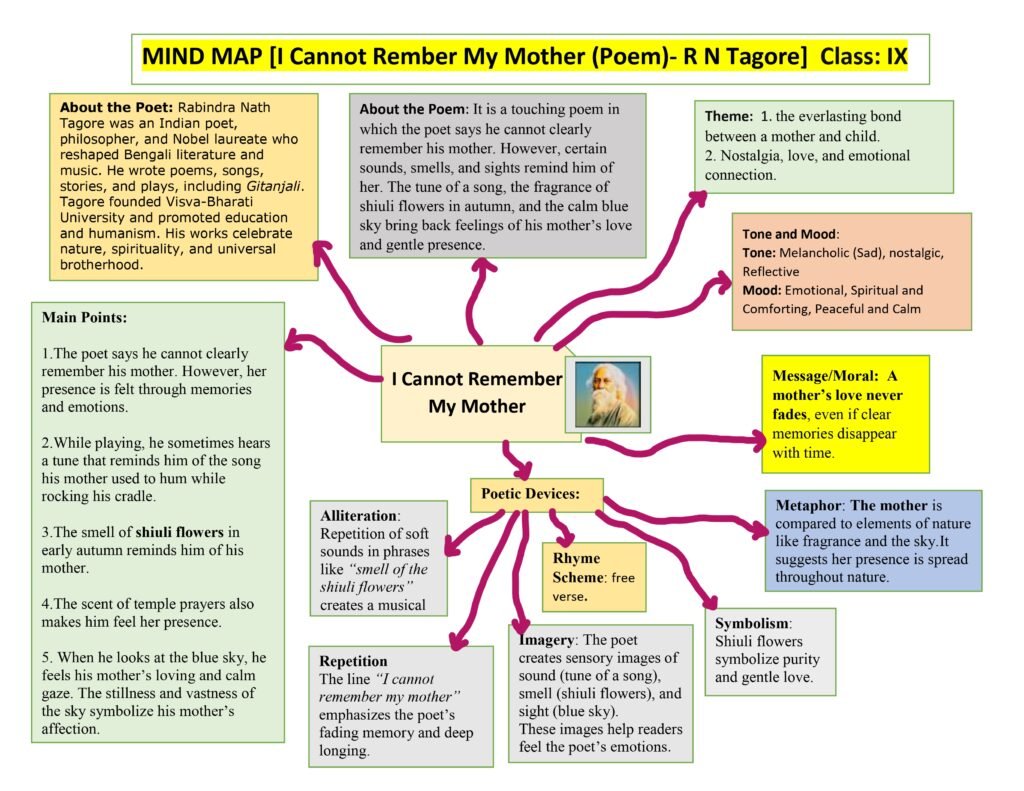
The poem explores the delicate emotional landscape of a child who lost his mother during infancy. The speaker begins with the bittersweet confession that he cannot visually recall his mother’s face. However, her memory is not entirely lost; it lives on through subterranean sensory experiences.
During playtime, a soft tune hovers over his toys, reflecting the distant echo of the lullabies his mother hummed while rocking his cradle. In early autumn, the sweet fragrance of blooming shiuli flowers wafts through the air, instantly triggering the memory of morning temple prayers and his mother’s sacred devotion.
Finally, when looking out at the vast, peaceful blue sky from his bedroom window, the child experiences an absolute stillness. This cosmic calm makes him feel as though his mother’s loving, protective gaze has spread across the entire horizon, keeping watch over him.

Summary in Hindi (हिंदी सारांश)
यह कविता एक ऐसे बच्चे के गहरे भावनात्मक अनुभवों को दर्शाती है जिसने अपनी माँ को बचपन में ही खो दिया था। कवि स्वीकार करते हैं कि उन्हें अपनी माँ का चेहरा स्पष्ट रूप से याद नहीं है। लेकिन माँ की यादें उनके जीवन से पूरी तरह गायब नहीं हुई हैं, बल्कि वे इंद्रियों के माध्यम से जीवित हैं।
जब कवि अपने खिलौनों से खेलते हैं, तो उन्हें हवा में एक हल्की धुन मंडराती हुई महसूस होती है। यह धुन उन्हें उस लोरी की याद दिलाती है जो उनकी माँ पालने को झुलाते समय गुनगुनाती थीं। शुरुआती शरद ऋतु में, जब शिउली के फूलों की सुगंध हवा में फैलती है, तो वह सुगंध कवि को मंदिर की सुबह की प्रार्थना और माँ की पवित्र उपस्थिति की याद दिलाती है।
अंत में, जब बच्चा अपनी खिड़की से दूर नीले आकाश को देखता है, तो उसे एक गहरी शांति महसूस होती है। यह शांति उसे उसकी माँ की उस स्नेहमयी दृष्टि की याद दिलाती है जो वे कभी उस पर डालती थीं। माँ की यादें स्पष्ट छवियों में नहीं बल्कि भावनाओं और प्रकृति के तत्वों में सुरक्षित हैं।
Summary in Assamese (অসমীয়া সাৰাংশ)
এই কবিতাটোৱে শৈশৱতে মাতৃক হেৰুওৱা এটা শিশুৰ গভীৰ আৱেগিক অনুভূতিক প্ৰকাশ কৰিছে। কবিয়ে স্বীকাৰ কৰিছে যে তেওঁৰ মনত মাতৃৰ মুখখন স্পষ্টকৈ জিলিকি থকা নাই। কিন্তু মাতৃৰ স্মৃতি তেওঁৰ জীৱনৰ পৰা হেৰাই যোৱা নাই, ই বিভিন্ন অনুভূতিৰ মাধ্যমেৰে সজীৱ হৈ আছে।
যেতিয়া কবিয়ে নিজৰ খেলনাবোৰৰ সৈতে খেলি থাকে, তেতিয়া তেওঁ খেলনাবোৰৰ ওপৰত এটা কোমল সুৰ ভাঁহি থকা যেন অনুভৱ কৰে। এই সুৰে তেওঁক মাকৰ সেই নিচুকণি গীতটোলৈ মনত পেলাই দিয়ে যিটো মাকে তেওঁৰ দোলাখন লৰাই থকাৰ সময়ত গুণগুণাইছিল। শৰৎকালৰ পুৱা যেতিয়া শিউলি ফুলৰ সুবাস বতাহত ভাঁহি আহে, তেতিয়া সেই সুবাসে কবিক উপাসনা গৃহৰ পুৱাৰ প্ৰাৰ্থনা আৰু মাকৰ পবিত্ৰ সান্নিধ্যৰ কথা সোঁৱৰাই দিয়ে।
শেষত, যেতিয়া শিশুটিয়ে শোৱা কোঠাৰ খিৰিকীৰে দূৰৈৰ শান্ত নীলা আকাশখনলৈ চায়, তেতিয়া সি এক গভীर নিস্তব্ধতা অনুভৱ কৰে। এই শান্ত ভাৱটোৱে তাক মাকৰ সেই মৰমীয়াল দৃষ্টিটোলৈ মনত পেলাই দিয়ে যিটো দৃষ্টিৰে মাকে তাক মৰম কৰিছিল।
Structural Plot Sequence Breakdown
[Child starts to play] ──► [Hovering tune arises] ──► [Recalls Mother's cradle lullaby]
                                                                     │
                                                                     ▼
[Sees vast blue sky] ◄── [Smells Shiuli flowers] ◄── [Connects scent to temple prayer]
         │
         ▼
[Feels Mother's loving, protective gaze spread across the cosmos]
Textbook Read and Answer: Extract-Based Questions
Extract 1
“I cannot remember my mother only sometimes in the midst of my play a tune seems to hover over my playthings,”
(i) Complete the following sentence appropriately: The poet is reminded of his mother during his playtime when he is actively engaged with his toys.
(ii) What is the primary emotion conveyed by the line ‘a tune seems to hover over my playthings’? A. It enhances the joy of play.
B. It disrupts the playtime atmosphere.
C. It activates memories of the mother. D. It symbolises the carefree nature of childhood.
Answer: C. It activates memories of the mother.
(iii) In the context of the poem, what role does the hovering tune play during the speaker’s playtime? Answer: The hovering tune serves as an unconscious sensory trigger. It bridges the gap between the child’s current immediate reality and his faded past, bringing his mother’s emotional presence back to his mind.
(iv) State whether the following sentence is true or false: The poet experiences the tune lingering over playthings only occasionally during playtime. Answer: True.
(v) How could the poet feel his mother’s presence, even though she isn’t there? Answer: The poet feels his mother’s presence through sensory echoes. Although her physical body is missing, her essence is preserved through auditory, olfactory, and visual impressions like humming, flower fragrances, and the calm sky.
Extract 2
“I feel that the stillness of my mother’s gaze on my face has spread all over the sky.”
(i) What does the poet suggest about the stillness of his mother’s gaze spreading over the sky? A. The mother’s gaze is physically present in the sky.
B. The sky is a symbolic extension of the mother’s presence. C. The sky mirrors the mother’s emotions.
D. The stillness is fleeting and unrelated to the mother.
Answer: B. The sky is a symbolic extension of the mother’s presence.
(ii) What emotion does the poet associate with the ‘stillness’ of his mother’s gaze? A. a sense of grief
B. a sense of anticipation
C. a sense of nostalgia
D. a sense of serenity Answer: D. a sense of serenity
(iii) State whether the following sentence is true or false: The poet suggests that the mother’s gaze has a tangible and visual effect on the sky. Answer: False.
(iv) What is the purpose of likening the mother’s gaze to the sky? Answer: The purpose is to demonstrate that the mother’s protection and love have become vast, infinite, and omnipresent. She envelopes the child’s entire world just like the boundless sky.
(v) Complete the sentence appropriately: The tone of the poet in the given extract is serene because he feels deeply comforted, secure, and peaceful under the imaginary protective gaze of his mother.

Textbook Solved Sheets: Exercise & Context Solutions
Reflect and Respond
I. Discuss childhood memories that you remember. List them.
Ans: * The comforting sound of bedtime stories and soft lullabies at night.
Playing simple outdoor games with neighborhood friends.
The excitement and slight nervousness of the first day at school.
Gathering around the table during family festivals for special traditional meals.
Making paper boats to float in puddles on rainy afternoons.
II. Discuss how a child’s relationship with their mother can influence their emotions and memories.
Ans: A mother serves as a child’s primary source of security, warmth, and absolute comfort during infancy. Her daily routines, soft voice, specific scents, and gentle expressions become deep emotional anchors. Even if a child loses their mother early and forgets her face, these sensory anchors linger in the subconscious mind, shaping how the child processes comfort and peace later in life.
III. Vocabulary Matching Matrix
hover — (v) linger or remain near a place
hum — (i) sing a tune with your lips closed
cradle — (vi) a small bed for a baby
shiuli — (ii) a type of flower (coral jasmine)
Morning service — (iv) rituals conducted in a temple
gaze — (iii) look steadily for a long time
Check Your Understanding
I. Stanza Blank Frameworks
Stanza 1: The poet remembers his mother while he is playing. The poet remembers the tune but not the mother. Setting: indoor.
Stanza 2: The poet remembers his mother in the early autumn season. The poet remembers his mother by the smell of shiuli flowers. Setting: outdoor.
Stanza 3: The poet feels that his mother is gazing at him from the sky. Setting: indoor.
II. Sensory Association Chart
Auditory (Hearing): “A tune seems to hover over my playthings,” / “the tune of some song that she used to hum while rocking my cradle.”
Olfactory (Smell): “the smell of the shiuli flowers floats in the air” / “the scent of the morning service in the temple”
Visual (Sight): “the blue of the distant sky,” / “the stillness of my mother’s gaze on my face has spread all over the sky.”
III. Literary Device Breakdown
Alliteration Examples: (i) “my mother” / (ii) “my playthings”
Onomatopoeia Example: “hum”
Imagery Explanation: Tagore masterfully constructs sensory landscapes. He translates abstract grief into touchable reality by utilizing the sound of humming, the perfume of autumn flowers, and the expansive sight of the blue sky.
Absence of Rhyme Scheme: Despite being written in free verse, the poem maintains an immaculate musical rhythm through the strategic use of repetition, soft cadences, and continuous sensory shifts.
Tone Analysis: The tone is intensely nostalgic, tender, and peaceful. There is no loud mourning or bitter crying; instead, there is a quiet, loving celebration of a lingering maternal bond.
Refrain Impact: The title and opening phrase “I cannot remember my mother” functions as a powerful refrain. It contrasts the structural loss of memory with the abundance of sensory presence.
Symbolism Key: The hovering tune symbolizes early childhood care; the shiuli flowers represent spiritual purity and domestic ritual; the wide blue sky symbolizes eternal, maternal protection.
Analytical Short Answer Type Questions (2-3 Marks)
Guidelines: Answers structured for the 2-mark or 3-mark CBSE marking scheme (30–40 words).
Q1. Why does the poet connect the smell of the shiuli flower with the temple morning service?
Ans: Conversely to modern perfumes, shiuli flowers bloom at night and carpet the ground in early autumn mornings, the exact time when temple prayers occur. The poet’s mother used these fresh, fragrant flowers for morning worship, structurally linking the flower’s scent with the holy atmosphere of prayer.
Q2. What is the significance of the cradle mention in the first stanza?
Ans: The cradle indicates that the child was an infant when his mother passed away. This confirms that his inability to recall her face is a biological reality due to his tender age, making the survival of her humming tune even more extraordinary.
Q3. How does the sky change from a physical entity to an emotional one in the poem?
Ans: Initially, the sky is introduced simply as the “blue of the distant sky” viewed through a bedroom window. Subsequently, as the child stares into the vastness, the atmospheric stillness morphs into the loving, protective gaze of his mother looking down from the heavens.
Long & Value-Based Competency Questions (5 Marks)
Guidelines: Mapped to the 5-mark long-answer format (100–120 words). Focus on thematic evaluations.
Q1. “Memories may fade, but love is indelible.” Analyze this statement with close reference to Rabindranath Tagore’s poem.
Ans: Taking everything into account, Tagore’s poem is an elegant proof that genuine emotional bonds can completely bypass cognitive memory. The child’s conscious mind has forgotten the physical attributes of his mother—her facial features, the precise color of her eyes, and her physical form are lost to time.
However, her maternal love has saturated his subconscious senses. It emerges effortlessly whenever he interacts with nature or everyday objects. Whether he is playing indoors, smelling autumn blooms, or gazing at the sky, he encounters his mother’s presence. This proves that a mother’s early care leaves an permanent mark on a child’s soul, surviving physical absence and the decay of memory.
Q2. How does Tagore use nature as a bridge to connect the human world with the spiritual memory of a lost parent?
Ans: Tagore brilliantly refuses to frame death as an absolute, dark separation. Instead, he treats nature as a living canvas where the mother’s spirit continues to express its love. He shifts through various natural elements to build this bridge.
The invisible air carries her humming tune over his playthings; the seasonal morning cycle brings the fragrant shiuli flowers that invoke her spiritual side; the boundless blue sky represents her infinite protection. By dissolving his mother’s memory into the cosmos, Tagore teaches the reader that those we lose do not disappear. They become an integral part of the beautiful, peaceful world around us.
🚨Extra Exam Questions
Q3.Explain how the poem shows that a mother’s love is permanent.
Answer: The poem beautifully demonstrates that death cannot destroy the bond between a mother and her child. Even though the child cannot visually recall his mother’s face, her love is permanently embedded in his soul. It triggers automatically through everyday sights, sounds, and smells, proving maternal love is eternal.
Q4.How does Rabindranath Tagore use nature to recall the memory of the mother?
Answer: Tagore uses nature as a physical carrier of spiritual memories. The invisible air carries her cradle tune, the autumn season brings the holy fragrance of shiuli flowers, and the boundless blue sky becomes a mirror of her protective gaze. Nature keeps her memory alive.
Q5.What is the significance of the temple morning service in the poem?
Answer: The temple service represents purity, warmth, and devotion. By connecting the smell of shiuli flowers to the morning prayers, the child associates his mother with sacred elements. It shows she was a gentle, pious figure who brought peace to his early life.
Q6.Analyze the shift in settings from indoor to outdoor and back to indoor in the poem.
Answer: The poem begins indoors with the child playing with his toys. In the second stanza, it moves outdoors into the fresh autumn air filled with flower fragrances. In the final stanza, it returns indoors to the bedroom window, looking out at the sky. This shows her memory occupies his entire world.
Q7.What message does the poem give to children who have lost their parents early?
Answer: The poem gives a highly comforting and motivational message. It suggests that lost parents never truly leave us. Their love, care, and blessings dissolve into the peaceful universe around us, and they continue to watch over us silently like the blue sky.

Founder of Englishfry.com, a captivating and knowledge-driven blog & Founder of Android app/website Studyfunnel.com, an online Mock Test Series Portal. With a wealth of experience spanning over 20+ years, he has excelled as an Ex-Asst.Professor, Teacher, Amazon published author, Website Developer, Graphic Designer,Blogger,Poet, and Creative academic content writer publisher of 4 academic books available Online on Amazon & Flipkart.Internationally Certified as the World’s Top 100 admired Educator 2021 by theexcelligent.com,National Award recipient-Golden Quill award for Best English educator 2024,Receipent of Indian Literature Award 2026.His tryst in Literature helped him realize his love for writing and telling stories. A tech-savvy language nerd by day and, a passionate writer by night, he now translates his experiences into tales of wisdom served with a side of humor.His widely recognized profound insights ,captivating writing style of weaving words make him contribute to prestigious publications and a sought-after authority in the field that transport readers to extraordinary worlds.