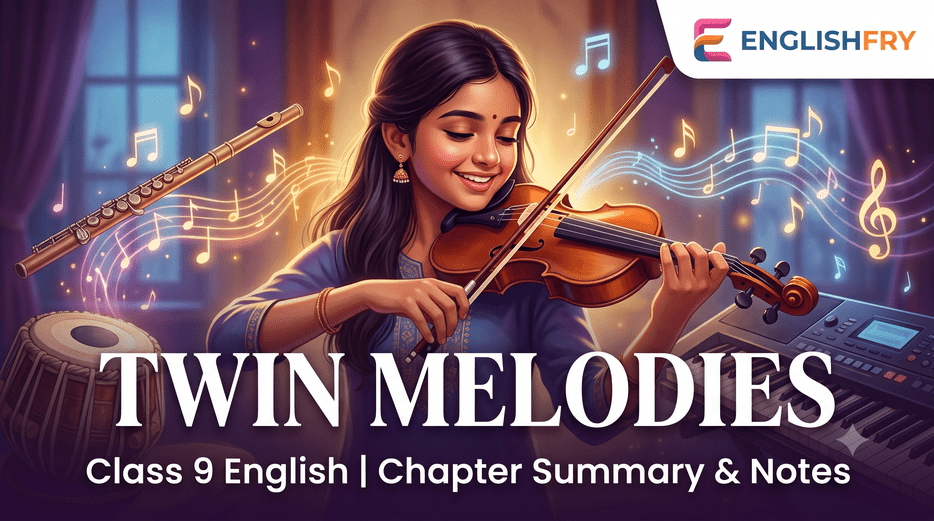
Hello students! Welcome back to EnglishFry. Today, we are exploring a beautiful and highly relatable one-act play from your English syllabus: “Twin Melodies” written by the acclaimed writer Mitra Phukan.
This play deals with a conflict that almost every teenager faces at some point: the clash between traditional family values and modern personal choices. In this story, the battlefield is not academics or career choices, but the pure, creative world of music. We see a young girl struggling to blend the classical traditions of her father with the modern fusion music she loves playing with her friends.
Let us break down this play act-by-act. We will dive into the core vocabulary, provide easy multi-lingual summaries, and explore an exam-ready question bank designed strictly according to the board blueprints to secure you full marks.

Table of Contents
ToggleSummary in Hindi (हिंदी सारांश)
“ट्विन मेलोडीज” (Twin Melodies) श्रुति नाम की एक युवा वायलिन वादक के बारे में एक दिल छू लेने वाला नाटक है। श्रुति अपने दोस्तों के साथ छुपकर इंडो-वेस्टर्न फ्यूजन (Indo-Western fusion) संगीत का अभ्यास करती है। वह अपने पिता, गुरु नबीन शर्मा को यह बताने से डरती है, जो एक सख्त शास्त्रीय संगीतकार हैं। नबीन का दृढ़ विश्वास है कि केवल शुद्ध राग और आलाप वाला शास्त्रीय हिंदुस्तानी संगीत ही सच्चा कला रूप है।
जब श्रुति रात के खाने पर उन्हें अपने आगामी फ्यूजन कॉन्सर्ट के बारे में बताती है, तो नबीन इस विचार को पूरी तरह से खारिज कर देते हैं। वह फ्यूजन संगीत को वायलिन का अपमान मानते हैं और गुस्से में वहां से चले जाते हैं। श्रुति निराश हो जाती है और अपने पिता के सम्मान में अपना ग्रुप छोड़ने का फैसला करती है।
हालाँकि, अंतिम भाग में कहानी एक सुंदर मोड़ लेती है। श्रुति के माता-पिता छुपकर उसके अभ्यास को देखने आते हैं। नबीन श्रुति के शानदार प्रदर्शन को देखकर हैरान रह जाते हैं, क्योंकि उसने फ्यूजन में भी पारंपरिक राग के सुरों को नहीं खोया था। तब श्रुति की माँ खुलासा करती हैं कि खुद नबीन ने भी अपने समय में वायलिन सीखने के लिए अपने पारंपरिक गायक परिवार से बगावत की थी। अपनी ही कहानी को अपनी बेटी में दोहराता देख, नबीन उसके फ्यूजन संगीत को खुशी-खुशी स्वीकार कर लेते हैं।
Summary in Assamese (অসমীয়া সাৰাংশ)
“টুইন মেলোডিজ” (Twin Melodies) হৈছে শ্ৰুতি নামৰ এগৰাকী যুৱ ভায়োলিনবাদকৰ ওপৰত আধাৰিত এখন হৃদয়স্পৰ্শী নাটিকা। শ্ৰুতিয়ে তাইৰ বন্ধুবৰ্গৰ সৈতে গোপনে ইণ্ডো-ৱেষ্টাৰ্ণ ফিউজন মিউজিকৰ আখৰা কৰে। তাই এই কথাটো তাইৰ পিতৃ গুৰু নবীন শৰ্মাক ক’বলৈ ভয় কৰে, যি এজন কঠোৰ পৰম্পৰাগত শাস্ত্ৰীয় সংগীতজ্ঞ। নবীন শৰ্মাই দৃঢ়ভাৱে বিশ্বাস কৰে যে কেৱল ৰাগ আৰু আলাপযুক্ত শাস্ত্ৰীয় হিন্দুস্তানী সংগীতহে প্ৰকৃত কলা।
যেতিয়া শ্ৰুতিয়ে ৰাতিৰ আহাৰ গ্ৰহণৰ সময়ত তাইৰ আগন্তুক ফিউজন কনচাৰ্টৰ বিষয়ে পিতৃক অৱগত কৰে, তেতিয়া নবীনে এই প্ৰস্তাৱটো সম্পূৰ্ণৰূপে নাকচ কৰে। তেওঁ ফিউজন মিউজিকক ভায়োলিনৰ এক অৱমাননা বুলি গণ্য কৰে আৰু খঙতে তাৰ পৰা গুচি যায়। শ্ৰুতি নিৰাশ হয় আৰু পিতৃৰ সন্মানৰ খাতিৰত নিজৰ গোটটো এৰাৰ সিদ্ধান্ত লয়।
অৱশ্যে, নাটিকাখনৰ শেষৰ ফালে এক সুন্দৰ পৰিৱৰ্তন দেখা যায়। শ্ৰুতিৰ মাক-দেউতাকে গোপনে তাইৰ আখৰা চাবলৈ আহে। নবীনে শ্ৰুতিৰ সুন্দৰ প্ৰদৰ্শন দেখি আচৰিত হয়, কাৰণ তাই ফিউজনৰ মাজতো পৰম্পৰাগত ৰাগৰ সুৰবোৰ হেৰুৱাই পেলোৱা নাছিল। তেতিয়া শ্ৰুতিৰ মাতৃয়ে প্ৰকাশ কৰে যে নবীনে নিজেও এসময়ত ভায়োলিন শিকিবলৈ নিজৰ পৰম্পৰাগত কণ্ঠশিল্পী পৰিয়ালৰ বিৰুদ্ধে গৈছিল। নিজৰ অতীতৰ ছাঁ জীয়েকৰ মাজত দেখি নবীনে আনন্দৰে তাইৰ ফিউজন মিউজিকক আঁকোৱালি লয়।
Extract-Based Questions (5 Marks)
“He will think it a desecration of the violin to be played to Western tunes. Papa firmly believes that Classical Hindustani music, with its ragas and aalaaps, is the only kind of music that an artist of any worth should play.”
(i) Who is the speaker of these lines and to whom are they spoken? The speaker of these anxious lines is the young violinist, Shruti Sharma. She is speaking to her supportive bandmates—Iqbal, Avinash, and Peter—during their practice session.
(ii) What does the speaker mean by the word “desecration”? By using the strong word “desecration,” Shruti means that her father would view playing Western tunes on a traditional instrument as a severe disrespect and insult to the sacred art of the violin.
(iii) What kind of music does “Papa” truly believe in? Papa, or Guru Nabin Sharma, firmly and strictly believes that pure Classical Hindustani music, deeply rooted in traditional ragas and complex aalaaps, is the only acceptable form of true music.
(iv) Why is the speaker so worried in this particular scene? The speaker is extremely worried because she has been secretly practicing Indo-Western fusion music, and she fears her strict, traditional father will be deeply disappointed and angry when he finds out.
(v) How do the friends react to the speaker’s intense worry? Her friends react with immense support and encouragement. They try to calm her down, advising her to stop hiding the truth and assuring her that her father will eventually understand and accept her choices.
Solved Textual Question & Answers
1. Justify the title ‘Twin Melodies’. How does the play explore the theme of tradition and modernity?
Answer: The title “Twin Melodies” perfectly captures the core of the play: the blending of two distinct musical styles—traditional Indian classical music and modern Western music. The play explores this theme by contrasting Nabin Sharma’s strict adherence to Classical Hindustani purity with his daughter Shruti’s desire to experiment with an Indo-Western fusion band. Ultimately, the play shows that tradition and modernity do not have to be enemies; they can coexist and create a beautiful “twin” harmony, as seen when Nabin appreciates the fusion piece because it stays true to classical ragas.
2. What are the different perspectives of Peter, Iqbal, and Avinash regarding confronting figures of authority? How do their attitudes towards Shruti’s dilemma provide insight into their characters?
Peter takes a secretive approach, suggesting she simply hide the truth (“Just tell them you come for the practice”). This shows he is pragmatic and prefers avoiding conflict.
Iqbal is highly optimistic and open, believing that honest communication works (“All ways are right ways… he will understand”). He has a thick skin, joking that he gets scolded for breakfast every day.
Avinash is realistic and minimizes the fear, pointing out that the worst consequence is just a little scolding. Together, their attitudes show they are a supportive, carefree group of friends who prioritize their passion for music over the strict rules of authority figures.
3. Analyse the character of Nabin Sharma. How does his attitude towards music evolve throughout the play?
Answer: Nabin Sharma is initially introduced as a rigid traditionalist. He firmly believes that Classical Hindustani music is the only music an artist should play and dismisses fusion as mere “noise” and a “desecration” of the violin. However, his attitude evolves beautifully by the end. Once he actually listens to Shruti’s fusion practice, he recognizes the skill involved. He realizes he underestimated the new generation and learns to appreciate their music, even offering them his music room to practice.
4. How does the play use Shruti’s internal conflict to explore the theme of duty towards family versus personal passion?
Answer: Shruti’s internal conflict drives the plot. She loves and deeply respects her father (“I don’t want papa to feel that I don’t care about his opinions”), representing her sense of duty and tradition. However, she is also drawn to her personal passion of trying something new with the fusion band. Her fear of disappointing him makes her hide her practices, perfectly illustrating the anxiety young people face when trying to balance family expectations with their own individual identity.
5. Evaluate the effectiveness of the play’s conclusion. Does it realistically address the conflicts presented?
Answer: The conclusion is both effective and realistic. Instead of a magical change of heart, Nabin’s acceptance is grounded in empathy and history. Leela reminds Nabin that he, too, rebelled against his father’s strict traditional views (a family of vocalists) to pursue a Western instrument (the violin). This parallel forces Nabin to step into Shruti’s shoes, making his sudden acceptance and pride in her performance highly believable.
6. Assess how well the role of cultural diversity contributes to the storyline of the play.
Answer: Cultural diversity is the backbone of the storyline. The fusion band itself is a melting pot of cultural instruments: the traditional Indian tabla (Avinash) and flute (Iqbal) combined with the Western keyboard (Peter) and violin (Shruti). This physical blending of diverse cultural instruments mirrors the overarching theme of the play—bringing different generations and musical cultures together to create something beautiful.
7. Do you think Shruti will gather the courage to speak to her father? Give a reason.
Answer: Yes, Shruti does gather the courage to speak to him. Encouraged by her friends, she decides it is “time to bite the bullet” and promises to bring it up at dinner. Despite her intense hesitation and fear, she stays true to her word and tells him about the Indo-Western fusion concert.
8. What might be Shruti’s father’s reaction? Why?
Answer: When Shruti first tells him, his reaction is overwhelmingly negative. He strictly says “No,” mocks the idea of a fusion orchestra, and calls their music “phoo” music (noise). This is because he is a classical purist who believes that blending ragas with Western beats destroys the purity and individual style of the art form.
9. Will Shruti’s father go for the rehearsal? Support your answer with a reason.
Answer: Yes, Nabin eventually goes to the rehearsal. The text shows him and Leela quietly entering the room while the children are playing. He goes because his wife, Leela, intervened and “opened his eyes” by reminding him of his own past struggles with his father over playing the violin, making him realize he was being unfairly rigid.
10. Do you think Shruti and her parents would understand one another? If yes, why? If no, why not?
Answer: Yes, they reach a profound understanding by the end of the play. Shruti proves to her father that she respects her roots by not losing sight of the classical ragas during her fusion performance. In return, Nabin understands Shruti’s need to experiment because he relates it to his own past rebellion of choosing the violin. This shared experience of pushing musical boundaries bridges the generational gap between them.
Short Answer Questions (2-3 Marks)
Q1. Why was Shruti wearing a look of distress after a very successful practice session? Despite having a highly successful Indo-Western fusion music practice, Shruti wore a look of deep distress because she was hiding this from her father. She knew Guru Nabin Sharma was a strict traditionalist who believed only in Classical Hindustani music. She was deeply anxious about how to break the news to him without making him feel that she disrespected his traditional values and opinions.
Q2. Describe Guru Nabin Sharma’s reaction when Shruti first tells him about the fusion concert. When Shruti timidly revealed her participation in an Indo-Western fusion concert, Guru Nabin Sharma reacted with immediate and cold anger. He firmly rejected the idea, stating that she was drowning her individual style in the chaotic “hubbub of an orchestra.” He insultingly referred to fusion as mere noise or “phoo” music, showing his complete loss of faith in her sense of musicality before abruptly leaving the dinner table.
Q3. What role does Leela Devi play during the climax of the story? Leela Devi plays the role of a wise peacemaker and a bridge between the two generations. When Nabin Sharma is pleasantly surprised by Shruti’s excellent performance, it is Leela who reveals the hidden truth about Nabin’s own rebellious past. By reminding him how he had to fight his own traditional vocalist family to play the Western violin, she opens his eyes and helps him empathize with his daughter’s modern musical choices.
Q4. What was the deep family secret regarding Nabin Sharma’s past with the violin? The deep family secret was that Nabin Sharma’s own father and uncles were highly traditional vocalists who had painstakingly nurtured the flame of their musical heritage. When Nabin chose to take up the violin—a Western instrument not yet incorporated into classical Indian music at the time—his family saw it as a massive betrayal. Nabin had to rebel and literally work his fingers to the bone to gain acceptance for his chosen art form.
Q5. Explain the significance of the phrase “each bay, its own wind” in the play. The phrase “each bay, its own wind” is a beautiful metaphor used by Nabin Sharma to signify acceptance of generational changes. It means that just as every geographical bay experiences its own unique wind patterns, every new generation will naturally discover its own unique style and voice. It highlights his realization that Shruti’s generation embracing Indo-Western fusion is a natural progression, not a betrayal of the past.
Long & Value-Based Questions (5 Marks)
Q1. Draw a detailed character sketch of Guru Nabin Sharma, highlighting his transformation. Guru Nabin Sharma is introduced as a highly authoritative, strict, and somewhat rigid figure. As a master violinist and the Principal of Sangeetika Music School, he holds immense pride in his art. He initially appears closed-minded, firmly believing that only Classical Hindustani music, with its ragas and aalaaps, holds any real worth. His immediate rejection of Shruti’s fusion concert shows his fear that modern music is a pure desecration of classical traditions.
However, his character undergoes a brilliant and heartwarming transformation in the final act. When he secretly watches Shruti perform, his identity as a true artist takes over his identity as a strict father. He is honest enough to recognize her soulful performance and praises her for not losing sight of the raga notes. Ultimately, when reminded of his own rebellious youth by his wife, he shows immense maturity and humility. He openly admits that his fears were entirely baseless, proving that beneath his strict exterior lies a deeply loving, understanding, and highly adaptable father.
Q2. Discuss the central theme of “Tradition vs. Modernity” as portrayed in the play “Twin Melodies.” The central theme of “Tradition vs. Modernity” is masterfully woven throughout the entire fabric of “Twin Melodies.” The play sets up a clear generational conflict. On one side stands Guru Nabin Sharma, representing the rigid preservation of ancient traditions. He believes that true art must strictly follow the rules of Classical Hindustani music, viewing any deviation as a severe threat to purity. On the other side is Shruti and her friends, representing modernity. They wish to honor their classical roots but also want to experiment by creating an innovative Indo-Western fusion.
The play brilliantly resolves this conflict not by choosing one side over the other, but by showing that tradition and modernity are part of a continuous cycle. Leela reveals that Nabin’s own “traditional” violin was once considered a modern, rebellious Western instrument by his vocalist ancestors. This powerful revelation proves that what is considered “modern fusion” today may become a respected “tradition” tomorrow. The play beautifully concludes that true art is fluid and that every generation must be allowed to find its own unique wind.
Q3. How do Shruti’s friends act as a positive catalyst in her journey of musical self-discovery? In “Twin Melodies,” Shruti’s friends—Iqbal, Avinash, and Peter—serve as a highly positive and essential support system. When the play opens, Shruti is paralyzed by fear and distress. She is ready to sacrifice her passion for Indo-Western fusion music simply to avoid angering her strict father. However, her friends actively step in as positive catalysts. They surround her with warmth, humor, and logical encouragement, urging her to stop hiding and face the situation bravely.
They remind her that communicating honestly with her parents is always better than living in fear. Even when Shruti faces rejection at the dinner table and contemplates quitting the group, her friends remain highly understanding and patient with her. Their continuous support provides Shruti with a safe space to experiment with her art. Ultimately, the high quality of their combined musical practice is what eventually melts Guru Nabin Sharma’s heart, proving that good friendships can help young individuals navigate difficult family dynamics successfully.
Q4. “I underestimated the power of our own music. I was afraid you would be lost to us.” Analyze this statement made by Nabin Sharma at the end of the play. This deeply emotional statement made by Nabin Sharma serves as the emotional climax of the play. Earlier, Nabin had harshly rejected the idea of an Indo-Western fusion concert because he was operating out of pure fear. He was terrified that the loud, chaotic “hubbub of an orchestra” would completely erase the delicate, traditional ragas and aalaaps that he had spent his life protecting. He feared that his daughter would drift away from her cultural roots entirely.
However, after watching her perform secretly, his perspective shifts completely. He witnesses firsthand that Shruti did not abandon her roots; instead, she used her strong classical foundation to elevate the Western beats. He realizes that Classical Hindustani music is not fragile; it is immensely powerful and can beautifully adapt to modern fusions without losing its core identity. His admission of this fear shows his deep love for his daughter and his newfound respect for her generation’s ability to balance both worlds gracefully.
Q5. Evaluate the role of Leela Devi as the emotional anchor of the Sharma family. Leela Devi may seem like a quiet background character initially, but she is the true emotional anchor of the Sharma family. At the dinner table, she provides a touch of lighthearted humor to ease the tension between her strict husband and anxious daughter. However, she does not spoil Shruti; she rightly scolds her for hiding her practice sessions, teaching her the importance of honesty within a family.
Her most crucial contribution occurs in the final act. When Nabin praises Shruti, it is Leela who steps forward to ensure that a deeper understanding is reached. She bravely brings up Nabin’s own painful past, reminding him of how his traditional vocalist family had rejected his choice to play the violin. By holding this mirror up to her husband, she single-handedly bridges the vast generational gap. Her wisdom prevents a permanent rift between father and daughter, proving that she is the silent but powerful glue that holds the family’s twin melodies together.

MCQ Bank
1. Which musical instrument does Shruti play in the fusion group?
A) Flute B) Keyboard C) Tabla D) Violin
Correct Answer: D) Violin
2. Who is the tabla player of the Indo-Western fusion group?
A) Avinash B) Peter C) Iqbal D) Nabin
Correct Answer: A) Avinash
3. What is the profession of Guru Nabin Sharma?
A) A professional Tabla player B) Principal of Sangeetika Music School C) A classical Vocalist D) Editor of the Parbatpuri Daily Clarion
Correct Answer: B) Principal of Sangeetika Music School
4. Whose room does the fusion group use for their practice sessions initially?
A) Shruti’s room B) Peter’s room C) Iqbal’s room D) Sangeetika Music School
Correct Answer: C) Iqbal’s room
5. Which famous musicians’ posters were hanging on the wall of the practice room?
A) Pandit Ravi Shankar and Zakir Hussain B) Pandit Hariprasad Chaurasia and Shashank Subramanyam C) Ustad Bismillah Khan and Amjad Ali Khan D) A.R. Rahman and Lata Mangeshkar
Correct Answer: B) Pandit Hariprasad Chaurasia and Shashank Subramanyam
6. Which newspaper published an article praising Shruti’s performance?
A) The Times of India B) The Assam Tribune C) Sangeetika Daily D) Parbatpuri Daily Clarion
Correct Answer: D) Parbatpuri Daily Clarion
7. Why is Shruti hesitant to tell her father about the fusion concert?
A) Because he hates her friends. B) Because she did not practice enough. C) Because he believes playing Western tunes is a desecration of the violin. D) Because he wants her to focus only on her school exams.
Correct Answer: C) Because he believes playing Western tunes is a desecration of the violin.
8. Which friend suggests that Shruti should hide the truth and just say she practices from “4 to 5”?
A) Iqbal B) Avinash C) Peter D) Leela
Correct Answer: C) Peter
9. Who jokes that he has “a little bit of scolding for breakfast every day”?
A) Avinash B) Peter C) Iqbal D) Nabin
Correct Answer: C) Iqbal
10. What food is Shruti staring at during dinner while lost in her thoughts?
A) Roti B) Rice C) Dosa D) Dal
Correct Answer: C) Dosa
11. What is Nabin Sharma’s strict rule regarding performances for his students? A) One performance in every six months B) One performance every year C) Only solo performances allowed, no groups D) Only performances inside the school
Correct Answer: A) One performance in every six months
12. According to Nabin Sharma, what happens if a musician performs too often? A) They lose their talent. B) Familiarity breeds contempt. C) They get distracted from studies. D) They ruin their instrument.
Correct Answer: B) Familiarity breeds contempt.
13. How does Nabin describe playing in an orchestra or fusion band?
A) A great way to learn teamwork. B) A beautiful blend of cultures. C) Drowning one’s individual style in the hubbub. D) A good way to earn fame.
Correct Answer: C) Drowning one’s individual style in the hubbub.
14. What derogatory term does Nabin initially use to mock the fusion music?
A) Trash music B) ‘Phoo’ music C) Western noise D) Disgraceful noise
Correct Answer: B) ‘Phoo’ music
15. Who helps Nabin realize that his fears about Shruti’s fusion music are baseless?
A) Iqbal B) Shruti’s grandfather C) Leela (Shruti’s mother) D) Peter
Correct Answer: C) Leela (Shruti’s mother)
16. What kind of musicians were Shruti’s grandfather and uncles?
A) Traditional Violinists B) Western Keyboard players C) Vocalists of a highly traditional school D) Classical Flutists
Correct Answer: C) Vocalists of a highly traditional school
17. Why was Shruti’s grandfather disappointed in Nabin when he was young?
A) Because Nabin chose to play a Western instrument (the violin) instead of singing. B) Because Nabin refused to practice. C) Because Nabin wanted to start a fusion band. D) Because Nabin played the tabla instead of the sitar.
Correct Answer: A) Because Nabin chose to play a Western instrument (the violin) instead of singing.
18. What did Nabin’s traditional family consider as a “betrayal of family values”? A) Starting the Sangeetika Music School. B) The violin, as it had not yet been incorporated into classical Indian music. C) Marrying Leela. D) Allowing his daughter to play with boys.
Correct Answer: B) The violin, as it had not yet been incorporated into classical Indian music.
19. How do Nabin and Leela react when they secretly watch the fusion practice? A) They get extremely angry and stop the practice. B) They silently leave without saying anything. C) They become engrossed, and Nabin taps his feet and claps furiously. D) They scold Iqbal for hosting the practice.
Correct Answer: C) They become engrossed, and Nabin taps his feet and claps furiously.
20. What specific musical detail makes Nabin proud of Shruti’s fusion performance?
A) Her incredible speed. B) Her ability to play the keyboard. C) She did not lose sight of the notes of the classical raga. D) She played entirely Western notes flawlessly.
Correct Answer: C) She did not lose sight of the notes of the classical raga.
21. What does Nabin offer the fusion band at the end of the play?
A) The use of the music room and equipment for regular practice. B) A chance to perform at a national television show. C) Free violin lessons for all of them. D) A front-page feature in the Parbatpuri Daily Clarion.
Correct Answer: A) The use of the music room and equipment for regular practice.
22. “After all each bay, its own wind.” Who says this line at the end of the play?
A) Leela B) Shruti C) Nabin D) Avinash
Correct Answer: C) Nabin
23. What is the central theme of the play “Twin Melodies”?
A) The importance of reading the newspaper. B) How to play the violin. C) The harmony between tradition and modernity/personal passion vs. family duty. D) The rivalry between vocalists and instrumentalists.
Correct Answer: C) The harmony between tradition and modernity/personal passion vs. family duty.
24. Who is the author of the play “Twin Melodies”?
A) Rabindranath Tagore B) Ruskin Bond C) Mitra Phukan D) R.K. Narayan
Correct Answer: C) Mitra Phukan
25. “You are a sensation now! The least you can do is throw a party!” Who says this to Shruti at the beginning of the play?
A) Avinash B) Peter C) Iqbal D) Leela
Correct Answer: A) Avinash

Founder of Englishfry.com, a captivating and knowledge-driven blog & Founder of Android app/website Studyfunnel.com, an online Mock Test Series Portal. With a wealth of experience spanning over 20+ years, he has excelled as an Ex-Asst.Professor, Teacher, Amazon published author, Website Developer, Graphic Designer,Blogger,Poet, and Creative academic content writer publisher of 4 academic books available Online on Amazon & Flipkart.Internationally Certified as the World’s Top 100 admired Educator 2021 by theexcelligent.com,National Award recipient-Golden Quill award for Best English educator 2024,Receipent of Indian Literature Award 2026.His tryst in Literature helped him realize his love for writing and telling stories. A tech-savvy language nerd by day and, a passionate writer by night, he now translates his experiences into tales of wisdom served with a side of humor.His widely recognized profound insights ,captivating writing style of weaving words make him contribute to prestigious publications and a sought-after authority in the field that transport readers to extraordinary worlds.