
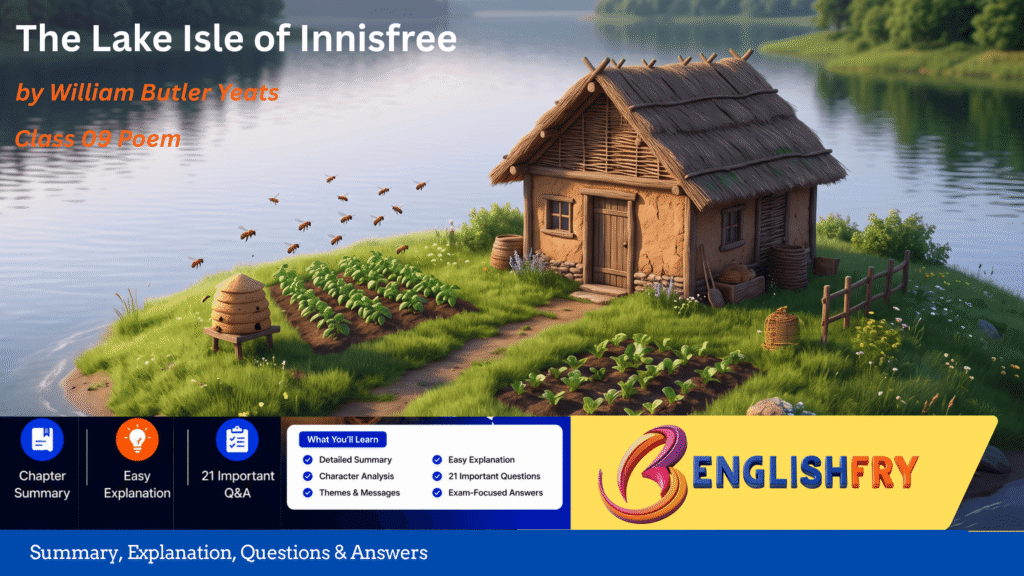
Hello students! Welcome back to EnglishFry. Today, we are exploring one of the most famous and musical poems in English literature: “The Lake Isle of Innisfree” by William Butler Yeats.
This beautiful, lyrical piece explores a universal human emotion: the deep desire to escape the noisy, stressful city life and find peace in the lap of nature. Because of its rhythmic beauty, this poem has been widely adapted into songs by various artists over the decades.
Let us break down this masterpiece The Lake Isle of Innisfree summary. We will learn the core vocabulary, provide our signature multi-lingual summaries, and dive into an exam-ready question bank designed to secure you full marks.
Table of Contents
ToggleThe Lake Isle of Innisfree Summary in English
The poem beautifully captures the poet’s intense longing for the peace and tranquility of Innisfree, a natural island where he spent a lot of time as a boy. He wishes to escape the noisy city to build a small cabin made of clay and sticks. He dreams of living a self-sufficient life, planting beans and keeping honey-bees. The central theme highlights the healing power of nature. Even when standing on the bleak, grey pavements of the city, the poet can hear the soothing sound of the lake water echoing deep inside his heart.

The Lake Isle of Innisfree Summary in Hindi (हिंदी सारांश)
यह कविता कवि विलियम बटलर येट्स की ‘इनिसफ्री’ नामक स्थान पर जाने की गहरी इच्छा को दर्शाती है। कवि शहर की भीड़-भाड़ और शोर-शराबे से दूर, प्रकृति की शांति में मिट्टी और लकड़ियों से एक छोटा सा केबिन बनाना चाहते हैं। वह बीन्स उगाना चाहते हैं और मधुमक्खियों के बीच अकेले शांति से रहना चाहते हैं। कविता का मुख्य विषय प्रकृति की उपचार शक्ति (healing power) है। जब कवि शहर की भूरी और उदास सड़कों पर खड़े होते हैं, तब भी वे अपने दिल की गहराई में इनिसफ्री झील के पानी की कल-कल आवाज़ को महसूस करते हैं।
The Lake Isle of Innisfree Summary in Assamese (অসমীয়া সাৰাংশ)
এই কবিতাত কবি উইলিয়াম বাটলাৰ ইয়েটছে ‘ইনচফ্ৰি’ নামৰ ঠাইখনলৈ যোৱাৰ গভীৰ ইচ্ছা প্ৰকাশ কৰিছে। কবিয়ে চহৰৰ কোলাহলৰ পৰা আঁতৰি প্ৰকৃতিৰ মাজত মাটি আৰু খৰিৰে এটা সৰু জুপুৰী সাজিব বিচাৰে। তেওঁ তাত মাহ খেতি কৰিব আৰু মৌমাখি পালন কৰি শান্তিত অকলে থাকিব বিচাৰে। এই কবিতাটোৰ মূল বিষয়বস্তু হৈছে প্ৰকৃতিৰ নিৰাময় শক্তি। যেতিয়া কবি চহৰৰ ধূলিয়ৰি আৰু নিৰ্জন ৰাস্তাত থিয় হৈ থাকে, তেতিয়াও তেওঁ নিজৰ হৃদয়ৰ গভীৰতাত ইনচফ্ৰি হ্ৰদৰ পানীৰ শব্দ অনুভৱ কৰে।
📖 Line-by-Line Explanation and Paraphrase
Stanza 1: The Dream of a Simple Life
Line 1: “I will arise and go now, and go to Innisfree,” Paraphrase: The poet expresses a strong, immediate determination to leave his current location and travel directly to the peaceful island of Innisfree.
Line 2: “And a small cabin build there, of clay and wattles made;” Paraphrase: Once there, he plans to construct a simple, humble shelter using basic, natural materials like mud and intertwined wooden sticks.
Line 3: “Nine bean-rows will I have there, a hive for the honey-bee,” Paraphrase: To survive independently and naturally, he intends to grow exactly nine rows of beans for food and keep a beehive to harvest fresh honey.
Line 4: “And live alone in the bee-loud glade.” Paraphrase: His ultimate goal is to live in complete solitude in an open forest clearing, surrounded only by the loud, musical buzzing of the honey-bees.
Stanza 2: The Magic of Nature’s Peace
Line 5: “And I shall have some peace there, for peace comes dropping slow,” Paraphrase: The poet is confident he will finally find mental tranquility there, a peace that settles over the environment gently and gradually.
Line 6: “Dropping from the veils of the morning to where the cricket sings;” Paraphrase: This soothing peace descends from the soft, misty fog of the morning sky right down to the grass where the crickets sing their morning songs.
Line 7: “There midnight’s all a glimmer, and noon a purple glow,” Paraphrase: The island’s beauty changes with the hours; midnight is magical and sparkling with stars, while the afternoon sun bathes everything in a warm, purplish light.
Line 8: “And evening full of the linnet’s wings.” Paraphrase: As the day comes to a close, the evening sky comes alive, fluttering full of small linnet birds flying back to their nests.
Stanza 3: The Eternal Call of the Lake
Line 9: “I will arise and go now, for always night and day” Paraphrase: The poet repeats his urgent resolve to leave immediately, driven by a feeling that haunts him constantly, all day and all night.
Line 10: “I hear lake water lapping with low sounds by the shore;” Paraphrase: In his mind, he continuously hears the gentle, rhythmic, and soothing sound of the lake water striking the shoreline of Innisfree.
Line 11: “While I stand on the roadway, or on the pavements grey,” Paraphrase: Even when he is physically trapped, standing on the dull, depressing, and lifeless concrete streets of the modern city…
Line 12: “I hear it in the deep heart’s core.” Paraphrase: …that beautiful natural music of the lake water echoes in the absolute deepest, most spiritual part of his soul, proving his eternal connection to the island.
Reference to Context (RTC) Questions (1 Mark Each)
Extract 1: Read the stanza given below and answer the questions that follow:
“I will arise and go now, and go to Innisfree, And a small cabin build there, of clay and wattles made; Nine bean-rows will I have there, a hive for the honey-bee, And live alone in the bee-loud glade.”
(i) Where does the poet urgently wish to go, and what is his immediate plan? The poet intensely wishes to travel to the peaceful Lake Isle of Innisfree, where he plans to build a small, rustic cabin made entirely of “clay and wattles.”
(ii) What specific agricultural plans does the poet have to sustain himself? To live a self-sufficient and simple life, the poet plans to plant exactly “nine bean-rows” and keep a hive for the honey-bee to produce his own food.
(iii) What does the beautiful phrase “bee-loud glade” suggest about the island’s environment? The phrase “bee-loud glade” suggests an open, vibrant clearing in the forest that is filled with the soothing, natural, and musical buzzing of honey-bees.
(iv) Why does the poet express the specific desire to live “alone”? The poet wishes to live alone because he wants to escape the chaotic, crowded, and stressful life of the modern city to find deep personal tranquility.
(v) Name the poem and its poet. This highly musical stanza is taken from the famous poem “The Lake Isle of Innisfree,” composed by the legendary poet William Butler Yeats.
Extract 2: Read the stanza given below and answer the questions that follow:
“And I shall have some peace there, for peace comes dropping slow, Dropping from the veils of the morning to where the cricket sings; There midnight’s all a glimmer, and noon a purple glow, And evening full of the linnet’s wings.”
(i) How does the poet describe the unique arrival of peace at Innisfree? The poet beautifully describes that “peace comes dropping slow,” gently and naturally descending from the misty skies down to the earth.
(ii) What do the “veils of the morning” poetically refer to? The phrase “veils of the morning” poetically refers to the soft morning mist or fog that covers the island at dawn, making it look peaceful and mysterious.
(iii) What distinct visual imagery is used to describe midnight and noon on the island? The poet uses rich visual imagery by describing the island’s midnight as a magical, starry “glimmer,” while the noon is bathed in a vibrant “purple glow” of sunlight.
(iv) What makes the evening at Innisfree so special and lively? The evening is made incredibly special because the sky is fluttering full of the “linnet’s wings,” adding the sweet songs of these small birds to the peaceful atmosphere.
(v) Which tiny insect’s song contributes to the peaceful environment of the island morning? The soothing, rhythmic song of the cricket significantly contributes to the tranquil and natural music of the island’s morning environment.
Extract 3: Read the stanza given below and answer the questions that follow:
“I will arise and go now, for always night and day I hear lake water lapping with low sounds by the shore; While I stand on the roadway, or on the pavements grey, I hear it in the deep heart’s core.”
(i) Why does the poet repeat the opening phrase “I will arise and go now”? The poet repeats this phrase to emphasize his intense, urgent, and unbreakable determination to finally escape his dreary city life and travel to the island.
(ii) What constant sound continuously haunts the poet’s mind night and day? The poet’s mind is constantly haunted by the natural, soothing, and rhythmic sound of the “lake water lapping with low sounds by the shore.”
(iii) What is the stark contrast presented between the city and the island in these lines? The stark contrast is between the dull, lifeless, and depressing reality of the city’s “pavements grey” and the vibrant, musical memory of the natural lake.
(iv) Explain the profound significance of the phrase “deep heart’s core.” The phrase signifies the absolute deepest, most spiritual part of the poet’s soul, proving that the pure memory of nature permanently resides within him, no matter where he stands physically.
(v) Identify the main poetic device used in the phrase “lake water lapping with low sounds.” The prominent poetic device used here is alliteration, which can be clearly seen in the rhythmic repetition of the consonant ‘l’ sound in “lake,” “lapping,” and “low.”

Short Answer Questions (30-40 Words | 2-3 Marks)
Q1. Describe the kind of cabin the poet wants to build at Innisfree. The poet wants to build a very simple, small cabin on the island to live a self-sufficient life. He specifically plans to construct this humble shelter using natural materials, entirely made of “clay and wattles.”
Q2. How will the poet find peace on the island? The poet believes that on the island, “peace comes dropping slow” from the beautiful natural surroundings. He will find deep mental tranquility by living completely alone in the natural, musical environment of the “bee-loud glade.”
Q3. Contrast the poet’s current surroundings with the Isle of Innisfree. The poet is currently trapped in a noisy, lifeless city defined by its bleak “pavements grey.” In sharp contrast, Innisfree is a vibrant natural paradise filled with the soothing sounds of crickets, flying linnets, and “lake water lapping.”
Q4. What do the “veils of the morning” symbolize, and how do they contribute to the island’s peace? The “veils of the morning” beautifully symbolize the soft, misty fog that blankets the island at dawn. This mist creates a deeply tranquil and isolated atmosphere where “peace comes dropping slow,” accompanied by the soothing morning song of the cricket.
Q5. Why does the poet specifically want to plant “nine bean-rows” and keep a hive for the honey-bee? The poet wishes to plant “nine bean-rows” and keep a honey-bee hive to live a completely self-sufficient and independent life. He wants to rely solely on nature for his survival, embracing minimalism while living peacefully alone in the “bee-loud glade.”
Q6. Explain the deep emotional significance of the phrase “deep heart’s core” in the poem. The phrase “deep heart’s core” signifies the poet’s profound, unbreakable spiritual connection to Innisfree. Even when physically trapped on the city’s bleak “pavements grey,” the soothing memory of the “lake water lapping” remains permanently embedded deep within his soul.
Long & Value-Based Questions (100-120 Words | 5 Marks)
Q1. “The Lake Isle of Innisfree represents the universal human desire to escape the chaos of city life.” Justify this statement with reference to the poem. The poem perfectly captures the deep human urge to escape the stressful, mechanical nature of modern city life. William Butler Yeats paints a suffocating picture of the urban world by describing the “pavements grey,” which represent dullness, noise, and spiritual emptiness. To survive this chaos, the human mind naturally seeks a sanctuary.
For the poet, this sanctuary is Innisfree. He desires to strip away all modern complications and build a simple life using “clay and wattles.” By wishing to plant “nine bean-rows” and live in a “bee-loud glade,” he shows that true happiness lies in minimalism and self-sufficiency. This powerful contrast proves that nature is the ultimate healer for a tired soul, offering a place where “peace comes dropping slow.”
Q2. How does the poet use sensory imagery (sound and sight) to bring the Isle of Innisfree to life? Yeats masterfully uses intense sensory imagery to make Innisfree feel like a living, breathing paradise. Visually, he paints a beautiful picture of the island’s changing skies. He describes midnight as a magical “glimmer,” noon as a vibrant “purple glow,” and the evening sky fluttering full of the “linnet’s wings.”
He relies heavily on the sense of sound to create a feeling of immense peace. The island is filled with the natural music of the singing cricket and the buzzing of the “bee-loud glade.” The most powerful sound is the constant “lake water lapping with low sounds by the shore.” Even when standing on the city’s roadway, this soothing imagery echoes in his “deep heart’s core,” proving that the memory of nature is permanent.

Founder of Englishfry.com, a captivating and knowledge-driven blog & Founder of Android app/website Studyfunnel.com, an online Mock Test Series Portal. With a wealth of experience spanning over 20+ years, he has excelled as an Ex-Asst.Professor, Teacher, Amazon published author, Website Developer, Graphic Designer,Blogger,Poet, and Creative academic content writer publisher of 4 academic books available Online on Amazon & Flipkart.Internationally Certified as the World’s Top 100 admired Educator 2021 by theexcelligent.com,National Award recipient-Golden Quill award for Best English educator 2024,Receipent of Indian Literature Award 2026.His tryst in Literature helped him realize his love for writing and telling stories. A tech-savvy language nerd by day and, a passionate writer by night, he now translates his experiences into tales of wisdom served with a side of humor.His widely recognized profound insights ,captivating writing style of weaving words make him contribute to prestigious publications and a sought-after authority in the field that transport readers to extraordinary worlds.