
Table of Contents
ToggleAbout the poet Carl Sandburg
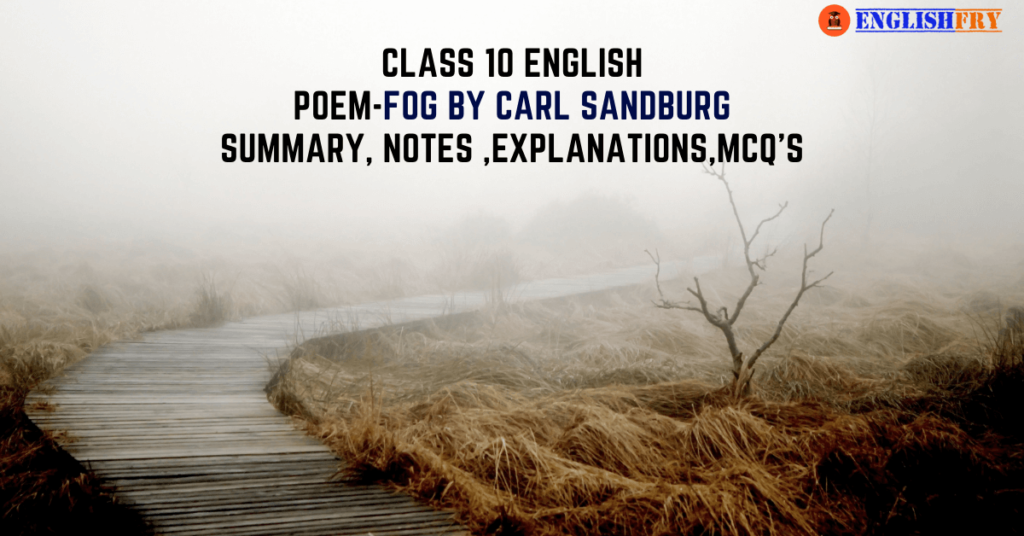
Hello students! Welcome back to EnglishFry. Today, we are analyzing one of the shortest yet most profound poems in your NCERT Class 9 English syllabus—“Fog” by the famous American poet Carl Sandburg.
In just six lines, Sandburg creates a brilliant extended metaphor, comparing the silent arrival and departure of fog over a harbor city to that of a stealthy cat. Let us break down the poem with multi-lingual summaries, simple line explanations, and a repetitive, high-yield board question bank optimized to score top marks effortlessly.
Line-by-Line Visual Explanation
“The fog comes / on little cat feet.”
Explanation: The poet states that fog rolls over the landscape completely silently and stealthily, exactly like a cat walking softly on its padded paws. It highlights the invisible and quiet arrival of nature.
“It sits looking / over harbour and city / on silent haunches”
Explanation: The fog spreads completely over the harbor (where ships dock) and the entire urban city. Sandburg uses the word “haunches” (sitting on folded knees) to show that the fog stays temporary, motionless, and watchful, mimicking a cat sitting quietly on a ledge.
“and then moves on.”
Explanation: Finally, the fog clears up and vanishes as silently as it arrived. It leaves the city without making a single sound or disturbance, just like a cat walking away.
Core Poetic Devices Used
Metaphor: The entire poem is an Extended Metaphor. The fog is directly compared to a cat without using the words ‘like’ or ‘as’.
Personification: The fog is personified as a living being that “comes”, “sits”, “looks”, and “moves on”.
Enjambment: When a sentence continues into the next line without punctuation marks (e.g., The fog comes / on little cat feet).
Free Verse: The poem has no regular rhyme scheme or rhythm.
Poem Fog
The fog comes
on little cat feet.
It sits looking
over harbour and city
on silent haunches
and then moves on.
-by Carl Sandburg
Explanation : This short poem is an expression of the view of fog. For the poet, fog is not just a natural phenomenon, it is rather a creature. Fog has been compared with a cat as the way fog comes, is very similar to the ways of a cat. As a cat walks silently on its small feet, the fog also comes in the same manner, as if trying to avoid any attention.
Fog’s presence over and around a city seems as if a cat is sitting silently on its haunches and looking over the harbour and the city. Finally, when fog leaves a city, it looks like a cat’s slow and silent steps moving on from a place.This very small poem is describing nature’s act in a beautiful manner.
Fog Summary in Hindi

यह लघु कविता कोहरे के दृश्य की अभिव्यक्ति है। कवि के लिए कोहरा महज एक प्राकृतिक घटना नहीं है, बल्कि यह एक प्राणी है। कोहरे की तुलना बिल्ली से की गई है क्योंकि जिस तरह से कोहरा आता है, वह बिल्ली के तौर-तरीकों से काफी मिलता-जुलता है।
जैसे बिल्ली अपने छोटे-छोटे पैरों पर चुपचाप चलती है, कोहरा भी उसी तरह आता है, मानो किसी का ध्यान भटकाने की कोशिश कर रहा हो। किसी शहर के ऊपर और उसके आस-पास कोहरे की मौजूदगी ऐसी लगती है जैसे कोई बिल्ली चुपचाप बैठी हो और बंदरगाह और शहर को देख रही हो।
अंत में, जब कोहरा किसी शहर से निकलता है, तो ऐसा लगता है जैसे एक बिल्ली के धीमे और चुपचाप कदम एक जगह से आगे बढ़ रहे हैं। यह बहुत छोटी सी कविता प्रकृति की इस लीला का सुंदर ढंग से वर्णन कर रही है।
Fog Summary in Assamese

এই চুটি কবিতাটোত কুঁৱলীৰ দৃষ্টিভংগীৰ প্ৰকাশ। কবিৰ বাবে কুঁৱলী কেৱল প্ৰাকৃতিক পৰিঘটনা নহয়, বৰঞ্চ ই এক জীৱ। কুঁৱলীক মেকুৰীৰ লগত তুলনা কৰা হৈছে কাৰণ কুঁৱলী অহাৰ ধৰণ, মেকুৰীৰ পদ্ধতিৰ সৈতে বহুত মিল আছে।
মেকুৰী এটাই সৰু ভৰিৰে নীৰৱে খোজ কাঢ়ি যোৱাৰ লগে লগে কুঁৱলীও একে ধৰণেৰে আহে, যেন কোনো ধৰণৰ মনোযোগ এৰাই চলিবলৈ চেষ্টা কৰিছে। চহৰ এখনৰ ওপৰত আৰু চাৰিওফালে কুঁৱলীৰ উপস্থিতি যেন মেকুৰী এটাই নিজৰ ঠেংত নিৰৱে বহি বন্দৰ আৰু চহৰখনৰ ওপৰেৰে চাই আছে।
শেষত কুঁৱলী যেতিয়া এখন চহৰৰ পৰা ওলাই যায়, তেতিয়া দেখা যায় যে এটা ঠাইৰ পৰা মেকুৰীৰ লেহেমীয়া আৰু নিস্তব্ধ খোজবোৰ আগবাঢ়িছে।এই অতি সৰু কবিতাটোত প্ৰকৃতিৰ কাৰ্য্যক সুন্দৰ ৰূপত বৰ্ণনা কৰা হৈছে।

Extra Very Short Answer Questions (1 Mark)
Q1. Who wrote the short nature poem “Fog”?
Ans: The poem “Fog” was written by the famous American poet Carl Sandburg.
Q2. What animal does the poet compare the fog to?
Ans: The poet compares the fog directly to a small, silent cat.
Q3. Where does the fog sit and look over?
Ans: The fog sits and looks over the harbor and the city.
Q4. What does the word “haunches” mean in the poem?
Ans: “Haunches” means sitting on folded knees or thighs, which is a typical sitting posture of a cat.
Q5. What is the rhyme scheme of this poem?
Ans: The poem is written in free verse and has no fixed rhyme scheme.
2. Extract-Based Questions (5 Marks)
“It sits looking / over harbour and city / on silent haunches / and then moves on.”
(i) What does “It” refer to in the above lines?
Ans: “It” refers to the silent fog rolling over the landscape.
(ii) Where does the fog spread itself?
Ans: The fog spreads itself completely over the harbor and the city.
(iii) In what position does the fog stay over the city?
Ans: The fog stays temporarily over the city on its silent haunches, just like a sitting cat.
(iv) How does the fog leave the city area?
Ans: The fog leaves the area completely silently, showing an unnoticed departure.
(v) Find a word from the passage which means a place where ships load or unload.
Ans: The word is “harbour”.
Short Answer Questions (2-3 Marks)
Q1. How does the poet describe the arrival of the fog?
Ans: The poet describes the arrival of the fog through a clear pattern of cat imagery.The fog comes silently on little cat feet without warning.It spreads over the harbor and the city without creating any noise or disturbance.This reflects the completely hidden and unnoticed arrival of natural phenomena.
Q2. What does the expression “silent haunches” signify in the poem?
Ans: The phrase “silent haunches” signifies temporary stillness and quiet observation.It shows the fog sitting over the harbor and the city, mimicking a crouching cat.It implies that the fog is taking a brief rest on its silent haunches before moving.It highlights that the stay of the fog is calm, watchful, and completely quiet.
Q3. Mention the dual comparison made through the extended metaphor.
Ans: The poet builds a beautifully structured dual comparison between nature and an animal.The fog’s soft entry is compared to the movement of little cat feet.Its motionless stay over the harbor and the city is compared to a cat sitting on its silent haunches.
Q4. How does the poem end? Describe the departure of the fog.
Ans: The poem ends with a very quiet, simple, and swift movement.After watching over the city, the fog simply clears up and moves on.It mimics a silent cat that walks away quietly after resting for a short while.It shows that nature undergoes changes through an unnoticed departure.
Q5. Why has the poet chosen a cat for the comparison instead of any other animal?
Ans: The poet specifically chooses a cat due to its matching characteristics.A cat is known for its stealthy, quiet footsteps (little cat feet) and independent nature.A cat sits on its silent haunches and observes things quietly, exactly like fog over a harbor and city.
Long & Value-Based Questions (5 Marks)
Q1. Explain how Carl Sandburg uses the extended metaphor of a cat to define the fog.
Ans: In this beautiful nature poem, Carl Sandburg creates a perfect extended metaphor by drawing a parallel between the fog and a silent cat. He transforms an ordinary weather phenomenon into a living creature to highlight its quiet, stealthy behavior.
The poem begins with the unnoticed arrival of the fog, which moves into the area on little cat feet. It does not announce its coming. Next, it settles down completely over the harbor and the city. It does not cause any chaos; instead, it rests quietly on its silent haunches, mirroring a calm cat watching the world.
Finally, the fog exhibits an unnoticed departure. Just as a cat silently stands up and leaves a room without making a sound, the fog thins out and moves on. Through these short, repetitive themes, Sandburg proves that nature operates with silent, mystical grace.
Q2. Nature works silently and leaves quietly. Discuss this idea with reference to the poem “Fog”.
Ans: The poem “Fog” presents a beautiful lesson about how the forces of nature operate around us. Sandburg highlights that the most powerful changes in environment happen without any loud noise or grand announcements.
The fog moves into the human world on little cat feet. It slowly envelops the bustling harbor and the city, bringing a sudden pause and calm to human life. It sits peacefully on its silent haunches, reminding us of the need to stop, look, and reflect.
Eventually, the fog obeys the laws of change and moves on. This unnoticed arrival and departure teaches students that nature does not boast about its power. It performs its duties with absolute silence, patience, and ultimate peace, leaving a lasting impression on our minds.
Fog MCQ with answers

- What is the central image used to describe the fog in the poem?
- Elephant
- Tiger
- Cat
- Lion
Correct Answer: c. Cat
- According to the poem, where does the fog sit and look?
- Mountains
- Forest
- Harbour and city
- Desert
Correct Answer: c. Harbour and city
- How does the fog move, as mentioned in the poem?
- Soaring
- Crawling
- Rolling
- Floating
Correct Answer: c. Rolling
- In what position does the fog sit before moving on?
- Running
- Jumping
- Silent haunches
- Flying
Correct Answer: c. Silent haunches
- What is the mood conveyed by the poem?
- Happiness
- Sadness
- Mystery
- Anger
Correct Answer: c. Mystery
- Which body part of the cat is mentioned in the poem?
- Tail
- Paws
- Haunches
- Ears
Correct Answer: c. Haunches
- What is the movement of the fog likened to in the poem?
- Dance
- Race
- Stroll
- Roll
Correct Answer: d. Roll
- According to the poem, where does the fog come?
- Swiftly
- Noisily
- On little cat feet
- Suddenly
Correct Answer: c. On little cat feet
- What does the fog do while sitting over harbour and city?
- Sleeps
- Looks
- Talks
- Sings
Correct Answer: b. Looks
- What is the poet describing in the poem?
- Rain
- Fog
- Snow
- Sunshine
Correct Answer: b. Fog
- What is the predominant sound associated with the fog in the poem?
- Roaring
- Silence
- Music
- Laughter
Correct Answer: b. Silence
- According to the poem, what happens after the fog sits looking over harbour and city?
- It disappears
- It rains
- It moves on
- It sleeps
Correct Answer: c. It moves on
- What does the fog do on its silent haunches?
- Jumps
- Sits
- Runs
- Dances
Correct Answer: b. Sits
- What is the poet’s attitude toward the fog in the poem?
- Fearful
- Curious
- Happy
- Angry
Correct Answer: b. Curious
- What does the fog look over, as mentioned in the poem?
- Ocean
- Forest
- Harbour and city
- Mountains
Correct Answer: c. Harbour and city
- How is the fog’s movement described in the poem?
- Swiftly
- Slowly
- Noisily
- Silently
Correct Answer: d. Silently
- What does the fog do after sitting on its silent haunches?
- Sleeps
- Vanishes
- Moves on
- Cries
Correct Answer: c. Moves on
- What part of the day is suggested by the poem’s description of the fog’s movement?
- Night
- Morning
- Afternoon
- Evening
Correct Answer: d. Evening
- What is the overall tone of the poem?
- Joyful
- Melancholic
- Excited
- Angry
Correct Answer: b. Melancholic
- How does the fog move after sitting on its silent haunches?
- Quickly
- Slowly
- Rapidly
- Steadily
Correct Answer: b. Slowly

Founder of Englishfry.com, a captivating and knowledge-driven blog & Founder of Android app/website Studyfunnel.com, an online Mock Test Series Portal. With a wealth of experience spanning over 16+ years, he has excelled as an Ex-Asst.Professor, Teacher, Amazon published author, Website Developer, Graphic Designer,Blogger,Poet, and Creative academic content writer publisher of 4 academic books available Online on Amazon & Flipkart. His tryst in Literature helped him realize his love for writing and telling stories. A tech-savvy language nerd by day and, a passionate writer by night, he now translates his experiences into tales of wisdom served with a side of humor.His widely recognized profound insights ,captivating writing style of weaving words make him contribute to prestigious publications and a sought-after authority in the field that transport readers to extraordinary worlds.