Table of Contents
ToggleHow to Write UPSC Essay Like a Topper in 2026
The UPSC Civil Services Examination is considered one of the toughest examinations in India. Every year lakhs of aspirants prepare day and night with the dream of becoming IAS, IPS, IFS, or other prestigious civil servants. Among all the papers in UPSC Mains, one paper that many students underestimate is the Essay Paper.
This is one of the biggest mistakes.
The UPSC Essay paper has the power to dramatically improve your final rank. A candidate who scores average marks in General Studies but excellent marks in Essay can still secure a very good rank. On the other hand, many students who perform well in GS papers fail to score good marks in essays because they never properly learned how to write UPSC essay effectively.
The good news is that essay writing is not a talent given only to toppers. It is a skill that can be learned with proper guidance, consistent practice, and smart preparation.
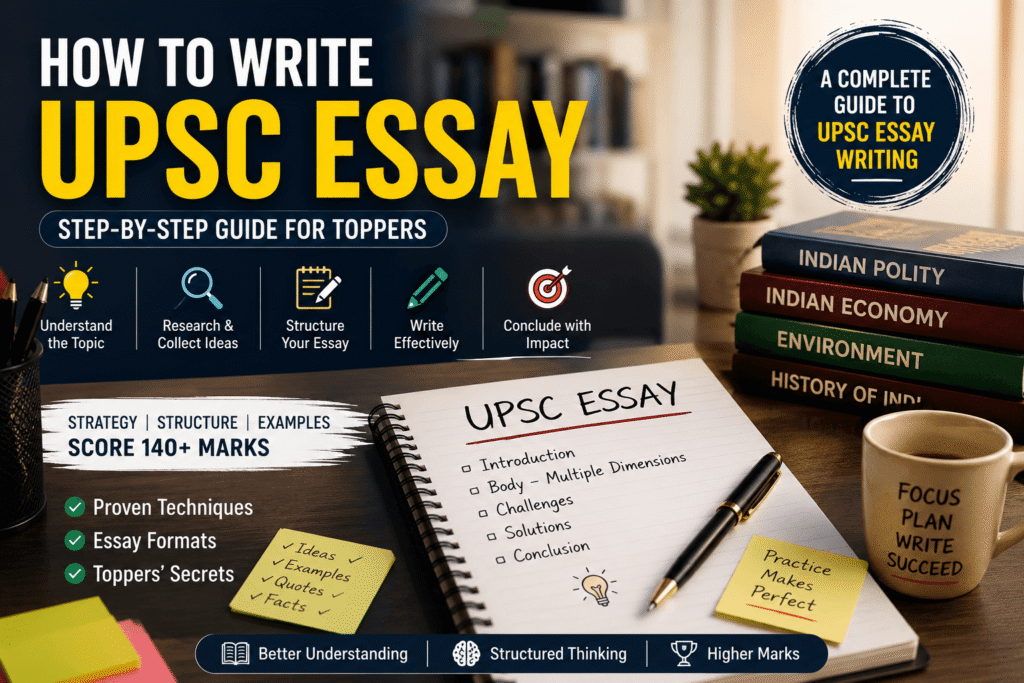
In this complete guide, you will learn:
- How to write UPSC essay step-by-step
- How UPSC toppers structure essays
- How to write powerful introductions
- How to develop multidimensional body paragraphs
- How to conclude effectively
- Common mistakes to avoid
- Essay practice strategy
- Time management techniques
- How to score 140+ marks in UPSC Essay paper
This guide is written in simple teacher-like language so that every beginner can understand the concepts clearly.
Understanding the UPSC Essay Paper
Before learning essay writing, you must first understand what the UPSC Essay paper actually demands.
The Essay paper in UPSC Mains carries 250 marks. Candidates usually need to write two essays in three hours. Each essay is generally around 1000–1200 words.
The topics may come from:
- Philosophy
- Society
- Economy
- Ethics
- Education
- Technology
- Environment
- Governance
- Women empowerment
- Democracy
- International relations
- Human values
Many students wrongly think that essay writing means writing beautiful English. This is completely false.
UPSC is not looking for Shakespearean English or difficult vocabulary.
UPSC wants:
- Clarity of thought
- Logical structure
- Balanced analysis
- Emotional maturity
- Administrative thinking
- Problem-solving ability
- Positive outlook
An essay reflects your personality. It shows how you think as a future administrator.
Why Essay Writing is Extremely Important in UPSC
A large number of aspirants focus mainly on:
- Current affairs
- Optional subjects
- Prelims preparation
- Test series
But they ignore essay practice.
This becomes dangerous because essay marks create huge differences in the final ranking.
For example:
| Candidate | GS Marks | Essay Marks |
|---|---|---|
| Student A | 430 | 90 |
| Student B | 420 | 145 |
Even though Student A scored higher in GS papers, Student B may get a much better rank due to essay performance.
This clearly shows why essay writing preparation is extremely important.
A good essay can:
- Improve your final rank
- Increase interview chances
- Compensate for weaker papers
- Demonstrate maturity and depth
What UPSC Really Wants in an Essay
This is the most important thing to understand.
UPSC does not want:
- Random facts
- Memorized content
- Political propaganda
- Emotional extremism
UPSC wants balanced and mature thinking.
Your essay should reflect:
- Rationality
- Sensitivity
- Ethics
- Humanity
- Practical solutions
- Constitutional values
You should think like a responsible civil servant while writing.
Step-by-Step Process to Write UPSC Essay
Now let us understand the complete process of how to write UPSC essay systematically.
Step 1: Read and Understand the Topic Carefully
This is the foundation of the entire essay.
Many students fail because they misunderstand the topic itself.
Never start writing immediately after reading the topic.
Spend at least 10–15 minutes understanding:
- What exactly is being asked?
- What is the central theme?
- Is the topic philosophical or factual?
- What dimensions can be included?
Example
Essay Topic:
“Technology is a useful servant but a dangerous master.”
What does this mean?
The topic is asking you to discuss:
- Benefits of technology
- Risks of overdependence on technology
This means your essay should remain balanced.
If you only praise technology, your essay becomes incomplete.
If you only criticize technology, again it becomes one-sided.
UPSC prefers balance.
Step 2: Brainstorm Ideas Before Writing
This is another important step.
Many students directly start writing without planning. As a result:
- They run out of ideas midway
- Their essays lose flow
- Repetition increases
Before writing, brainstorm all possible dimensions.
How to Brainstorm Properly
Take rough space and create a mind map.
Think from different perspectives.
Social Dimension
- Social media addiction
- Human relationships
- Mental health
Economic Dimension
- Automation
- Employment
- Digital economy
Political Dimension
- Surveillance
- Data privacy
Ethical Dimension
- AI ethics
- Human control
Environmental Dimension
- E-waste
- Energy consumption
Educational Dimension
- Online learning
- Digital classrooms
This makes your essay rich and multidimensional.
Step 3: Create Proper Essay Structure
A high-scoring UPSC essay always has a clear structure.
Think of your essay like a building.
Without structure, even good ideas collapse.
Ideal Structure of UPSC Essay
1. Introduction
Purpose:
- Introduce the topic
- Capture examiner’s attention
2. Background or Context
Purpose:
- Explain historical or social context
3. Main Body
Purpose:
- Discuss multiple dimensions
- Analyze issues deeply
4. Challenges and Problems
Purpose:
- Show critical thinking
5. Solutions and Way Forward
Purpose:
- Show administrative maturity
6. Conclusion
Purpose:
- End positively
- Give hope and vision
How to Write a Powerful Introduction
The introduction creates the first impression.
A dull introduction can reduce the impact of the entire essay.
A good introduction should:
- Be interesting
- Be relevant
- Naturally introduce the theme
Types of UPSC Essay Introductions
1. Quote-Based Introduction
Very useful for philosophical and ethical essays.
Example
“Education is the most powerful weapon which you can use to change the world.” — Nelson Mandela
Then connect the quote with the essay topic.
2. Story-Based Introduction
A short real-life incident creates emotional connection.
This technique works well in:
- Society essays
- Ethics essays
- Human values essays
3. Historical Introduction
Useful for:
- Democracy
- Governance
- Freedom
- Social justice topics
4. Current Affairs Introduction
Use recent events carefully to establish relevance.
Example of Strong Introduction
Topic:
“Education is the key to social transformation.”
Introduction:
Education has always played a transformative role in human civilization. From ancient gurukuls to modern digital classrooms, education has empowered individuals, reduced inequalities, and strengthened democratic societies. In a diverse country like India, education is not merely a tool for employment but a powerful instrument for social justice, equality, and national development.
This introduction sounds mature, balanced, and meaningful.
How to Develop the Main Body Effectively
The body is the heart of your essay.
This is where you:
- Analyze
- Explain
- Connect ideas
- Demonstrate depth
Golden Formula for Writing Body Paragraphs
Point → Explanation → Example → Link
Example
Point
Technology improves governance.
Explanation
Digital systems increase transparency and reduce corruption.
Example
Digital India initiatives improved online public service delivery.
Link
However, excessive dependence on technology also raises cybersecurity concerns.
This creates smooth flow.
Importance of Multidimensional Analysis
One of the biggest qualities of topper essays is multidimensional thinking.
Average essays discuss only one angle.
Topper essays discuss:
Social impact
Economic impact
Ethical impact
Environmental impact
Political impact
International impact
This makes the essay rich and mature.
How to Use Examples in UPSC Essays
Examples make essays powerful and realistic.
Without examples, essays become theoretical.
Best Types of Examples
Historical Examples
Freedom struggle
Green Revolution
Government Initiatives
Digital India
Beti Bachao Beti Padhao
International Examples
Scandinavian education systems
Constitutional References
Fundamental Rights
Directive Principles
Real-Life Examples
Covid-19 challenges
Social movements
How to Write Philosophical Essays
Many aspirants fear philosophical essays.
But these essays are highly scoring if approached correctly.
Simple Formula for Philosophical Essays
Step 1: Decode the Meaning
Understand the hidden meaning.
Step 2: Convert Philosophy into Practical Reality
Connect abstract ideas with:
Society
Governance
Human life
Step 3: Use Real-Life Examples
This prevents the essay from becoming too theoretical.
Example
Topic:
“Wisdom finds truth.”
Meaning:
Knowledge alone is not enough. True wisdom helps people understand and apply truth ethically.
Possible dimensions:
Leadership
Governance
Science
Morality
Importance of Balance in UPSC Essays
UPSC dislikes extreme viewpoints.
A mature essay always maintains balance.
For example:
Wrong approach:
“Technology has destroyed humanity.”
Balanced approach:
“Technology has transformed human life positively, but excessive dependence creates serious ethical and social concerns.”
Balanced thinking reflects administrative maturity.
How to Write Effective Conclusions
A conclusion is the final impression.
Never end abruptly.
A good conclusion should:
Summarize key ideas
Provide hope
Be inspirational
Offer constructive vision
Example Conclusion
Topic:
“Development and environment can coexist.”
Conclusion:
Humanity today stands at a critical turning point where economic progress and environmental sustainability must move together. Sustainable development is not merely a policy choice but a moral responsibility toward future generations. With innovation, awareness, and collective global action, it is possible to build a future where development and environmental protection complement each other harmoniously.
This conclusion sounds optimistic and mature.
Common Mistakes Students Must Avoid
1. Treating Essay Like GS Answer
Essay is not a fact-dumping exercise.
It requires:
Flow
Reflection
Emotional depth
2. Poor Structure
Random writing confuses the examiner.
3. Overuse of Quotes
Too many quotes make essays artificial.
4. Political Bias
UPSC prefers neutral analysis.
5. Ignoring Handwriting and Presentation
Presentation affects readability.
Use:
Proper spacing
Clean paragraphs
Legible handwriting
Time Management Strategy for UPSC Essay Paper
Many students fail to complete essays on time.
Ideal Time Division
| Activity | Time |
|---|---|
| Topic Selection | 10 mins |
| Brainstorming | 15 mins |
| Essay 1 | 60 mins |
| Essay 2 | 60 mins |
| Revision | 15 mins |
Practice writing within time limits.
Best Sources for UPSC Essay Preparation
1. Newspapers
Especially editorials.
They improve:
Analysis
Vocabulary
Perspective
2. Yojana and Kurukshetra
Excellent for:
Social issues
Government schemes
3. NCERT Books
Helpful for:
Basic understanding
Clear concepts
4. Ethics Notes
Improve:
Human values
Emotional maturity
How UPSC Toppers Prepare for Essays
Most toppers:
Practice weekly essays
Maintain quote notebooks
Read editorials daily
Analyze topper copies
Focus on multidimensional thinking
Consistency matters more than talent.
Weekly Essay Practice Strategy
Monday
Read editorials
Tuesday
Collect examples and quotes
Wednesday
Brainstorm essay topics
Thursday
Write one essay
Friday
Self-review mistakes
Saturday
Rewrite weak sections
Sunday
Read topper essays
Important Quotes for UPSC Essays
Mahatma Gandhi
“Be the change you wish to see in the world.”
Dr. APJ Abdul Kalam
“Dream is not that which you see while sleeping.”
Nelson Mandela
“Education is the most powerful weapon.”
Swami Vivekananda
“Arise, awake and stop not till the goal is reached.”
How to Improve Vocabulary for UPSC Essays
You do not need difficult English.
Use:
Clear language
Effective expressions
Simple vocabulary
Avoid:
Overly decorative words
Artificial language
Clarity is more important than complexity.
Final 30-Day UPSC Essay Preparation Plan
Week 1
Understand essay structure and introductions.
Week 2
Practice body development and multidimensional analysis.
Week 3
Write full essays within time limits.
Week 4
Improve speed, presentation, and revision.
Frequently Asked Questions (FAQs)
How to write UPSC essay for beginners?
Beginners should first understand essay structure, practice brainstorming, read editorials regularly, and write one essay every week.
How many words should UPSC essays contain?
Usually around 1000–1200 words per essay is considered ideal.
How can I score 140+ in UPSC essay?
To score high marks:
Maintain structure
Use multidimensional analysis
Write balanced arguments
Practice regularly
Improve introductions and conclusions
Is good English necessary for UPSC essay?
No. Simple, clear, and meaningful English is enough.
Which essays are most scoring in UPSC?
Philosophical and social essays often score well when written with maturity and balanced analysis.
Can I prepare UPSC essay without coaching?
Yes. With regular practice, self-analysis, quality reading, and proper strategy, essay preparation can be done effectively at home.
Conclusion
The UPSC Essay paper is not about writing complicated English or memorizing facts. It is about expressing thoughtful, balanced, and mature ideas in a structured and meaningful manner.
A high-scoring essay combines:
Clarity
Structure
Emotional depth
Logic
Human values
Optimism
Essay writing is a skill that improves gradually through:
Reading
Reflection
Brainstorming
Consistent practice
If you follow the techniques explained in this guide and practice sincerely, you can significantly improve your UPSC Essay score and move one step closer to achieving your dream of becoming a civil servant.

Founder of Englishfry.com, a captivating and knowledge-driven blog & Founder of Android app/website Studyfunnel.com, an online Mock Test Series Portal. With a wealth of experience spanning over 20+ years, he has excelled as an Ex-Asst.Professor,IIT Mumbai Co-ordinator, Post Graduate Teacher, Principal, Amazon published Author, Website Developer, Graphic Designer,Blogger,Poet, and Creative academic content writer publisher of 4 academic books available Online on Amazon & Flipkart. Internationally Certified as the World’s Top 100 admired Educator 2021 by theexcelligent.com,National Award recipient-Golden Quill award for Best English educator 2024,Receipent of Indian Literature Award 2026,Teachmint certified Silver Educator .His tryst in Literature helped him realize his love for writing and telling stories. A tech-savvy language nerd by day and, a passionate writer by night, he now translates his experiences into tales of wisdom served with a side of humor.His widely recognized profound insights ,captivating writing style of weaving words make him contribute to prestigious publications and a sought-after authority in the field that transport readers to extraordinary worlds.